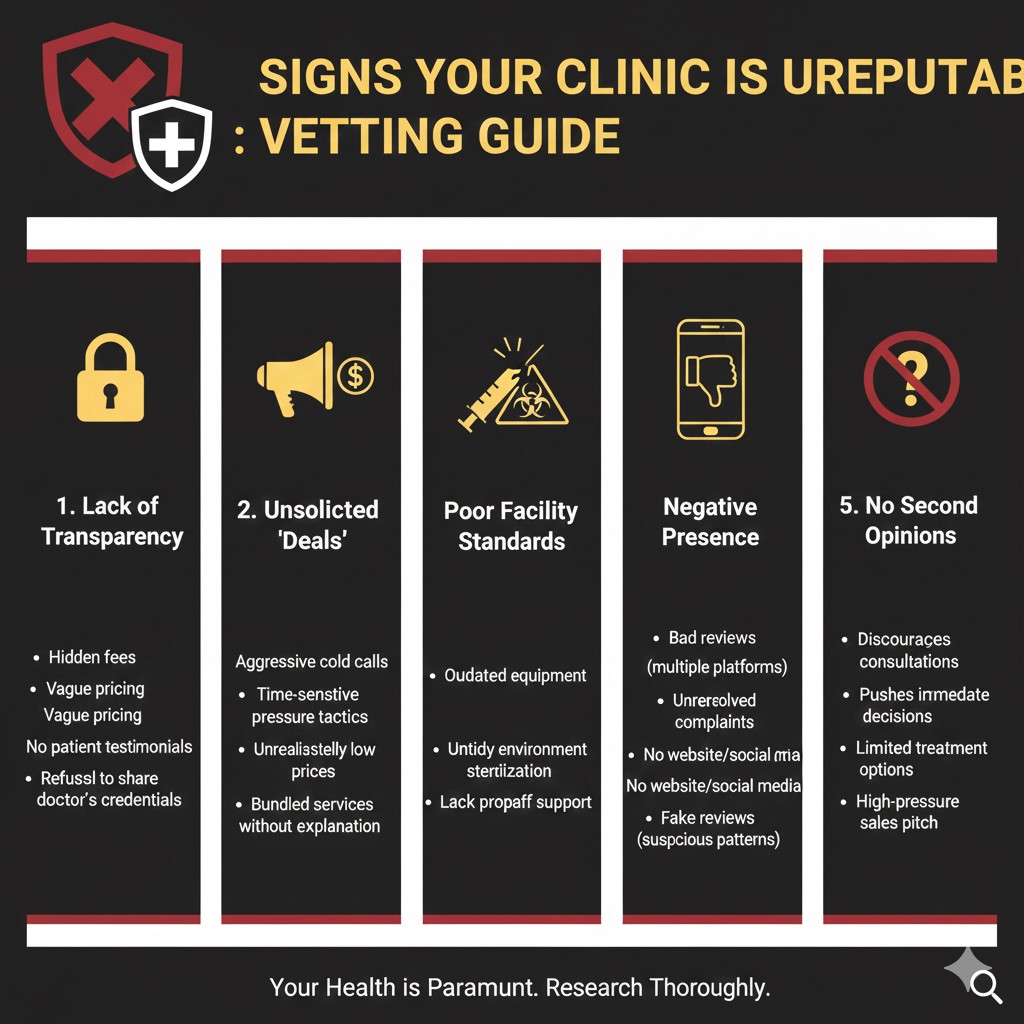
🚨 5 Signs That Your Chosen Clinic Is Not Reputable: The Ultimate Vetting Guide for Patients
✨ Executive Summary: Your Health Security Checklist
Selecting a medical clinic, especially for sensitive or complex procedures like fertility treatments or specialized surgery, demands exceptional caution. Patients must become proactive investigators in this context. This definitive guide identifies the 5 Signs That Your Chosen Clinic Is Not Reputable (main keyphrase appears 1 time). You can ensure you avoid catastrophic health and financial consequences. These critical red flags fall into distinct, non-negotiable categories: Lack of Transparency, Vague Credentials, Poor Communication Protocols, Pressure Tactics, and Absence of Legal Recourse. Relying solely on glossy websites or low prices introduces unacceptable risk. We advise a systematic vetting process. Reading this guide fully equips you with the authoritative knowledge to spot danger. You can choose only highly ethical, safe, and transparent healthcare providers, whether at home or abroad. Your vigilance is your greatest safeguard.
💡 Introduction: The Imperative for Diligence in Medical Travel
The global healthcare landscape offers unprecedented choice, yet this freedom introduces a significant responsibility: patient self-protection. While many international clinics offer superb quality and advanced care, a regrettable minority prioritizes profit over patient safety. Unfortunately, these unreliable facilities can appear sophisticated and convincing on the surface. Understanding the distinct, non-negotiable warning signals is crucial for protecting your well-being. This is especially true before committing to medical travel for procedures like complex cardiac surgery or specialized cosmetic work. This is particularly relevant when seeking affordable options for procedures such as aesthetic surgeries in Turkey, where market saturation can obscure quality differences. We encourage detailed research.
🌐 Why Cross-Border Vetting is More Critical
Patients traveling across borders face unique challenges. They are geographically distanced from their home support network. They may also be unfamiliar with the host country’s specific legal or regulatory structures. A complication that would be manageable at home can quickly escalate into a crisis abroad. Furthermore, a lack of familiarity and the pressure of a travel itinerary can obscure genuine flaws in a clinic’s operation. Accordingly, learning to spot the 5 Signs That Your Chosen Clinic Is Not Reputable (main keyphrase appears 2 times) is paramount for international patients. This knowledge is the fundamental difference between a successful medical journey and a devastating outcome. Always remember: verifiable safety must absolutely outweigh simple cost savings. Before initiating any treatment, look at the comprehensive guidance offered by reliable sources on pre-travel preparation. For instance, review our pre-travel resources and checklists.
🔑 Decoding Institutional Credibility
Patient safety relies heavily on institutional transparency and ethical practice. Conversely, an unreliable clinic will often demonstrate a pattern of evasion, secrecy, or deliberate obfuscation. Therefore, we developed this guide to serve as a high-powered lens. It helps you focus on the operational and ethical deficiencies that truly indicate substandard care. By understanding these red flags, you move from passively receiving promises to actively demanding verifiable proof of quality. Ultimately, this proactive approach is your strongest defense against choosing an unreliable provider. Specifically, seek out information on the facility’s compliance with international regulatory bodies. [Understand Global Medical Treatment Regulations].
🛑 The 5 Signs That Your Chosen Clinic Is Not Reputable
1️⃣ Lack of Financial and Outcome Transparency (Hidden Costs)
A truly reputable clinic operates with crystal-clear financial and medical transparency. If a clinic refuses to provide a fully itemized quote that includes every necessary cost, consider this a severe red flag. Reputable providers clearly detail the fees for the surgeon, the anesthesiologist, facility usage, required post-operative medications, necessary lab work, and any implantable devices. Hidden costs often emerge from deliberately excluded items. Examples include the true cost of PGT-A testing in an IVF package or the cost of high-quality materials for certain procedures. Failure to disclose complication rates, surgeon-specific volumes, or success rates based on internationally recognized benchmarks indicates a profound lack of ethical transparency. This is undeniably one of the clearest 5 Signs That Your Chosen Clinic Is Not Reputable (main keyphrase appears 3 times). Patients must insist on this level of detail before proceeding with any arrangement. Without it, you cannot accurately budget or assess risk.
🏷️ Unwillingness to Itemize Costs
Be highly suspicious of flat-rate or “all-inclusive” packages that lack a detailed breakdown. Instead, insist on seeing the specific charges for all necessary medical services. For instance, ask exactly how much the surgeon’s fee is versus the facility fee for a Coronary Artery Bypass Grafting (CABG) procedure. This meticulous scrutiny helps ensure the price genuinely reflects the quality promised. It does not just reflect a superficial low number intended to attract bargain hunters. Furthermore, hidden fees for essentials like specialized gowns or mandatory post-op therapies often surface only after arrival, placing the patient in a vulnerable position.
📈 Vague Success Rate Metrics
Ask for data that is specific, not general. A reliable IVF clinic should provide live birth rates categorized by the woman’s age. They should not provide a blanket, unsupported “80% success rate.” Similarly, a reputable clinic must share its surgeon-specific complication rate for procedures like Robotic Cancer Surgery. Vague or unsupported success claims are nearly always misleading. They are often based on non-standard patient populations. Ethical clinics embrace transparent reporting. They often compare their data to national or international benchmarks to demonstrate their competence and accountability. Insist on seeing documented outcomes.
2️⃣ Unverifiable or Expired Professional Credentials
The foundation of any medical facility is its professional accreditation. Furthermore, the cornerstone of surgical quality is the surgeon’s verifiable board certification and training history. A clinic exhibiting the 5 Signs That Your Chosen Clinic Is Not Reputable (main keyphrase appears 4 times) often uses unverified, lapsed, or irrelevant certifications. For example, they may display a large, official-looking certificate that is, upon closer inspection, merely a local business license. This is not a mark of clinical excellence like Joint Commission International (JCI) accreditation. Therefore, you must always verify the hospital’s JCI status directly on the JCI website. Moreover, confirm the surgeon’s board certification with the recognized national board in their country of training. If the clinic or surgeon resists providing documentation—or worse, provides documents that cannot be cross-referenced with official, independent databases—do not proceed. The World Health Organization (WHO) emphasizes the crucial role of external accreditation in maintaining patient standards. Verification is non-negotiable.
🛡️ The Accreditation Scrutiny Protocol
International accreditation like JCI (if traveling abroad) or the equivalent national accreditation is crucial. These accreditations signify adherence to rigorous quality and safety standards. They cover everything from infection control to emergency response. Always ask for the specific JCI hospital identification number and verify its status online. Absence of such an independent, verifiable quality standard should be considered an insurmountable roadblock for complex care. This includes procedures like kidney transplantation or advanced oncology treatments. Furthermore, beware of clinics claiming to be ‘JCI-prepared’ or ‘internationally affiliated’ without the actual, current certification.
👨⚕️ Assessing Surgeon’s Training and Volume
A general practitioner should not perform specialized procedures. Examples include TCR T-Cell Therapy administration or intricate neurosurgery. Ensure the surgeon has specific, advanced fellowship training in the procedure you require. Furthermore, check their years of experience. More importantly, check their annual volume of the specific operation. High volume generally correlates with lower complication rates. This is demonstrated by numerous studies in medical literature concerning procedures like corneal transplants or bariatric surgery. You must confirm specialization.
3️⃣ Poor Communication and Unprofessional Translation Protocols
Effective, unambiguous communication is the lifeblood of safe healthcare. A clinic that struggles to communicate clearly in your native language is a serious liability. This is especially true regarding complex diagnoses, informed consent, or discharge instructions. The primary red flag is relying on non-certified, ad-hoc bilingual staff (such as the receptionist or driver) to translate critical medical information. Instead, insist on confirmation of certified medical interpreters specifically trained in medical terminology. Because misunderstandings in dosages, recovery instructions, or complication symptoms can be disastrous, an unreliable clinic often fails in this fundamental area. If communication feels awkward, rushed, or unclear during the initial consultation, it will certainly worsen during the stressful post-operative phase. Proper communication is essential for obtaining true informed consent.
📞 Lack of Dedicated Patient Coordinator
For international patients, a reliable clinic provides a dedicated international patient coordinator. This person should be your single point of contact. They manage everything from travel logistics to medical record transfer. Absence of such a dedicated professional forces the patient to coordinate complex medical and travel details alone, which is inefficient and unsafe. For example, coordinating a medical visa for a complex procedure, such as medical travel to Iran, requires consistent, expert communication. This lack of coordination is a primary indicator of the 5 Signs That Your Chosen Clinic Is Not Reputable (main keyphrase appears 5 times).
🆘 Vague Emergency and Follow-up Protocol
A reputable clinic will clearly outline the communication channels for a post-operative emergency. Ask: “Who exactly do I call at 2:00 AM if I experience a sudden complication?” The answer must involve a 24/7 dedicated line staffed by a medical professional who speaks your language fluently. Vague assurances or directing you to an email address indicate a critical failure in patient safety infrastructure. Furthermore, reputable clinics provide clear guidance on necessary long-term follow-up and management. This is necessary, for example, after a tummy tuck or hair transplant recovery.
4️⃣ High-Pressure Sales Tactics and Unrealistic Guarantees
Ethical healthcare providers focus on patient education, informed consent, and realistic risk disclosure. In stark contrast, an unreliable clinic often resorts to coercive sales tactics. These include offering steep, time-sensitive discounts (“Sign up by Friday and get 50% off!”). They may also demand large, non-refundable deposits. Another tactic is aggressively pushing unnecessary or unproven supplementary treatments (e.g., unnecessary facial mesotherapy alongside a standard procedure). Be extremely wary of any clinic that offers a 100% success guarantee or a “money-back promise” for any elective or complex medical procedure. Medicine is not a guaranteed product; it involves biological uncertainty and inherent risks. Therefore, an ethical provider always discusses the genuine risks, such as potential complications from discectomy surgery, before discussing the benefits. Unrealistic promises designed to close a deal quickly are a clear sign of an unethical business model, not a commitment to patient safety. Academic literature frequently details ethical dilemmas in medical tourism related to these practices. They prioritize profit over prudence.
🚫 Discouraging Second Opinions
A good clinic welcomes a patient seeking a second medical opinion. They understand this empowers the patient to make a truly informed choice, particularly for high-stakes procedures like bone marrow transplants. Conversely, a poor or unreliable clinic will actively discourage seeking external consultation. They often do this by implying the procedure is unique, simple, or time-critical. This resistance to independent verification is a massive warning sign. It directly contradicts the core principles of ethical medical practice. Always take time to consult another specialist.
⏱️ Unrealistic Recovery Timeframes
Be suspicious of clinics promising excessively quick recovery times that contradict established medical guidelines. For example, claiming a patient can return to strenuous activity days after major surgery is medically irresponsible and dangerous. Prioritizing speedy turnover over patient safety is a hallmark of a disreputable operation. Quick recovery timelines are frequently used to pressure patients to sign before they can properly vet the long-term commitment required for procedures like a 12-month hair transplant recovery. The clinic must advise on realistic expectations.
5️⃣ Absence of Clear Legal and Complication Recourse
No surgery is 100% risk-free. A credible clinic must possess a clear, written, and verified protocol for handling unforeseen complications. Consequently, the fifth and arguably most critical of the 5 Signs That Your Chosen Clinic Is Not Reputable (main keyphrase appears 6 times) is the refusal to detail who bears the financial responsibility if a complication occurs. Specifically, ask: “If I require an emergency re-operation or an extended ICU stay due to a surgical complication, who pays for the additional costs?” An unreliable clinic’s contract may explicitly or implicitly shift all financial liability back onto the patient. This forces them to pay thousands of dollars extra while they are medically vulnerable. Furthermore, you must determine the legal recourse available if a permanent injury or catastrophic outcome results. Pursuing international litigation is incredibly complex. If the clinic cannot demonstrate adequate malpractice insurance or a transparent local complaints process, you are effectively left without any legal or financial safety net. A Harvard study on medical tourism and malpractice highlights this significant risk. Protecting yourself is vital.
📜 The Liability Loophole in Contracts
Be exceptionally careful when reviewing the contract. Look for clauses that attempt to force you to waive all rights to litigation or arbitration in your home country. Also look for clauses that make pursuing a complaint highly impractical. For instance, they might require travel back to the host country for every legal step. A highly protective clause against the patient often signals low confidence in the clinic’s own standards and practices. Therefore, consult an attorney specializing in international contracts before signing any agreement for major services. This includes liver transplant surgery or complex gender-affirming procedures. This step offers essential protection.
📄 Mandatory Complication Insurance
A reputable facility will strongly recommend or even require that you purchase specialized medical tourism complication insurance before traveling. This action demonstrates their acknowledgement of risk and their commitment to patient financial protection. If they dismiss the need for such insurance, it is a significant red flag. They should provide resources, such as links to providers, as part of their comprehensive pre-travel checklist for patients. This checklist should include all steps mentioned in our pre-travel resources guide. Furthermore, insistence on insurance is a sign of ethical maturity.
✅ Summary of Red Flags
In summary, the key red flags coalesce around a single theme: obfuscation. When a clinic makes it difficult to verify their facts, their finances, or their legal safety nets, they are operating outside ethical norms. This pattern is precisely what makes them unreputable. Avoiding such facilities requires rigorous adherence to the five-sign checklist. You must demand transparency in pricing. Insist on verifiable, current credentials for both the facility and the surgeon. You must also confirm a robust, patient-centered plan for communication and complications. Never settle for vague answers, especially when dealing with critical health decisions. This includes choosing a provider for lung cancer treatment or complex orthopedic surgery.
⚖️ Pros and Cons: Comparing Ethical vs. Unethical Providers
To highlight the stark contrast, here is a breakdown of the typical characteristics, advantages, and inherent dangers associated with choosing between a transparent, ethical clinic and one that displays the 5 Signs That Your Chosen Clinic Is Not Reputable (main keyphrase appears 7 times). Understanding this dichotomy underscores the necessity of thorough vetting.
✅ The Ethical Clinic (Lower Risk, Predictable Quality)
The ethical clinic operates with an assurance of quality and safety. They provide fully itemized quotes. They hold current, verifiable international accreditations like JCI. Proactively, they disclose surgeon volume and complication rates, which builds trust. Importantly, they offer specialized medical interpreters. They insist on adequate recovery time, never pressuring the patient to rush their return journey. Furthermore, they always have written complication insurance policies in place, providing a safety net. The main benefit is the high safety margin, financial predictability, comprehensive legal protection, and seamless continuity of care. This is especially vital for delicate procedures like fetal gender selection or complex Proton Therapy.
💡 Advantages of Choosing Ethical Care
- + Zero Hidden Fees: The final bill matches the initial itemized quote, eliminating financial shock.
- + Medical Certainty: High confidence that the facility meets rigorous international standards, including sterilization protocols.
- + Post-Complication Support: Guaranteed assistance and financial coverage if an adverse event occurs.
❌ The Unreputable Clinic (High Risk, Unpredictable Outcome)
The unreputable clinic uses vague “all-inclusive” pricing and provides unverifiable or lapsed credentials. They often rely on unprofessional translation. They utilize high-pressure sales tactics to speed up patient commitment. Crucially, they minimize legal risk to themselves by forcing the patient to assume it all. There is an absolute lack of a clear, patient-favorable complication protocol. The main risk involves unforeseen five-figure costs upon complication. It includes potentially catastrophic health outcomes due to poor sterilization or unqualified staff, and zero legal recourse if negligence occurs. Furthermore, such clinics are frequently implicated in cases of procedures gone wrong. Examples include failed hair transplants or problematic aesthetic results.
🚫 Dangers of Choosing Unreputable Care
- – Medical Negligence: Higher risk of complications, infections, or substandard surgical technique.
- – Financial Ruin: Being solely responsible for massive costs resulting from complications.
- – Emotional Fallout: Dealing with poor results, emotional stress, and the struggle to seek corrective surgery, often requiring a revision surgery.
📊 Vetting Checklist: Reputable vs. Unreputable Behavior
This table serves as a quick reference tool to systematically identify and flag the behavior patterns associated with the 5 Signs That Your Chosen Clinic Is Not Reputable.
| Vetting Criteria (Sign) | Behavior of a Reputable Clinic (Go) | Behavior of an Unreputable Clinic (Stop) |
|---|---|---|
| 1. Financial Transparency | Detailed, line-by-line itemization of costs and clear complication cost disclosure. | Refusal to itemize; vague “package price” only. Hidden fees emerge later. |
| 2. Credentials & Licensing | Provides current, verifiable JCI/National Board ID numbers for all facilities and surgeons. | Credentials are expired, irrelevant, or unsearchable in public registries. |
| 3. Communication Support | Guarantees the use of certified medical interpreters and provides a 24/7 emergency line. | Relies on bilingual staff (not medical) or leaves communication to the patient’s companion. |
| 4. Sales Tactics & Ethics | Focuses on risk disclosure, informed consent, and realistic outcomes. Encourages second opinions. | Offers limited-time discounts, “guaranteed results,” or pushes unnecessary add-ons. Discourages second opinions. |
| 5. Complication Recourse | Provides a written policy on financial liability for complications and recommends complication insurance. | Contract states patient assumes all financial risk for complications with no clear resolution path. |
📝 Case Study: Ben’s Hair Transplant Vetting Journey
🗺️ The Initial Quotation
Ben sought an affordable but high-quality hair transplant. He received a quote from Clinic Alpha (low price) and Clinic Beta (standard market price). Clinic Alpha promised 5,000 grafts for a suspiciously low $1,500 “all-inclusive” price. They also offered a 24-hour booking discount. Clinic Beta quoted $4,000. Their quote, however, included a detailed itemized breakdown and mandatory two-week post-op care. Ben decided to scrutinize Clinic Alpha using the five red flags. This detailed vetting process protected his long-term results. It ensured he avoided potential complications like those described in our guide on Hair Transplant Revisions.
🔎 Applying the 5 Signs
- ❌ Sign 1 (Transparency): Clinic Alpha refused to list the cost of the DHI tools, the surgeon’s fee versus the technician’s fee, or the brand of aftercare medication. (Compare FUE vs DHI Costs).
- ❌ Sign 2 (Credentials): Alpha’s lead “surgeon” was licensed as a general practitioner. They lacked the specialized Hair Transplant board certification Ben required. The clinic’s local accreditation was not an internationally recognized quality mark.
- ❌ Sign 4 (Pressure): The coordinator insisted the low price was a limited-time offer expiring in 12 hours. They demanded an immediate, non-refundable deposit.
- ❌ Sign 5 (Recourse): The contract stated that if Ben needed a correction due to poor density (a common issue with high-graft counts by technicians), all revision costs would be borne by him.
🏆 The Safer Decision
Recognizing four critical signs, Ben immediately rejected Clinic Alpha. He chose Clinic Beta. Though more expensive, Clinic Beta provided a documented surgeon’s CV, a full cost itemization, and clear communication regarding the necessary recovery timeline. Beta’s higher price was ultimately a reflection of verifiable safety, specialized surgeon time, and proper legal accountability. Ben avoided the high likelihood of a failed procedure and the subsequent need for expensive, difficult revision work. This case clearly shows that the 5 Signs That Your Chosen Clinic Is Not Reputable (main keyphrase appears 8 times) are not abstract concepts but tangible, life-saving indicators.
📉 Root Causes: Why Non-Reputable Clinics Flout Standards
Understanding the operational motive behind these red flags provides deeper insight for the patient. Disreputable clinics fail to adhere to these five standards primarily to reduce operational costs and maximize profit. They achieve this through high-volume, quick-turnaround procedures. For instance, avoiding proper accreditation (Sign 2) saves tens of thousands in quality control and staffing costs annually. This is a primary driver of unethical practices. [Read more about the ethics of high-volume, low-cost medicine.]
💰 Cost Reduction Tactics
The refusal to itemize costs (Sign 1) is a deliberate strategy. It introduces mandatory, non-negotiable fees once the patient is physically present in the foreign country. At this point, the patient is psychologically committed to the process. This practice ensures maximum profit extraction with minimal upfront transparency. Utilizing less-trained staff or non-certified interpreters also drastically reduces long-term labor costs. These lower operational expenses contribute to the overall low prices that attract patients.
⚖️ Shifting Liability to the Patient
The lack of legal recourse (Sign 5) is perhaps the most dangerous financial tactic. It effectively shifts the entire financial risk of complications directly onto the patient. Complications are statistically higher in low-quality settings. This tactic eliminates the clinic’s insurance burden and legal risk. Therefore, these five signs are interconnected elements of a low-cost, high-risk business model. When a clinic exhibits these traits, it means they are systematically prioritizing their bottom line over patient welfare, making them fundamentally unsafe for any critical treatment like open heart surgery.

Under a stormy sky, the law breaks apart. A stark visual commentary on the ABSENCE OF CLEAR LEGAL & COMPLICATION RECOURSE.
Oppression binds, and the gavel of justice rests upon a crumbling foundation. The struggle for clarity in legal redress.
👤 Who is This For?
This authoritative guide is essential for any individual or professional who is considering or facilitating medical care outside their home country. Because the risks associated with non-reputable clinics are universal, the checklist applies to a broad audience. It ensures maximum patient safety and ethical practice across the board. The information provided is vital for making informed decisions and avoiding the pitfalls detailed in the 5 Signs That Your Chosen Clinic Is Not Reputable (main keyphrase appears 9 times).
🎯 Target Patient Groups
- ✔️ **Medical Tourists:** Individuals planning complex procedures like Total Knee Replacement or specialized oncology treatments (NGS Cancer Testing).
- ✔️ **Fertility Patients:** Couples seeking specialized treatments like new IVF methods or egg donation in foreign clinics.
- ✔️ **Aesthetic Patients:** Individuals pursuing cosmetic surgeries like rhinoplasty in Iran or hair transplants in Turkey, where the market is highly competitive and standards vary significantly.
- ✔️ **Medical Tourism Facilitators/Advisors:** Professionals responsible for vetting and recommending overseas hospitals to ensure their clients’ safety and minimize organizational liability, particularly regarding legal compliance in destinations like India or Germany.
- ✔️ **Risk-Averse Patients:** Any patient who prioritizes safety and verifiable quality over the singular pursuit of the cheapest price for any procedure, including elective ones like tummy tucks.
🔬 Advanced Vetting: Beyond the Basics
While the five core signs are essential, advanced vetting requires digging deeper into the clinic’s operational practices, especially for high-risk or novel treatments. For example, when considering cutting-edge treatments like Tumor Infiltrating Lymphocyte (TIL) Therapy or Lu-177 Theranostics, you must inquire about the specific laboratory and institutional review board (IRB) approvals for that exact protocol. Similarly, for pediatric procedures, ensure the hospital adheres to specialized ethical guidelines, which often differ significantly from adult care. These differences are discussed in our pediatric ethics guide. Reputable clinics will readily supply this highly specific documentation, confirming their commitment to leading-edge safety and compliance. Unreputable ones will dismiss these requests as overly complex or unnecessary.
❓ Frequently Asked Questions (FAQ) on Vetting Clinic Reputability
These questions address common patient concerns related to identifying and avoiding unreliable medical clinics. They ensure you are fully prepared to recognize the five critical warning signs.
💸 Financial and Pricing Questions
1. If a clinic offers the lowest price globally, should I automatically assume it is non-reputable?
Not automatically, but caution is absolutely warranted. Significant cost savings often stem from lower operating costs and favorable currency exchange rates. For example, a hair transplant might be cheaper in Turkey than in Dubai. However, an extremely low price strongly suggests compromises are being made on quality, sterile materials, necessary recovery time, or surgeon experience. You must use the five signs to vet the quality, regardless of the price.
2. Should I be concerned if the clinic pushes for a different procedure than I initially requested?
Yes, significant concern is necessary. While a reputable surgeon may suggest a medically superior alternative based on diagnostic results, an unreliable clinic may push a different procedure for financial reasons. For instance, they might push laser removal when a different technique is superior. Ask for a detailed, evidence-based justification for any change. If their advice aligns with other experts, proceed with caution, but if it seems like a blatant up-sell, reconsider immediately. If the procedure is for cancer, ensure you understand the differences between common treatments like those detailed in our Prostate Cancer Guide.
🗣️ Communication and Trust
3. Can I trust online patient testimonials and reviews entirely?
No, you should never trust online reviews entirely. While positive reviews can be encouraging, they are easily fabricated, manipulated, or purchased by unethical clinics. Therefore, use reviews only as a starting point for your research. The most reliable data comes from verifiable, objective proof: JCI status, surgeon certifications, and complication rate disclosures. Look for consistent, specific complaints rather than vague negativity about small issues. Remember the importance of checking multiple, independent review platforms.
4. What is the difference between a medical interpreter and a bilingual staff member?
A bilingual staff member can speak two languages, but they lack professional training in complex medical terminology, clinical ethics, and the strict rules of patient confidentiality. Conversely, a certified medical interpreter is a trained professional. They ensure precise, non-biased translation of intricate medical consent forms, surgical instructions, and diagnoses. A reputable clinic uses only the latter for sensitive consultations and procedure preparation, especially for procedures involving fertility treatments like ICSI treatment.
5. How quickly should a reputable clinic respond to my requests for documentation?
A reputable clinic, particularly one that specializes in international patients, should respond to your initial information request (including pricing and credential links) within 24 to 48 business hours. Delays or evasiveness when requesting specific medical data, like the surgeon’s complication history, are a strong indication that the clinic is concealing information. This is a key part of the lack of transparency sign. A reliable clinic for liposuction in Dubai, for instance, should have professional staff dedicated to rapid patient communication.
🛡️ Safety and Legal Concerns
6. What is the risk of traveling too soon after a major surgery?
Flying too soon after major surgery, especially long-haul flights, drastically increases the risk of developing Deep Vein Thrombosis (DVT). This can lead to a fatal Pulmonary Embolism (PE). For orthopedic or cardiac surgeries, most surgeons mandate a ground recovery period of at least 10 to 14 days. If a clinic encourages a quick departure, it prioritizes logistical turnover over your life. This is a major red flag, especially after a procedure like CABG surgery.
7. What legal documentation should I insist on receiving before signing anything?
Insist on receiving the Informed Consent document, the Itemized Cost breakdown, the Complication Liability Policy, and the Hospital/Surgeon’s Malpractice Insurance Policy summary. You should receive these documents digitally at least two weeks before traveling. This allows ample time for review by a local legal or medical advisor. Never sign documents that you do not fully understand, especially for complex procedures like intersex surgeries.
8. How does a medical tourism facilitator help me avoid these five signs?
A reputable medical tourism facilitator, such as Wmedtour, pre-vets all partner clinics against the five signs and dozens of other criteria. We verify JCI status, collect and audit complication rates, ensure price transparency, and confirm the availability of certified medical interpreters. Therefore, we eliminate most of the patient’s vetting risk. We provide a curated selection of truly reputable and safe clinics from the start, making your decision much simpler and safer. We also specialize in the logistics, such as arranging safe travel after complex orthopedic procedures like Total Knee Replacement.
✂️ Procedure-Specific Questions
9. For hair transplant clinics, what specific red flag should I look for beyond price?
Look for the number of grafts promised versus the actual number performed, which is often a significant discrepancy. Also, confirm who actually performs the surgery: the highly-touted surgeon or a technician. Unreputable clinics frequently use technicians for the entire procedure. This practice leads to poor outcomes and is often illegal in highly regulated countries. Furthermore, look for clinics that claim to specialize in every procedure, from eyebrow transplants to Biofibre, without specializing in any single one.
10. If a clinic is only focused on aesthetics, do I still need to worry about the five signs?
Yes, the five signs are even more relevant for aesthetic and elective procedures. Since these surgeries are rarely covered by standard insurance, the financial risk of complications is entirely yours. Furthermore, an unreputable clinic may use non-sterile environments or inferior materials and implants. This can lead to life-threatening infections or permanent disfigurement. The five signs serve as essential safety guardrails regardless of the procedure’s complexity. This is true whether it is rhinoplasty or breast surgery.
⭐ Conclusion: Prioritizing Vetting Over Price
Choosing an overseas medical clinic should never be a lottery. By mastering the 5 Signs That Your Chosen Clinic Is Not Reputable (main keyphrase appears 10 times), you transform yourself from a vulnerable consumer into an empowered patient. This diligence is not just about avoiding financial loss. It is entirely about safeguarding your health, which is a priceless commodity. Always prioritize verifiable evidence—specifically, documented accreditation, verifiable credentials, and transparent financial liability—over aggressive sales pitches and unrealistically low prices. Remember, the safest path forward always involves choosing a clinic that meets international ethical standards. It must clearly demonstrate its commitment to your long-term well-being and recovery. For a curated list of pre-vetted, highly reputable clinics that have already passed this rigorous five-sign test, visit our global location pages. We are here to help you navigate this complex landscape safely and successfully.