🦷 The All-on-4 Dental Price Index: Best Countries for Full-Mouth Restoration 2026
Your definitive guide to global pricing, safety, and saving up to 70% on your new smile through WMedTour.
📋 Executive Summary
Dental care costs in Western nations have reached unprecedented highs. Consequently, many patients delay necessary treatments. The All-on-4 Dental Price Index for 2026 reveals a shifting landscape. High-quality care is now accessible abroad at a fraction of the cost. This guide analyzes the best destinations for full-mouth restoration.
We break down safety protocols, material quality, and total travel costs. You will discover why countries like Turkey, India, and Iran are top contenders. Furthermore, we outline the WMedTour safety verification process. Our goal is to empower you with data. You deserve a smile that fits your budget and your lifestyle.
Key Takeaways:
- Global Savings: Expect to save between 50% to 75% compared to US/UK prices.
- Quality Assurance: Lower cost does not mean lower quality when using verified clinics.
- Speed: Many international clinics offer immediate loading, meaning you leave with teeth in days.
- Comprehensive Care: Packages often include accommodation and transport.
Start your journey by exploring our dental department or checking our all locations page.
🤔 Understanding the Procedure: What is All-on-4?
The All-on-4 treatment concept is a revolutionary approach to dental restoration. It replaces a whole arch of teeth using only four implants. Two implants go in the front. Two angled implants go in the back. This specific angulation avoids the need for bone grafting in most cases.
This procedure is ideal for patients with significant tooth loss or decay. It offers a fixed, non-removable bridge. Unlike dentures, these teeth do not slip. They feel and function like natural teeth. You can bite an apple or chew steak with confidence.
Many patients visit our dental implant placement specialists for this exact solution. It provides immediate improvement in quality of life. The All-on-4 Dental Price Index helps you find where to get this life-changing surgery affordably.
🌍 The All-on-4 Dental Price Index 2026: Country Breakdown
We have analyzed data from hundreds of clinics. The following countries offer the best balance of cost, technology, and expertise for 2026.
1. Turkey 🇹🇷
Turkey remains the crown jewel of dental tourism. Cities like Istanbul and Antalya combine luxury vacations with medical excellence. Turkish clinics often use top-tier Swiss or German implant brands. However, their labor and operational costs are significantly lower than in Europe.
Most packages are all-inclusive. They cover your hotel, VIP transfer, and medication. You can view our verified partners in Turkey to see specific offers. The surgeons here perform thousands of these procedures annually. Their experience level is incredibly high.
2. India 🇮🇳
India offers the lowest prices on the All-on-4 Dental Price Index. Yet, the medical standards are rigorous. Many Indian dentists train in the UK or US. They speak excellent English. The technology in major hubs like Delhi or Mumbai matches Western standards.
If you have a complex case, India is a strong choice. Browse our medical tours in India for options. The savings here can often cover the cost of a long vacation.
3. Iran 🇮🇷
Iran is a powerhouse for cosmetic and restorative surgery. The surgeons possess high artistic skill. This is crucial for the final look of your new teeth. While sanctions affect some sectors, the medical field thrives with local and imported technology.
Costs here are extremely competitive due to currency exchange rates. You receive premium care for a budget price. Check our medical tours in Iran for safe, guided trips. Doctors like Dr. Naser Mozafari exemplify the high level of expertise available.
4. Oman 🇴🇲
Oman is emerging as a luxury medical destination. It is perfect for patients who value privacy and calmness. The facilities are state-of-the-art. Hygiene standards are exceptional. It is slightly more expensive than India but offers a very relaxed recovery environment.
Explore our tours in Oman. This destination is gaining traction in the All-on-4 Dental Price Index for 2026 due to its focus on patient comfort.
💰 Detailed Cost Analysis: Quality vs. Price
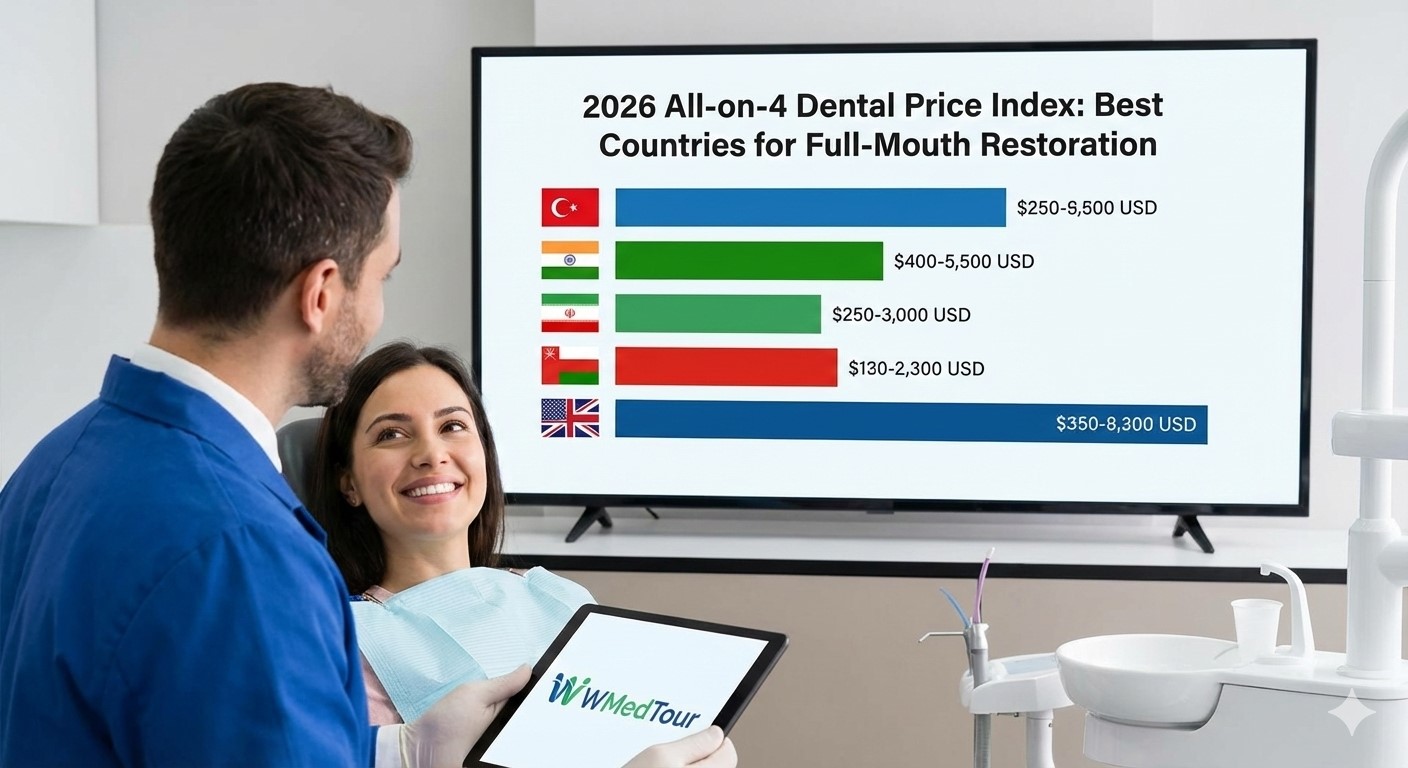
Understanding the numbers is vital. Below is a comparison of average costs for a single jaw (All-on-4) in 2026. These prices typically include the surgery and the temporary prosthesis.
| Country | Average Cost (USD) | Potential Savings | Typical Inclusions |
|---|---|---|---|
| USA / UK | $25,000 – $40,000 | 0% | Procedure only |
| Turkey | $4,500 – $8,000 | ~75% | Hotel, Transfers, X-Rays |
| India | $3,500 – $6,000 | ~80% | Airport Pickup, Meds |
| Iran | $3,000 – $5,500 | ~85% | Full Guide Service |
| Oman | $6,000 – $9,000 | ~65% | Luxury Recovery Room |
The All-on-4 Dental Price Index clearly shows the financial advantage of travel. However, never choose based on price alone. Always verify the brand of the implant (e.g., Nobel Biocare, Straumann). You can ask about this during a telemedicine consultation with our partners.
⚖️ Breakdown: Pros and Cons of Going Abroad
Every medical decision has two sides. We want you to be fully informed.
Pros ✅
- Massive Cost Reduction: You save thousands of dollars.
- High-Tech Facilities: Clinics catering to tourists often have better tech than local neighborhood dentists.
- Combined Vacation: You can see the world while you heal.
- Specialized Surgeons: Doctors in these hubs perform this specific surgery daily.
- No Wait Lists: Get your appointment immediately.
Cons ❌
- Travel Fatigue: Long flights can be tiring after surgery.
- Follow-up Logistics: If a screw loosens later, you need a local dentist willing to help.
- Two Trips Required: Usually, you go for the implants first, then return months later for the permanent teeth.
📖 Case Study: Robert’s Journey to a New Smile
(This is a hypothetical example based on real patient experiences.)
The Patient: Robert, a 58-year-old teacher from London.
The Problem: Robert suffered from severe periodontal disease. His local dentist quoted him £28,000 for full mouth restoration. He could not afford this.
The Solution: Robert consulted the All-on-4 Dental Price Index. He contacted WMedTour. We connected him with Dentes Clinic in Turkey. He had a video consultation first.
The Journey:
1. Robert flew to Istanbul. A driver met him.
2. On Tuesday, he had the surgery. He received sedation and felt no pain.
3. On Thursday, he received his temporary fixed bridge. He cried when he saw his smile.
4. He spent three days enjoying the Bosphorus views before flying home.
The Result: Robert returned 6 months later for his permanent Zirconia teeth. His total spend, including flights and hotels, was £9,500. He saved nearly £20,000.
🙋 Who is This For?
The All-on-4 procedure and medical tourism are not for everyone. This path is best for:
- Denture Wearers: People tired of glue and slipping teeth.
- Severe Bone Loss Patients: Those told they cannot have standard implants without massive grafting.
- Budget-Conscious Individuals: People who refuse to go into debt for dental care.
- Adventure Seekers: Patients who view travel as a positive part of the healing process.
If you have serious underlying health issues like uncontrolled diabetes, please consult our checkup department first. You must be healthy enough for surgery.
🛣️ The Patient Roadmap: Your Step-by-Step Guide
Traveling for surgery requires planning. Here is how WMedTour manages your journey.
Phase 1: Discovery
You research using the All-on-4 Dental Price Index. You send us your panoramic X-Ray. We share it with top surgeons globally.
Phase 2: The Plan
We provide you with 3 quote options. You choose the destination. We arrange the dates. We can also help with pre-operative anesthesia consultation if you are anxious.
Phase 3: Arrival & Surgery
You land. We pick you up. You have your surgery. You rest in a premium hotel. Our local team checks on you via WhatsApp daily.
Phase 4: The Healing Period
You return home with temporary teeth. The bone heals around the implants. This takes 3 to 6 months. You maintain oral hygiene strictly.
Phase 5: The Final Smile
You return for a shorter trip (5-7 days). The dentist fits your permanent, custom-made teeth. You fly home with a smile that lasts decades.
🏖️ Recovery & Tourism: Healing in Paradise
Recovery does not have to be boring. In the days following your procedure, you will likely feel well enough for light activities. However, you should avoid strenuous exercise.
If you choose India, a quiet retreat in Kerala is perfect. In Turkey, a boat tour on the calm Mediterranean is ideal. We can customize your itinerary. If you need assistance moving around, we even offer air ambulance short route services or ground transport options.
Remember to protect your skin. If you also plan for laser therapy or other cosmetic treatments, schedule them wisely. Ask our coordinators for the best sequence of treatments.
⚠️ Medical Disclaimer
The information in this All-on-4 Dental Price Index is for educational purposes only. It does not replace professional medical advice. Prices are estimates and can change based on individual needs. Always consult with a qualified dentist before making decisions. WMedTour facilitates connections but does not perform medical procedures.
❓ Frequently Asked Questions (FAQ)
1. Is the quality of implants abroad really the same as in the US?
Yes, absolutely. Reputable international clinics use the exact same global brands as Western dentists. Common brands include Nobel Biocare, Straumann, and Osstem. The implant hardware is identical. You are paying less for the labor, rent, and insurance costs of the clinic, not for a cheaper product. Always ask for the warranty card and lot number of your implants for your records.
2. How long do I need to stay in the country for All-on-4?
For All-on-4 dental implants, the required stay in the country depends on the treatment protocol and whether you choose immediate loading (same-day teeth) or a more traditional staged approach. Here’s a clear breakdown:
Typical Stay for All-on-4
1. Immediate Loading (Same-Day Teeth)
- Procedure: Implants are placed, and a temporary prosthesis is attached the same day.
- Required stay: 3–5 days in most cases
- Day 1: Consultation, scans, treatment plan
- Day 2: Surgery + temporary teeth placement
- Day 3–4: Recovery and check-up
- Day 5: Final follow-up and discharge
- Follow-up: Permanent teeth are usually delivered 3–6 months later, either locally or back home, depending on the clinic.
2. Staged Approach (Delayed Loading)
- Procedure: Implants are placed first; temporary prosthesis may not be attached immediately.
- Required stay: 5–10 days
- Implants placed
- Short hospital/clinic stay for monitoring
- Sutures removed 1 week later
- Follow-up: Permanent teeth are delivered after 3–6 months once osseointegration (bone integration) is confirmed.
Other Factors Affecting Stay Duration
- Health & healing: Smokers, diabetics, or patients with bone grafts may require extra monitoring.
- Bone grafting: If a graft is needed, an extra 3–7 days may be required, and healing may extend several months.
- Post-op complications: Any swelling, pain, or minor complications may extend your stay.
Practical Tip for Medical Tourism
- Most international patients plan for 1 week in the country for All-on-4 with immediate teeth.
- Permanent prosthesis can often be delivered remotely or during a short return visit if the clinic offers international support.
✅ Bottom Line:
- Immediate loading: 3–5 days
- Staged/delayed loading: 5–10 days
- Additional visits may be needed for permanent teeth or follow-ups.
3. What happens if there is a complication after I return home?
Complications are rare but possible. Before you leave, WMedTour ensures you have a continuity of care plan. Many of our partner clinics have affiliations with dentists in your home country. For minor issues, a local dentist can often help. For major implant failure, most partner clinics will repair it for free if you return. We clarify these guarantees before you book.
4. Is the procedure painful?
The surgery itself is not painful because you will be under local anesthesia or IV sedation. You will not feel the cutting or drilling. After the surgery, you will experience swelling and some soreness for a few days. The clinic will prescribe painkillers and antibiotics. Most patients report that the pain is manageable and less severe than a tooth extraction.
5. Can I get All-on-4 if I have been told I have low bone density?
Yes, this is the main advantage of All-on-4. The back implants are tilted at a 45-degree angle. This maximizes contact with the existing bone. It often eliminates the need for expensive bone grafting. However, extreme cases might still need grafting or Zygomatic implants. Our surgeons will analyze your X-rays to confirm.
6. Why is the All-on-4 Dental Price Index so different between countries?
Economic factors drive the difference. The cost of living in Turkey or India is much lower than in the UK or USA. Dentists there have lower student debt and lower malpractice insurance premiums. They pass these savings on to you. The All-on-4 Dental Price Index reflects these local economic realities, not a difference in medical skill.
7. Do the dentists speak English?
Yes. WMedTour only partners with clinics that have fluent English-speaking staff. In major medical tourism hubs, English is the standard language of communication. In some countries like Turkey, clinics often provide personal translators for other languages as well to ensure you understand every detail.
8. Does insurance cover dental tourism?
Generally, domestic health insurance does not cover dental treatments abroad. However, some international plans might. The out-of-pocket cost abroad is often still lower than the “co-pay” or deductible you would pay domestically for such a major procedure. We can provide detailed invoices if you wish to try claiming reimbursement.
9. What materials are the teeth made of?
For full-arch dental implants (All-on-4, All-on-6, or similar systems), the “teeth” are not natural teeth—they’re part of a fixed prosthetic bridge. These teeth can be made from several materials, each with different durability, aesthetics, and cost.
Common Materials Used for Implant Teeth
1. Acrylic (PMMA) Teeth
Most common for temporary or entry-level bridges
Pros
- Lightweight
- Lower cost
- Easier and cheaper to repair
- Often used for immediate (same-day) teeth
Cons
- Wears down faster
- More prone to chipping
- Less stain-resistant
Lifespan: ~5–10 years (sometimes longer with good care)
2. Composite Resin Teeth
Upgraded version of acrylic
Pros
- Better aesthetics than basic acrylic
- Improved wear resistance
- More natural translucency
Cons
- Still wears faster than ceramics
- May discolor over time
Lifespan: ~8–12 years
3. Zirconia (Monolithic or Layered)
Premium, long-term option
Pros
- Extremely strong and durable
- Highly stain-resistant
- Very natural appearance
- Ideal for All-on-6 or heavy bite forces
Cons
- Higher cost
- Repairs are more complex
Lifespan: 15–20+ years with proper care
4. Porcelain / Ceramic (on a Metal or Zirconia Framework)
Used in high-aesthetic cases
Pros
- Excellent aesthetics
- Natural translucency
Cons
- Can chip if layered
- Usually more expensive
Lifespan: 10–15+ years
Framework Materials (What Holds the Teeth)
The teeth are attached to a rigid framework made from:
- Titanium (light, strong, proven)
- Zirconia (metal-free, highly aesthetic)
Quick Comparison
| Material | Durability | Aesthetics | Cost | Best Use |
| Acrylic | Low–Moderate | Basic | $ | Temporary / budget |
| Composite | Moderate | Good | $$ | Mid-term solution |
| Zirconia | Very High | Excellent | $$$ | Long-term / premium |
| Porcelain | High | Excellent | $$$ | High-aesthetic cases |
Bottom Line
- Temporary teeth: Acrylic or composite
- Long-term solution: Zirconia (most durable and natural-looking)
- The best choice depends on bite force, budget, bone support, and aesthetic goals
10. How long do All-on-4 implants last?
All-on-4 dental implants are designed to be a long-term, often lifelong solution for full-arch tooth replacement, but their actual lifespan depends on several factors.
How Long Do All-on-4 Implants Last?
🦷 Implants (Titanium Posts)
- With proper placement and care, the implants themselves can last 20 years or more, and in many cases a lifetime.
- Long-term studies show survival rates above 90–95% after 10–15 years.
😁 Prosthetic Teeth (Bridge / Arch)
- The fixed prosthesis attached to the implants typically lasts:
- 10–15 years for acrylic or composite bridges
- 15–20+ years for zirconia or high-quality ceramic bridges
- Wear, fractures, or aesthetic changes may require repair or replacement over time.
Factors That Affect Longevity
✅ Key Positive Factors
- Experienced implant surgeon
- High-quality implant system
- Good oral hygiene
- Regular dental checkups
- Non-smoking or smoking cessation
- Controlled medical conditions (e.g., diabetes)
⚠️ Risk Factors
- Smoking
- Poor oral hygiene
- Bruxism (teeth grinding)
- Untreated gum disease
- Low bone quality or severe bone loss
- Poorly designed or overloaded prosthesis
Maintenance Matters
Even though All-on-4 implants don’t decay like natural teeth, they still require:
- Daily cleaning (special brushes, water flossers)
- Professional maintenance every 6–12 months
- Monitoring for peri-implantitis (implant-related inflammation)
Realistic Expectation Summary
| Component | Expected Lifespan |
| Implants | 20+ years to lifetime |
| Acrylic prosthesis | 10–15 years |
| Zirconia prosthesis | 15–20+ years |
Bottom Line
✔️ All-on-4 implants are a durable, long-term solution
✔️ The implants often last for life, while the teeth may need periodic replacement
⚠️ Longevity depends heavily on care, materials, and surgical expertise
11. What is Differences between All-on-4 vs All-on-6 implant ?
Here’s a clear, side-by-side explanation of the differences between All-on-4 and All-on-6 dental implants, focusing on stability, longevity, and who each option is best for:
All-on-4 vs All-on-6: Key Differences
| Feature | All-on-4 | All-on-6 |
| Number of implants | 4 implants per arch | 6 implants per arch |
| Implant placement | Two straight + two angled implants | Usually all straight |
| Stability | Very good | Excellent |
| Load distribution | Moderate | Superior (more balanced) |
| Bone requirement | Lower | Higher |
| Need for bone grafting | Rare | More likely |
| Treatment time | Faster | Slightly longer |
| Cost | Lower | Higher |
| Long-term durability | Very good | Outstanding |
All-on-4: Best For
✔️ Patients with limited jawbone volume
✔️ Those wanting to avoid bone grafting
✔️ Faster treatment with immediate teeth
✔️ More affordable full-arch restoration
Considerations:
- Slightly higher stress per implant
- Prosthesis wear may occur sooner in high-bite-force patients
All-on-6: Best For
✔️ Patients with adequate bone density
✔️ Younger patients seeking maximum longevity
✔️ Heavy bite force or bruxism
✔️ Preference for zirconia bridges
Advantages:
- Better force distribution
- Lower risk if one implant fails
- Often longer prosthesis lifespan
Longevity Comparison
- All-on-4: 90–95% success over 10–15 years
- All-on-6: Comparable or slightly higher long-term success, especially in high-load cases
Which Should You Choose?
The right option depends on:
- Bone quality and volume
- Bite force and habits (e.g., grinding)
- Budget
- Long-term expectations
A CBCT scan and specialist evaluation are essential before deciding.
Bottom Line
- All-on-4 = efficient, cost-effective, bone-friendly
- All-on-6 = stronger, more durable, higher long-term security
If you want, I can:
- Recommend the best option based on your bone scan
- Compare cost differences by country
- Explain All-on-X alternatives (All-on-5 / Zygomatic implants)
12. How do I start the process with WMedTour?
It is simple. Visit our contact us page. Upload your recent panoramic X-ray. Our medical team will review it. We will then send you a personalized treatment plan with quotes from our top partners. There is no obligation to book. We are here to help you explore your options safely.