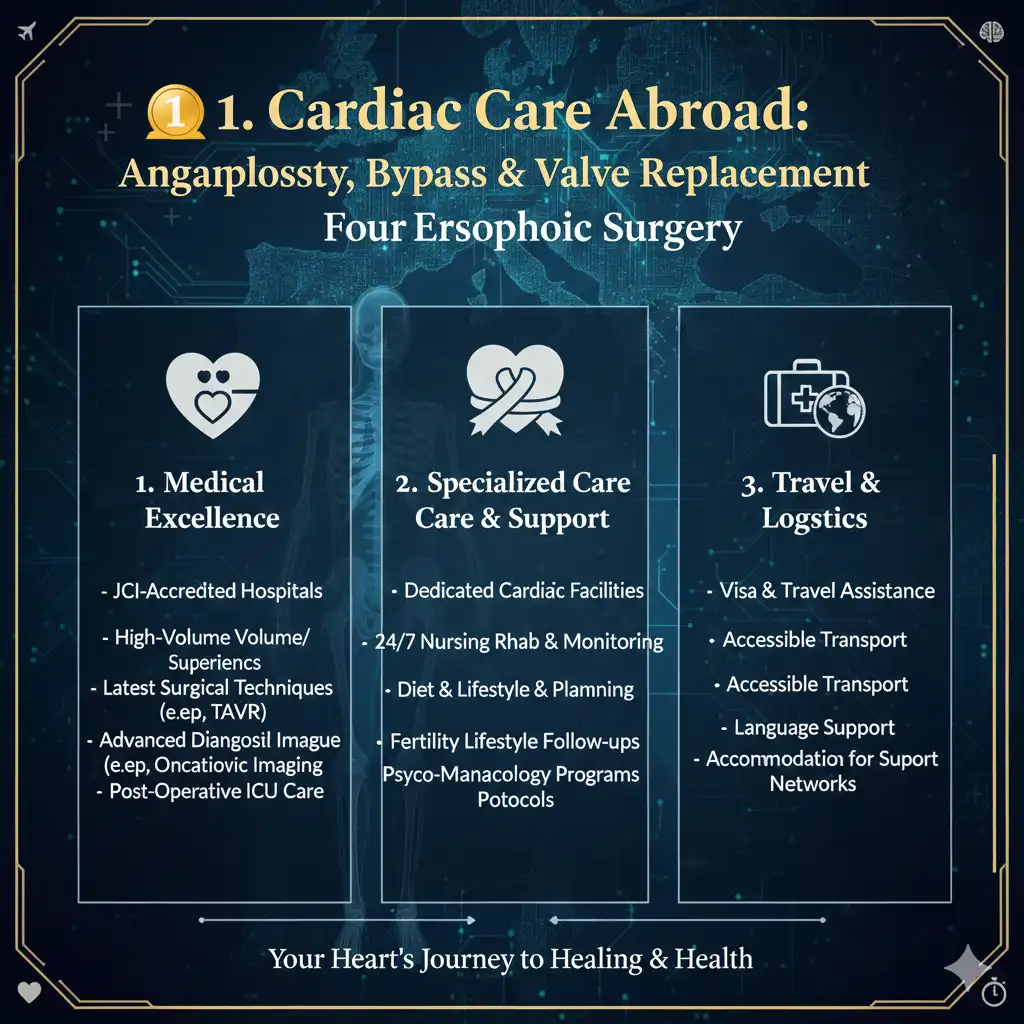
🩺 Cardiac Care Abroad: Angioplasty, Bypass & Valve Replacement
📋 Executive Summary
Seeking cardiac care abroad has transitioned from a luxury to a life-saving necessity for many. This guide explores the triad of major heart interventions: Angioplasty, Coronary Artery Bypass Grafting (CABG), and Valve Replacement. We delve into how international patients access world-class surgeons in hubs like Iran, India, and Turkey. Key takeaways include a 60-80% cost reduction compared to Western markets, zero waiting times, and the integration of advanced robotic-assisted technologies. Whether you are navigating a blockage or a structural heart issue, this post provides the technical and logistical roadmap for your journey to health.
🎯 Who is This For?
This comprehensive resource is specifically curated for individuals who find themselves at a crossroads in their cardiovascular health journey. Are you facing a long waiting list for a critical procedure? Do you find the local costs of private heart surgery prohibitive? Perhaps you are a medical professional seeking the best referral options for patients requiring complex cardiac surgery. This guide serves those looking for a balance between high clinical success rates and financial feasibility. It is also designed for families who wish to combine life-altering treatment with a peaceful environment for the initial stages of recovery.
💔 Understanding the Core of Cardiac Care Abroad
Heart disease remains the leading global health challenge. Consequently, the demand for specialized interventions has surged. When we talk about cardiac care abroad, we refer to a ecosystem of excellence that spans across continents. International heart centers are often accredited by the JCI (Joint Commission International). This ensures that the quality of care matches or exceeds that of North American or European hospitals. Furthermore, these centers often treat a higher volume of patients. This high volume leads to exceptional surgical dexterity and refined post-operative protocols.
🧪 1. Angioplasty: The Minimally Invasive Lifeline
Angioplasty, or Percutaneous Coronary Intervention (PCI), is a procedure used to open clogged heart arteries. It involves temporarily inserting and inflating a tiny balloon where your artery is narrowed to help widen it. Often, a stent is placed to keep the artery open. This is frequently combined with angiography for precise diagnosis.
Pros and Cons of Angioplasty
| Pros | Cons |
|---|---|
| Minimally invasive with local anesthesia. | Risk of re-narrowing (restenosis). |
| Quick recovery (usually 24-48 hours). | Not suitable for multi-vessel severe blockages. |
| Immediate improvement in symptoms like chest pain. | Potential for artery damage during balloon inflation. |
⚔️ 2. Bypass Surgery (CABG): Re-routing the Path to Life
Coronary Artery Bypass Grafting (CABG) is a major surgery. Surgeons take a healthy blood vessel from another part of the body and use it to bypass a blocked artery. This procedure is the gold standard for complex, multi-vessel coronary artery disease. Many patients specifically seek CABG abroad to access surgeons who specialize in “Off-Pump” or beating-heart surgery, which reduces the risk of complications associated with heart-lung machines.
Pros and Cons of CABG
| Pros | Cons |
|---|---|
| Long-term solution for severe heart disease. | Highly invasive with a long recovery (6-12 weeks). |
| Reduces risk of future heart attacks significantly. | Requires general anesthesia and hospitalization. |
| Proven success rates over decades of clinical use. | Significant scarring and physical trauma. |
🏗️ 3. Valve Replacement: Restoring the Heart’s Architecture
Heart valves ensure blood flows in the correct direction. When valves become stenotic (narrowed) or leaky (regurgitation), valve replacement becomes necessary. Patients can choose between mechanical valves (long-lasting but require blood thinners) or biological valves (bovine/porcine, which don’t require blood thinners but may wear out over time). Modern TAVI (Transcatheter Aortic Valve Insertion) is also gaining traction as a less invasive alternative.
📊 Comparative Analysis of Major Procedures
| Feature | Angioplasty | Bypass (CABG) | Valve Replacement |
|---|---|---|---|
| Invasiveness | Low (Catheter) | High (Open Heart) | High to Moderate |
| Hospital Stay | 1 Day | 5-7 Days | 4-6 Days |
| Average Cost Abroad | $2,500 – $5,000 | $8,000 – $15,000 | $10,000 – $20,000 |
🗺️ The Patient Roadmap: Your Journey to a Healthier Heart
Navigating the logistics of cardiac care abroad requires a clear strategy. We have developed a step-by-step roadmap to ensure safety and comfort throughout the process.
Phase 1: Initial Consultation and Records Review
The journey begins with a digital exchange. You provide your latest ECG, echocardiogram, and diagnostic tests to our medical team. This allows the surgeons to perform a preliminary assessment. Consequently, we can provide an accurate quote and timeline.
Phase 2: Travel and Pre-Operative Assessment
Upon arrival in a destination like Mashhad, patients undergo a physical comprehensive checkup. This includes blood work, chest X-rays, and consultations with anesthesiologists to ensure surgery readiness.
Phase 3: Surgery and Immediate Recovery
The procedure takes place in a state-of-the-art theater. For major surgeries like CABG, the first 24-48 hours are spent in the Cardiac Intensive Care Unit (CICU). Here, one-on-one nursing care ensures vital signs remain stable.
Phase 4: Post-Hospitalization and Follow-up
After discharge, patients remain in the destination city for 7-10 days. During this time, they visit the clinic for wound checks and medication adjustments. We also assist with obtaining a “Fit to Fly” certificate.
💰 Cost Analysis Table (Global Comparison)
| Country | CABG Cost | Valve Replacement Cost | Savings % |
|---|---|---|---|
| USA | $120,000+ | $150,000+ | Base |
| UK (Private) | $35,000 | $40,000 | 70% |
| Iran | $7,500 – $11,000 | $9,000 – $14,000 | 90%+ |
| India | $8,000 – $12,000 | $10,000 – $15,000 | 90% |
🏥 Case Study: John’s Journey from Canada to Tehran
John, a 62-year-old teacher from Vancouver, was diagnosed with triple-vessel blockages. The wait time for a public bypass surgery in Canada was projected at 9 months. During this time, his quality of life plummeted. Consequently, he reached out to WMedTour. Within three weeks, John was in a top hospital in Tehran. He received an off-pump CABG performed by a surgeon with over 20 years of experience. Total cost, including business-class flights and a 2-week recovery stay, was less than $15,000. Today, John is back to hiking and teaching, living a life free from chest pain.
🌿 Recovery & Medical Tourism
The philosophy of cardiac care abroad is not just about the surgery. It is about the environment in which you heal. Destinations like Oman or Iran offer a blend of modern medicine and cultural tranquility. Recovery often includes specialized cardiac rehabilitation programs, healthy Mediterranean-style diets, and stress-free environments. This holistic approach significantly improves long-term outcomes. Furthermore, having an air ambulance option provides an extra layer of security for high-risk patients during transit.
❓ Frequently Asked Questions
1. Is it safe to travel long distances for heart surgery?
Yes, it is safe provided the patient is stabilized first. We work closely with cardiologists to ensure you are fit for travel. If necessary, we arrange for medical escorts or air ambulance services to monitor you during the flight. Modern aircraft are pressurized, and we ensure you have all the necessary medications for the journey. Preparation is key to ensuring that the travel itself does not put undue stress on your cardiovascular system.
2. How do I know the surgeons abroad are qualified?
We only partner with hospitals that employ board-certified surgeons. Many of these doctors have trained in the US or Europe. You can view detailed doctor profiles on our portal. We provide data on their surgical success rates and years of experience. Transparency is our priority, so we encourage patients to have a video consultation with their surgeon before traveling to build trust and clarity.
3. What happens if there are complications after I return home?
We provide a detailed discharge summary in English for your local GP. We also offer 6 months of remote follow-up. Our surgeons are available for digital consultations to discuss any concerns you might have. Most complications occur within the first 10 days, which is why we require you to stay near the hospital during that initial window. We ensure a seamless transition between your international surgical team and your local healthcare provider.
4. Are language barriers an issue in international hospitals?
Not at all. The leading cardiac centers we work with have dedicated international patient wings where English is the primary language. Moreover, WMedTour provides a dedicated medical translator who will be by your side from the moment you land. This ensures that every nuance of your medical care is understood. You will never feel lost or unheard during your treatment or recovery phases.
5. Will my insurance cover cardiac care abroad?
Many private insurers now have “Global Health” clauses. However, even if they don’t, the out-of-pocket cost abroad is often lower than the deductible/co-pay in Western countries. We can provide all the itemized billing required for you to attempt a reimbursement claim. It is always best to check with your provider beforehand, but we help you navigate the paperwork to maximize your chances of coverage.
6. How long is the total trip duration?
For a major procedure like CABG, you should plan for a 21-day trip. This includes 3 days of pre-op tests, 7 days in the hospital, and 10 days of local recovery. For a simpler procedure like angioplasty, 7-10 days is usually sufficient. We believe that rushing the recovery process is counterproductive. By staying a few extra days, you ensure that you are physically robust enough for the return flight home.
7. Can a family member accompany me?
Absolutely, and we highly recommend it. Emotional support is vital for heart patients. We arrange “Attendant Packages” which include hospital stay-in beds for one relative and nearby hotel accommodations for others. Our team also handles their visa and local transport logistics. Having a loved one nearby can significantly lower patient anxiety and potentially speed up the psychological aspects of physical recovery.
8. What kind of heart valves are used in replacements?
In modern cardiac care abroad, surgeons primarily use two main types of heart valves for replacements, typically sourced from world-renowned medical manufacturers to ensure international quality standards.
The choice depends on your age, lifestyle, and medical history:
Mechanical Valves: These are crafted from high-quality, durable materials like carbon and metal. Their primary advantage is longevity, as they can last a lifetime and rarely need to be replaced. However, because blood tends to clot on the surface of mechanical materials, patients must take blood-thinning medication (anticoagulants) for the rest of their lives.
Biological (Tissue) Valves: These are made from animal tissues, such as porcine (pig) or bovine (cow) heart valves. The major benefit is that they do not require long-term use of blood thinners. While they feel more “natural” to the body, they typically have a lifespan of 12 to 20 years and may eventually require a follow-up procedure.
When you choose to undergo valve repair or replacement through our network, your surgeon will provide a certification card for the specific valve used—often from top-tier brands like Medtronic or Edwards Lifesciences—ensuring you have a global record of your implant for future medical checkups.
9. Is the technology in Iran or India as good as the West?
In many cases, the technology in specialized heart centers is superior because they invest heavily in the latest equipment to attract international patients. This includes 3D mapping for arrhythmias and robotic surgical systems. These hospitals are designed to compete on a global stage. They utilize the same diagnostic tools and surgical hardware found in the world’s most famous medical institutions.
10. How do I get a visa for medical travel?
We provide a “Medical Invitation Letter” from the hospital. This letter significantly speeds up the visa process at the embassy. In many cases, we can facilitate an e-visa or visa-on-arrival. Our local teams are experts in the immigration requirements of each destination. We handle the bureaucracy so you can focus entirely on your health and upcoming procedure.
11. What is “Beating Heart” Bypass surgery?
This is a technique where the surgeon operates while the heart is still pumping. It avoids the need for a heart-lung machine, which can sometimes cause inflammation or cognitive issues. Our surgeons abroad are world leaders in this technique. It is often preferred for older patients or those with kidney issues. It results in a faster recovery and fewer systemic complications compared to traditional bypass methods.
12. Are the medications provided after surgery high-quality?
Yes, we ensure all patients are prescribed FDA-approved or internationally recognized pharmaceutical equivalents. You will receive a full supply of medications to take home. We also provide a list of generic and brand names so your local pharmacist can easily refill your prescriptions. Clear instructions on dosage and side effects are provided in writing to prevent any confusion during your transition back home.
⚠️ Medical Disclaimer
The information provided in this article is for educational purposes only and does not constitute medical advice. Cardiac procedures carry inherent risks. Always consult with a qualified cardiologist or cardiac surgeon to determine the best course of action for your specific condition. WMedTour acts as a facilitator and does not directly provide medical services. Statistics and costs are based on average data and may vary depending on individual patient needs and hospital selection. For a personalized assessment, please contact our medical team.
References and Authority Sources (Nofollow):
- Harvard Health: Angioplasty vs Bypass
- Mayo Clinic: CABG Procedures
- Johns Hopkins Medicine: Valve Replacement Guide