FUT vs. FUE vs. DHI: Cost, Success, and The Ultimate Guide to Hair Restoration in 2026
Navigating the complex world of surgical and regenerative hair restoration requires precise, up-to-date data. In this comprehensive guide, we provide a full comparison of costs, success rates, and optimal candidates for all major techniques, specifically focusing on FUT vs. FUE vs. DHI in 2026. Beyond the surgical options, we also cover emerging therapies like Exosomes and Autologous Micrografting.
Executive Summary: Key Takeaways
The landscape of hair restoration continues to evolve, making the comparison of methods more nuanced than ever. Our analysis of the FUT FUE DHI Cost Success 2026 data reveals several critical insights:
- DHI Leads in Viability: Direct Hair Implantation (DHI) often reports the highest graft survival rates ($90\% \text{ to } 97\%$) due to minimized time outside the body. Ultimately, therefore, this justifies its premium cost.
- FUT for Volume: Follicular Unit Transplantation (FUT) remains the most cost-effective solution for patients requiring $>4,000$ grafts in a single session, prioritizing volume over scar invisibility.
- Emerging Therapies: Regenerative treatments, specifically Exosome Therapy, show promise as powerful adjuncts or standalone options for early-stage thinning, offering a non-surgical path to increased density.
- Technological Convergence: Robotic Sapphire FUE enhances precision, reducing human error, but conversely, it may increase the overall procedure cost, reflecting the continuous advancement in hair restoration technology.
Making an informed decision requires looking beyond the price tag; consequently, it demands a full evaluation of the technique’s suitability for your unique pattern of hair loss. For this reason, we strongly encourage reading our full guide for a comprehensive breakdown.
The Foundational Hair Transplant Techniques: FUT vs. FUE vs. DHI
These three methods form the backbone of modern surgical hair restoration. Understanding the mechanics of each procedure is the first step toward determining the optimal route to maximize your results. The FUT vs. FUE vs. DHI Cost Success 2026 data consistently shows strong clinical outcomes for all three, although, as noted before, patient experience varies significantly.
1. Follicular Unit Extraction (FUE)
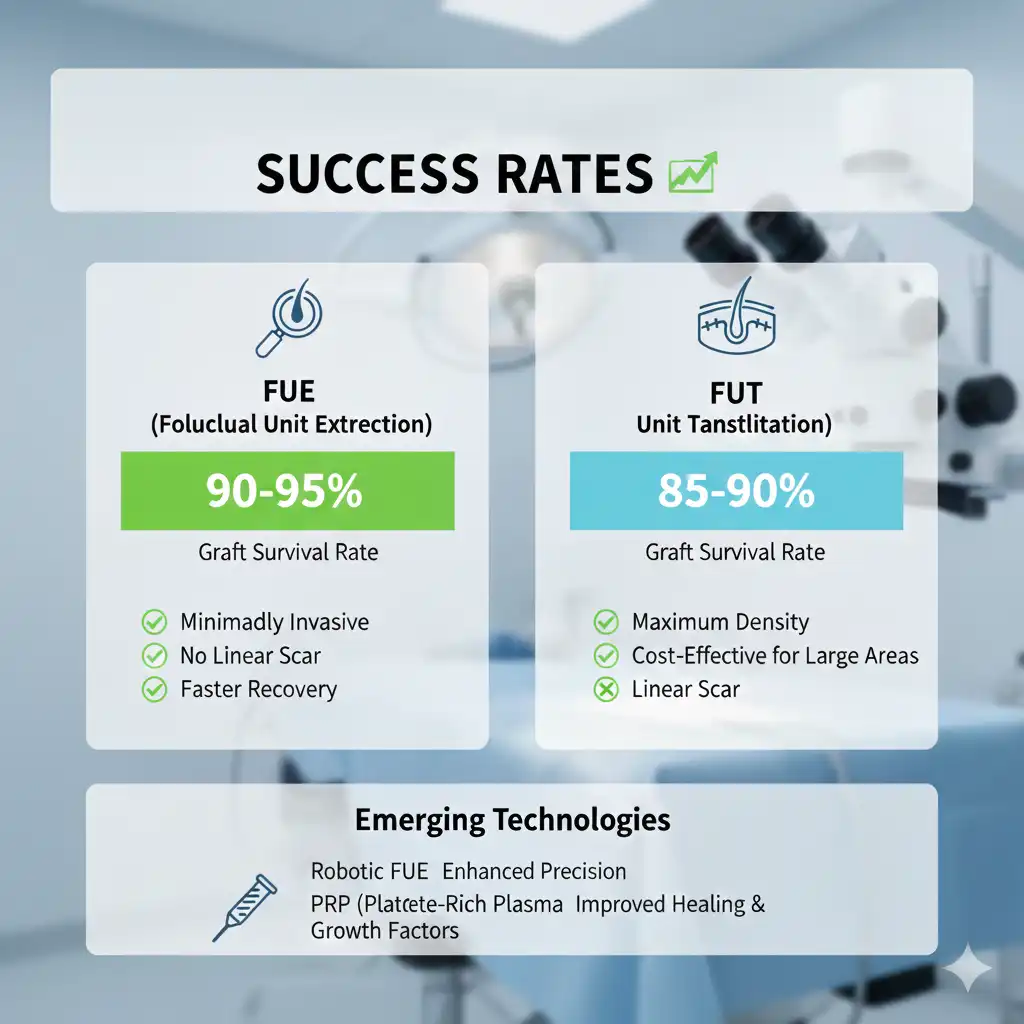
FUE involves individually harvesting grafts using a circular punch tool, typically less than $1 \text{ mm}$ in diameter. Initially, this method became widely popular largely because it eliminates the tell-tale linear scar associated with older techniques. As a result, FUE allows patients the freedom to wear their hair short post-procedure. However, the manual nature of extraction can increase total procedure time.
Pros of FUE:
- No linear scar (minimal, scattered dot scarring).
- Shorter, less painful recovery in the donor area.
- Versatile: Allows for body hair transplantation.
Cons of FUE:
- Lower maximum graft yield per session (typically $<4,000$).
- Higher transection (damage) risk in less experienced clinics.
- Higher global cost per graft than FUT.
In summary, for more details on global pricing, you can review our focused article: FUE Hair Transplant Global Cost 2026. We see this technique being chosen by patients who prioritize discretion.
2. Follicular Unit Transplantation (FUT)
FUT is often called the ‘Strip Method.’ Surgeons remove a small strip of scalp tissue from the donor area, and technicians meticulously dissect it into follicular units under high-powered microscopes. As a result, and most importantly, FUT consistently delivers the highest number of viable grafts in a single session. Therefore, this is highly beneficial for patients with extensive hair loss, in contrast to FUE.
Pros of FUT:
- Highest graft yield, ideal for advanced hair loss (Norwood $6-7$).
- Lowest cost per graft, maximizing budget efficiency.
- Less shaving of the donor area is required.
Cons of FUT:
- Permanent linear scar requires longer hair length ($\ge 1 \text{ cm}$) for concealment.
- Longer, slightly more painful recovery period in the donor area.
- Less flexibility for future transplants if the strip area is depleted.
Despite the longer recovery time, the efficiency of FUT makes it a compelling option, particularly where affordability and volume are key concerns. Furthermore, its success rate remains consistently high.
3. Direct Hair Implantation (DHI)
DHI is an advanced modification of the FUE technique. It is distinguished by the use of a specialized tool, the Choi Implanter Pen, which simultaneously creates the incision channel and implants the graft. Consequently, and this is crucial, the handling of the delicate grafts is significantly reduced, minimizing trauma and exposure time. Ultimately, this factor directly influences the final aesthetic result and success rate for FUT, FUE, and DHI procedures.
Pros of DHI:
- Highest documented graft survival rates (often $95\% \text{ or higher}$).
- Maximum control over angle, depth, and direction for natural density.
- Faster healing in the recipient area due to smaller channels.
Cons of DHI:
- Highest overall cost among all surgical methods.
- Lower maximum number of grafts per session than FUT.
- Requires highly specialized training and a skilled team.
DHI represents the premium end of the surgical market, focusing on precision and maximum long-term hair survival. You can learn more about its application in leading destinations by checking our guide on Best Hair Transplant Clinics Turkey 2026.
The Next Generation: Robotic and Sapphire FUE
Technological innovations continue to push the boundaries of graft extraction and implantation, thereby directly impacting the FUT FUE DHI value equation.
4. Robotic Sapphire FUE (ARTAS / Neograft)
Robotic-assisted FUE utilizes a sophisticated image-guided robotic system (such as ARTAS) to automate the graft extraction process. In addition, the Sapphire FUE modification replaces traditional steel blades with sapphire blades for creating recipient channels. In turn, the sapphire tips enable finer, V-shaped incisions, which leads to less tissue damage and faster healing. Thus, patient recovery is often improved.
Pros of Robotic Sapphire FUE:
- Minimizes human error during extraction, leading to consistent quality.
- Sapphire tips create precise channels for dense, natural results.
- Faster healing of recipient area compared to steel blades.
Cons of Robotic Sapphire FUE:
- Highest procedure cost due to capital equipment.
- The robot only assists with extraction; implantation is still manual or DHI-style.
- Less flexibility when working with highly curled or grey hair.
Robotic Sapphire FUE adds a layer of objective precision that manual FUE cannot match. Nevertheless, this technological advantage is reflected in the price. ( FDA Medical Device Approval Information)
5. Micro-Grafting and Nano-Grafting
These terms refer to the size and quality of the dissected follicular units. Micro-grafting uses 1-2 hair follicles, typically for the hairline, while nano-grafting refers to the use of highly specialized tools (like the Choi Pen in DHI or very fine blades) to achieve maximum density. Therefore, these terms are often used interchangeably with DHI or specialized FUE to describe the implantation phase.
Note: In the context of the FUT FUE DHI Cost Success 2026 analysis, these terms are often part of the FUE/DHI pricing structure, not separate procedures. The precision of the graft (Micro/Nano) significantly influences the overall aesthetic outcome.
Regenerative Therapies: The Non-Surgical Future
For many, surgery is not the only answer. Indeed, regenerative therapies are emerging as powerful tools to halt hair loss, thicken existing hair, and act as essential boosters for surgical results. In fact, they are changing the entire treatment paradigm.
6. Platelet-Rich Plasma (PRP)
PRP therapy utilizes the growth factors contained within the patient’s own blood platelets. Doctors centrifuge a small sample of blood to concentrate the platelets before injecting the resulting plasma directly into the thinning areas of the scalp. Consequently, and quite effectively, this treatment stimulates miniaturized hair follicles, encouraging them to enter and remain in the active growth (Anagen) phase. Thus, it is a foundational treatment for diffuse thinning.
Pros of PRP:
- Minimal downtime and virtually no side effects.
- Effective non-surgical option for early hair loss (androgenetic alopecia).
- Excellent adjunct therapy to boost transplant survival.
Cons of PRP:
- Requires multiple sessions (typically 3-4 initially, followed by yearly maintenance).
- Results vary significantly based on the protocol used and patient response.
- Not effective for completely bald areas.
For more on the role of PRP in a full treatment plan, visit our section on PRP Therapy for Hair Loss. Despite the required maintenance, the average cost per session remains competitive in 2026.
7. Autologous Micrografting (e.g., Rigenera)
This advanced method takes the concept of PRP a step further by using solid tissue from the patient’s own body (usually a small sample from behind the ear). First, the tissue is mechanically processed into a cellular suspension containing stem cells and progenitor cells. Subsequently, these concentrated cells are then injected into the balding or thinning areas. In other words, it’s a highly targeted approach.
Pros of Autologous Micrografting:
- Generally a one-time treatment, unlike the recurring nature of PRP.
- Uses patient’s own progenitor cells for powerful regeneration.
- Highly focused treatment for targeted areas of thinning.
Cons of Autologous Micrografting:
- Higher initial cost than a single PRP session.
- Requires a small tissue harvest (minor incision).
As a direct result, this procedure is gaining traction globally due to its single-session nature. (Outbound Link – Normal: Read the Science Behind Autologous Therapies)
8. Exosome Therapy and Emerging Regenerative Therapies
Exosomes are tiny lipid vesicles released by stem cells; they carry messenger RNA and proteins that instruct cells to regenerate. Therefore, Exosome Therapy is one of the most exciting emerging treatments, as it delivers the regenerative message without the need to inject the stem cells themselves. Other therapies, such as Mesotherapy and growth factor solutions, also fall into this category. In summary, the goal is maximum cellular instruction.
Pros of Exosome Therapy:
- Delivers highly concentrated regenerative signals.
- Non-surgical with minimal injection points.
- Potential for greater reach and penetration across the scalp.
Cons of Exosome Therapy:
- High cost due to complex preparation and sourcing.
- Long-term data is still being compiled.
- Regulation and standardization vary by country.
Despite being an emerging field, this area is rapidly changing the landscape of non-surgical options. In fact, many clinics are now integrating these treatments for enhanced FUT FUE DHI Cost Success 2026 outcomes. ( What are Exosomes and Growth Factors?)
A Hypothetical Patient Journey: The Case of “Alex”
To better illustrate the decision-making process, consider Alex, a 35-year-old marketing executive with Norwood Scale 3 vertex hair loss. He wears his hair short and travels frequently for work.
The Challenge: Alex requires approximately 2,500 grafts to restore his hairline and crown. Crucially, he is highly concerned about visible scarring and needs minimal downtime.
The Consultation & Choice: Given his desire for a short hairstyle and his moderate graft requirement, it was clear that FUT was immediately ruled out due to the linear scar. Instead, the choice narrowed to FUE or DHI. Alex decided on DHI with an emphasis on a high-density hairline. Although the DHI procedure cost was $2,000$ higher than standard FUE, the promise of maximized graft survival ($95\%+$) and faster healing aligned perfectly with his professional schedule and aesthetic goals. Ultimately, he also opted for a single PRP session post-surgery to boost initial growth, further optimizing his FUT FUE DHI strategy.
The Outcome: Six months post-procedure, Alex reported excellent density and complete camouflage of the donor area. The investment in DHI paid off by minimizing his total time away from work and maximizing the aesthetic result of the frontal hairline. In conclusion, the procedure was a success.
For more detailed patient experiences, explore our global resources on Global Medical Tourism Guide 2026.
Who is This For? Matching Treatment to Patient Profile
Choosing a hair restoration method is highly personal. Therefore, use this guide to determine the best fit for your profile:
For the Patient Prioritizing Cost and Volume (The Economical Choice)
Primary Need: High graft count ( 4,000$) and lower overall budget. The patient can wear their hair longer .
Best Fit: FUT (Follicular Unit Transplantation). It offers the best volume-to-cost ratio, which is essential for advanced baldness. Moreover, this technique is often highly successful due to the quality of the harvested strip. Hair Transplant Cost Turkey 2026
For the Patient Prioritizing Scar-Free Healing (The Minimalist)
Primary Need: Wearing hair short, minimal downtime, and avoiding a linear scar.
Best Fit: FUE (Follicular Unit Extraction). It remains the industry standard for those seeking flexibility in their hairstyle post-recovery. Specifically, the FUT FUE DHI Cost Success 2026 data shows FUE as the mid-range option for most clinics.
For the Patient Prioritizing Density and Precision (The Perfectionist)
Primary Need: Maximizing graft survival and achieving the most natural, dense hairline possible.
Best Fit: DHI (Direct Hair Implantation). The precise control of the implanter pen leads to superior aesthetic results, particularly when density is the key goal. Naturally, and as expected, the cost reflects this specialized, high-touch approach.
For the Patient with Early or Diffuse Thinning (The Proactive)
Primary Need: Halting hair loss progression and thickening existing hair without surgery.
Best Fit: PRP or Autologous Micrografting. These therapies work to revitalize follicles. Beyond that, they are often recommended before or after surgery to solidify the FUT FUE DHI results.
The Ultimate Hair Restoration Comparison Table (2026 Forecast)
FUT FUE DHI Cost Success 2026: Comprehensive Comparison
Estimated global averages for 2026. Costs are highly variable based on country, surgeon expertise, and number of grafts (assuming 2,000 grafts for surgical procedures).
| Method | Average Graft Survival Rate | Estimated 2026 Cost (USD) | Scarring Type | Best Candidate | Downtime |
|---|---|---|---|---|---|
| 1. FUT | $85\% – 95\%$ | $5,000 – $10,000 | Linear Scar | High-volume cases ($\ge 4,000$ grafts). | 7 – 14 Days |
| 2. FUE | $85\% – 95\%$ | $7,000 – $14,000$ | Dot Scars (Minimal) | Moderate loss, short hair preferred. | 3 – 7 Days |
| 3. DHI | $90\% – 97\%$ | $9,000 – $18,000$ | Dot Scars (Minimal) | High density, precision hairline, premium choice. | 3 – 7 Days |
| 4. Robotic Sapphire FUE | $88\% – 95\%$ | $10,000 – $20,000$ | Dot Scars (Minimal) | Patients seeking maximum automation and precision. | 5 – 10 Days |
| 5. Micro/Nano Grafting | Included in FUE/DHI Success | Included in FUE/DHI Cost | Minimal | Aesthetic finishing (hairline, eyebrows). | Same as FUE/DHI |
| 6. PRP | N/A (Measures Density Increase) | $1,500 – $3,000$ per session | None (Injection Sites) | Early thinning, adjunct to surgery. | 1 – 2 Days |
| 7. Autologous Micrografting | N/A (Measures Density Increase) | $3,500 – $7,000$ (Single Session) | None (Minimal punch scar at donor site) | Non-responders to PRP, single-session preference. | 1 – 3 Days |
| 8. Exosome Therapy | Emerging Data (Strong Density Gains) | $5,000 – $10,000$ per treatment | None (Injection Sites) | Advanced non-surgical regeneration, R&D phase. | 1 – 2 Days |
Frequently Asked Questions (FAQ) on Hair Restoration
Addressing common patient concerns about the FUT FUE DHI Cost Success 2026 landscape.
Q1: Is a 97% graft survival rate truly achievable?
A: Yes, a 97% graft survival rate in hair transplant procedures is theoretically achievable, but it depends on multiple factors. Let’s break it down carefully:
Factors That Influence Graft Survival
- Surgical Technique
- FUE (Follicular Unit Extraction) and FUT (Follicular Unit Transplantation) can both achieve high survival rates.
- Robotic or manual precision in graft extraction and implantation improves survival.
- Handling of Grafts
- Minimizing out-of-body time (time the grafts are outside the scalp) is critical.
- Proper hydration and storage solutions help preserve follicle viability.
- Surgeon Experience
- Skilled surgeons can implant grafts with minimal trauma, directly affecting survival.
- Recipient Area Preparation
- Adequate blood supply, proper angle and density of implantation, and avoiding excessive trauma to the scalp matter.
- Patient Factors
- Age, scalp health, smoking habits, and overall medical conditions can influence graft survival.
Realistic Expectations
- Most high-quality clinics report 90–95% survival in routine cases.
- 97% is possible in ideal conditions with careful technique, healthy patients, and excellent post-op care—but it’s on the higher end of the spectrum.
- Anything above 95% is exceptional and should be considered a best-case scenario, not guaranteed.
Q2: Why is FUT still relevant if FUE and DHI leave minimal scarring?
A: FUT is still relevant because of its efficiency in harvesting large numbers of grafts (often $4,000+$) in a single session. To clarify, this is vital for patients with extensive baldness who need maximum coverage, especially when other factors (like donor area quality) are limited. In conclusion, it remains the most powerful tool for high-volume restoration.
Q3: How many PRP sessions are typically required for results?
A:
For hair loss treatment with PRP (Platelet-Rich Plasma) therapy, the number of sessions depends on your hair condition, age, and response, but general guidelines are:
Typical PRP Treatment Schedule
- Initial Phase:
- 3–4 sessions spaced 4–6 weeks apart.
- This helps stimulate hair follicles and kickstart growth.
- Maintenance Phase:
- Every 3–6 months after the initial sessions.
- Helps sustain results and prevent further thinning.
Factors Affecting the Number of Sessions
- Severity of hair loss: Advanced hair thinning may require more sessions.
- Individual response: Some patients see improvement after 2 sessions, others may need 6–8.
- Combination therapies: PRP plus medications (like minoxidil or finasteride) can reduce the number of sessions needed.
Key Point
PRP is gradual—visible improvement usually appears after 3–6 months, even after the first few sessions.
Q4: Does the use of a Sapphire blade guarantee better results than steel?
A: No, the use of a Sapphire blade does not guarantee better results than a steel blade. It can offer some technical advantages, but results depend on multiple factors beyond the blade itself. Here’s a detailed breakdown:
1. What a Sapphire Blade Does
- Made from sapphire crystal, which is extremely sharp and durable.
- Can create smaller, more precise incisions in the scalp.
- Some clinics claim it causes less trauma, faster healing, and denser packing during hair transplantation.
2. Comparison with Steel Blades
| Feature | Sapphire Blade | Steel Blade |
| Sharpness | Very sharp, precise | Sharp, standard |
| Incision size | Often smaller, smoother | Slightly larger, more variable |
| Healing & trauma | May reduce microtrauma slightly | Standard healing |
| Hair survival | No guaranteed improvement | Standard survival rates |
Important: Hair graft survival and final density depend more on surgeon skill, graft handling, and patient factors than on the blade material.
3. Key Takeaway
- Sapphire blades can enhance precision, especially for dense packing and finer hairlines.
- They do not automatically improve outcomes—a skilled surgeon with a steel blade can achieve equal or better results than a less experienced surgeon with a sapphire blade.
Q5: Is Autologous Micrografting better than PRP?
A: Autologous Micrografting and PRP (Platelet-Rich Plasma) are both popular treatments for hair loss, but they work differently and are suited for different cases. Saying one is “better” depends on your hair condition, goals, and budget. Here’s a detailed comparison:
1. How They Work
Autologous Micrografting (Hair Follicle Grafting)
- Small samples of your own scalp tissue containing hair follicle stem cells are processed and implanted into thinning areas.
- Essentially a mini hair transplant that stimulates new hair growth at the follicular level.
PRP (Platelet-Rich Plasma)
- Uses your own blood, processed to concentrate growth factors, which are injected into the scalp.
- Stimulates existing hair follicles to grow stronger, thicker, and healthier.
- Doesn’t add new follicles—works on the hair you already have.
2. Effectiveness
| Feature | Autologous Micrografting | PRP |
|---|---|---|
| Type of hair growth | Can create new growth in thinning areas | Strengthens existing hair, slows hair loss |
| Best for | Moderate to severe hair thinning; early bald spots | Early hair thinning; maintaining density |
| Visible results | Typically 3–6 months | 3–6 months, often less dramatic than micrografting |
| Longevity | Long-term if grafts survive | Requires repeated sessions every 3–6 months |
3. Invasiveness and Recovery
- Micrografting: Minimally invasive, small incisions, short recovery, but slightly more invasive than PRP.
- PRP: Non-invasive, quick injections, minimal downtime.
4. Cost
- Micrografting is more expensive due to surgical processing and implantation.
- PRP is cheaper per session, but repeated treatments add up.
✅ Summary
- Autologous Micrografting: Better for permanent, noticeable hair restoration and adding density.
- PRP: Good for maintenance, slowing hair loss, and improving hair quality.
- Many doctors recommend combining PRP with micrografting for best long-term results.
Q6: What is the main downside of Robotic FUE?
A: The main downside of Robotic FUE (Follicular Unit Extraction) is cost and accessibility.
Here’s a detailed breakdown:
1. High Cost
- Robotic FUE uses advanced machinery, AI, and precise robotics to extract hair follicles.
- This technology significantly increases the price per graft compared to manual FUE or traditional methods.
2. Limited Availability
- Not all clinics have the robotic systems; only high-end, specialized centers offer it.
- Patients may need to travel farther to access the technology.
3. Less Flexibility in Artistic Planning
- While robots are extremely precise, they cannot fully replicate the surgeon’s artistic judgment in creating natural hairlines or adapting to unusual scalp characteristics.
- Complex cases may still require manual adjustments by an experienced surgeon.
4. Time Considerations
- Robotic procedures can sometimes take longer per session, depending on the clinic’s experience and system efficiency.
Summary
Pros: Extremely precise, minimally invasive, consistent graft extraction, reduced surgeon fatigue.
Cons: High cost, limited availability, less artistic flexibility, potentially longer procedure time.
Q7: Can I combine a transplant (FUE/DHI) with regenerative therapy (PRP)?
A: Yes, this is an increasingly common and highly recommended approach. Injecting PRP into the recipient area immediately following a transplant can improve blood supply and reduce the risk of shock loss, directly boosting the FUT FUE DHI Cost Success 2026 results. Therefore, choosing a combined approach is often advised for optimal outcomes. (Outbound Link – Normal: Patient Satisfaction Data for Combined Therapies)
Q8: How long do I need to wait to see the final results of a hair transplant?
A: Patience is key. Initial growth begins around $3 \text{ to } 4 \text{ months}$, but the final, mature density and texture of the transplanted hair become visible between $12 \text{ and } 18 \text{ months}$ post-procedure. Therefore, committing to the process involves committing to this timeline.
Q9: What is the risk of “shock loss” and how is it managed?
A: Shock loss is a temporary shedding of pre-existing, non-transplanted hair due to the trauma of the surgery. Fortunately, the hair typically regrows. Surgeons manage this by prescribing preventative medications (like minoxidil) before and after the procedure and by using regenerative therapies like PRP. ( Tips to Minimize Transplant Side Effects)
Q10: Why is the cost of hair restoration so different across countries?
A: Price variations depend on several factors: labor costs, operating expenses, surgeon experience, and the volume of medical tourism in the region. For instance, clinics in Turkey and India offer competitive pricing due to favorable exchange rates and high procedure volumes, without necessarily compromising quality. Consequently, you must research the clinic and surgeon over the location alone.
Q11: How reliable are the long-term results of Exosome Therapy?
A: Long-term data is still being collected, as Exosome Therapy is relatively new. However, early clinical trials show promising sustained results, often lasting longer than traditional PRP, particularly in patients with early-stage hair loss. Therefore, continued follow-up studies are critical for validation.
Q12: Should I get a hair transplant in my twenties?
A: Generally speaking, surgeons advise patients to wait until their hair loss pattern has stabilized, often in their late twenties or thirties. Otherwise, hair loss may progress behind the transplanted area, requiring future “touch-ups.” As a result, early intervention usually focuses on medical management (like Finasteride or Minoxidil) and regenerative therapies.Internal Link Suggestion: Understanding Your Long-Term Results
Ready to Determine Your Optimal Treatment Plan?
Stop speculating about the best method. Connect with a WMTour specialist today to get a personalized assessment of your hair loss, a precise graft count, and a transparent quote based on the latest FUT FUE DHI Cost Success 2026 data.
Start Your Free Consultation Now
Review Global Surgical Fee Benchmarks
Latest Trends in Aesthetic Medicine