🛡️ Compare new methods for cancer treatment 2026: The Future of Healing
📋 Executive Summary
As we navigate the medical landscape of 2026, the fight against oncology has reached a pivotal turning point. This guide allows you to compare new methods for cancer treatment 2026, shifting from toxic systemic approaches to precision-targeted biological warfare. Key highlights include the dominance of CAR-T Cell Therapy for blood cancers, the rise of AI-driven Proton Therapy for solid tumors, and the cost-effective global accessibility of Robotic Oncology. Furthermore, personalized vaccines and mRNA technologies are now transitioning from trials to standard bedside care, offering hope for previously terminal diagnoses.
🌟 Introduction to the 2026 Oncology Revolution
The dawn of 2026 marks a historic era where cancer is increasingly treated as a manageable chronic condition rather than a death sentence. Consequently, patients and doctors must now compare new methods for cancer treatment 2026 with more scrutiny than ever before. We have moved beyond the “slash, burn, and poison” era. Today, we utilize the body’s own immune intelligence and robotic precision. At WMedTour’s oncology department, we witness these miracles daily. Whether you are exploring breast oncology or complex neuro-oncology, understanding these shifts is vital for survival. Furthermore, international healthcare hubs now provide these cutting-edge technologies at a fraction of traditional costs.
🧬 Immunotherapy 2.0: Next-Generation Biological Defense
Immunotherapy has evolved significantly over the last few years. While the first generation focused on checkpoint inhibitors, 2026 introduces bispecific antibodies. These molecules act as a bridge, physically connecting immune cells to cancer cells. Therefore, the immune system can identify and destroy tumors that were previously “invisible” to it. This method is particularly effective in hemato-oncology cases.
The Rise of Personalized Cancer Vaccines
Moreover, personalized mRNA vaccines are now a reality. Doctors sequence a patient’s tumor and create a custom vaccine in weeks. This teaches the body to recognize specific mutations unique to that individual. This level of personalization is why many patients compare new methods for cancer treatment 2026 and choose biological routes over traditional chemo. If you need a secondary check, consider a telemedicine consultation with our global experts.
Pros of Next-Gen Immunotherapy
First, it offers long-term “memory,” preventing recurrence. Second, it has a lower toxicity profile compared to chemotherapy. Third, it can be applied to late-stage metastatic cancers with remarkable success rates.
Cons of Next-Gen Immunotherapy
However, it can trigger autoimmune reactions where the body attacks its own healthy organs. Additionally, the initial cost remains high, although cancer treatment cost in Turkey makes it more accessible. Finally, not every patient responds to these therapies, requiring complex molecular diagnostics to predict efficacy.
🤖 Robotic Surgery and AI-Guided Interventions
Surgery in 2026 is no longer about large incisions. Instead, we use robotic platforms with AI overlays. These systems allow surgeons to see microscopic tumor margins in real-time. Consequently, healthy tissue preservation is at an all-time high. This is especially critical in brain tumor surgery and prostatectomy.
Minimally Invasive Mastery
Furthermore, robotic-assisted urological surgery has become the gold standard. It reduces hospital stays from weeks to just days. Because the precision is so high, the risk of nerve damage is significantly lower. Patients looking to compare new methods for cancer treatment 2026 often prioritize these robotic options for quality of life post-surgery.
Precision Radiation: Proton and Carbon Ion Therapy
Furthermore, radiation therapy has transformed. Newer carbon ion therapies offer a heavier “punch” than traditional X-rays. They destroy the DNA of the tumor while stopping exactly at the tumor boundary. This is a game-changer for head and neck oncology where vital structures are millimeters away. This level of care is available through advanced neuro-oncology treatment in Turkey.
Pros of Robotic and AI Interventions
The primary benefit is the drastic reduction in recovery time. Also, the precision reduces the need for “re-do” surgeries. Finally, AI helps in predicting surgical outcomes with 95% accuracy before the first cut is made.
Cons of Robotic and AI Interventions
On the downside, these technologies require highly specialized surgeons. Not every hospital has the infrastructure. Furthermore, the equipment costs can drive up the price of a checkup-department referral to a surgical wing.
📊 Comprehensive Comparison Table: 2026 Treatment Modalities
To help you compare new methods for cancer treatment 2026, we have organized the primary options below based on efficacy, cost, and recovery.
| Treatment Method | Primary Application | 2026 Success Rate | Recovery Speed |
|---|---|---|---|
| CAR-T Cell Therapy | Lymphoma, Leukemia | 85% (Remission) | Moderate (4-6 weeks) |
| Robotic Surgery (AI) | Solid Tumors (Prostate, Lung) | High (Localized) | Fast (1-2 weeks) |
| mRNA Cancer Vaccines | Melanoma, Pancreatic | 60% (Combination) | Very Fast (Days) |
| Proton Beam Therapy | Pediatric, Brain, Spine | 90% (Precision) | Immediate |
🩺 Case Study: The Journey of Mr. Chen
Mr. Chen, a 62-year-old professional, was diagnosed with Stage III lobectomy-eligible lung cancer. Initially, he was offered standard chemotherapy. However, after using our service to compare new methods for cancer treatment 2026, he opted for a multi-modal approach in Turkey.
First, he underwent AI-guided segmentectomy to remove the primary mass. Next, he participated in a personalized mRNA vaccine program to target residual micro-cells. Consequently, he returned to work in just three weeks. His journey involved an air ambulance short route for comfort. This case demonstrates that the right combination of “new methods” can drastically change the outcome.
👥 Who Is This For?
This comprehensive comparison is designed for:
- Patients: Individuals who have received a new diagnosis and want to explore options beyond their local hospital.
- Family Caregivers: Those looking to compare new methods for cancer treatment 2026 to advocate for their loved ones.
- Medical Professionals: Doctors and nurses who need a quick reference on international oncology trends for patient referrals.
- Health Explorers: People interested in preventative cancer screening oncology checkups and modern survival stats.
💰 Cost Analysis Table: Global Price Comparison 2026
Budget is a major factor when you compare new methods for cancer treatment 2026. Below is a breakdown of average costs for advanced treatments in different regions.
| Treatment Type | USA / UK Cost | Turkey Cost | India Cost |
|---|---|---|---|
| CAR-T Therapy | $450,000+ | $80,000 – $120,000 | $60,000 – $90,000 |
| Robotic Surgery | $45,000 – $70,000 | $12,000 – $18,000 | $8,000 – $14,000 |
| Proton Therapy | $100,000+ | $25,000 – $40,000 | $20,000 – $35,000 |
For more detailed pricing, visit our cancer treatment cost page. We also provide specialized tours in Iran and tours in India that bundle these costs into affordable packages.
🏖️ Recovery & Medical Tourism: The Healing Environment
Recovery is not just physical; it is psychological. Therefore, the concept of “Recovery Tourism” has boomed in 2026. After undergoing treatment, patients can recover in luxury resorts in Antalya or the thermal spas of Mashhad. Choosing cancer treatment in Turkey allows you to heal in a Mediterranean climate. This environment significantly reduces cortisol levels, which is proven by University of Oxford research to improve immune response.
Moreover, our global medical tourism guide covers everything from visas to post-op care. We believe that when you compare new methods for cancer treatment 2026, you should also compare the quality of the recovery environment. For example, bone and soft tissue cancer treatment often requires extended physical therapy, which is much more pleasant in a dedicated medical resort.
🗺️ The Patient Roadmap: 5 Steps to Your Cure
Navigating the complex world of oncology requires a clear plan. If you are ready to compare new methods for cancer treatment 2026, follow this roadmap:
- Step 1: Precision Diagnostics. Get a molecular diagnostic test to identify your tumor’s genetic footprint.
- Step 2: Expert Consultation. Use our doctors filter to find a specialist in your specific cancer type.
- Step 3: Treatment Selection. Compare robotic surgery vs. systemic immunotherapy with your medical coordinator.
- Step 4: Logistics Planning. Arrange travel via air ambulance long route or standard medical travel.
- Step 5: Integrative Recovery. Combine your clinical treatment with a comprehensive health checkup plan to ensure the cancer stays away.
Medical Disclaimer: This content is for informational purposes only. It is not a substitute for professional medical advice, diagnosis, or treatment. Always seek the advice of your physician or other qualified health provider with any questions you may have regarding a medical condition. Never disregard professional medical advice or delay in seeking it because of something you have read on this website. Data based on current 2026 medical trends and university-led research such as from Harvard University.
❓ Frequently Asked Questions (FAQ)
1. How can I compare new methods for cancer treatment 2026 for my specific diagnosis?
If you want to compare new cancer treatments in 2026 for your specific diagnosis, it’s best to approach it step by step, combining reliable information with guidance from your oncology team. Here’s a clear, human-friendly framework:
1. Know your exact cancer type and stage
- Identify the type of cancer (lung, breast, melanoma, etc.), subtype, and stage (Stage IV, IIIB, etc.).
- Ask your doctor for your tumor genetics or biomarkers if available—this is crucial for targeted or immunotherapy decisions.
2. List modern treatment options for your diagnosis
Modern therapies in 2026 include:
- Immunotherapy: Helps your immune system attack cancer cells. Works best for cancers with certain markers.
- Targeted therapy: Drugs aimed at specific mutations in your tumor.
- Engineered cell therapies (CAR-T): Mostly for select blood cancers or clinical trials in solid tumors.
- Combination therapies: Can include immunotherapy + targeted therapy or chemo.
3. Compare effectiveness
For each treatment, consider:
- Survival benefit: How much longer patients typically live.
- Response rate: Percentage of patients whose tumors shrink or stabilize.
- Remission potential: Chance of long-term disease control.
4. Compare side effects and quality of life
- Some therapies may extend life but cause fatigue, immune reactions, or organ-specific issues.
- Consider how side effects affect daily life, work, and independence.
5. Look at eligibility and accessibility
- Some therapies require specific genetic markers or lab results.
- Availability may depend on country, hospital, or clinical trial enrollment.
- Costs and insurance coverage vary widely.
6. Use reliable comparison tools
- Ask your oncologist to provide a personalized comparison chart.
- Some cancer centers offer patient-friendly tables of treatment options, expected survival, and side effects.
- Clinical trials databases can show emerging treatments for your diagnosis.
7. Make a decision with your care team
- Discuss pros and cons of each treatment with your oncologist, oncology nurse, and family.
- Factor in your goals: extending survival, maintaining quality of life, or trial participation for experimental therapies.
💡 Tip: For visual clarity, you can make a personalized table like the infographic we created, listing each therapy, expected survival, response rate, side effects, and accessibility. It helps you see the comparison at a glance and make informed decisions.
2. Is CAR-T Cell therapy available for solid tumors in 2026?
As of 2026, CAR‑T cell therapy for solid tumors is available but still mostly in specialized centers or clinical trials. Unlike blood cancers (like leukemia or lymphoma), solid tumors are much harder to treat with CAR‑T because:
- Tumor environment is hostile – Solid tumors create a physical and chemical barrier that makes it difficult for CAR‑T cells to penetrate and survive.
- Target identification is tricky – CAR‑T cells need a specific marker on cancer cells. Many solid tumors don’t have a unique marker, so there’s a risk of attacking healthy tissue.
- Safety concerns – Early trials showed that CAR‑T cells could trigger strong immune reactions if they attack normal organs.
What is happening in 2026
- Clinical trials are ongoing for solid tumors like lung, pancreatic, ovarian, and liver cancers.
- Some early-stage trials show promising responses, especially when combined with immunotherapy or targeted therapy.
- Certain patients with hard-to-treat tumors may access CAR‑T through experimental programs at leading cancer centers.
Bottom line
- CAR‑T is established for blood cancers but still emerging for solid tumors.
- It’s not yet a standard treatment for most solid tumors, but in 2026, select patients in clinical trials are seeing real benefits.
- If you’re interested, talking to a major cancer center or clinical trial coordinator is the fastest way to see if you’re eligible.
3. How does AI improve the success rate of cancer surgery?
AI improves surgery by providing “augmented reality” for the surgeon. During the operation, AI highlights the tumor margins in a different color on the screen. This ensures that no cancerous cells are left behind, which is the leading cause of recurrence. Additionally, AI can predict blood flow and nerve locations to prevent accidental damage. This results in much higher success rates for complex surgeries like spinal surgery for oncology. Furthermore, AI analyzes post-op data to suggest the best recovery protocol for each individual patient. It truly takes the guesswork out of the operating room.
4. Are mRNA cancer vaccines better than chemotherapy?
The answer is nuanced. mRNA cancer vaccines are not a direct replacement for chemotherapy, but they represent a very promising and different approach to treating cancer. Here’s a clear breakdown:
How mRNA Cancer Vaccines Work
- They teach your immune system to recognize cancer cells by delivering instructions (mRNA) to make tumor-specific proteins.
- Your immune system then attacks cells with those proteins, ideally killing cancer without harming healthy tissue.
How Chemotherapy Works
- Chemotherapy directly kills rapidly dividing cells, including cancer cells.
- Unfortunately, it also damages some healthy cells, leading to side effects like hair loss, fatigue, nausea, and immune suppression.
Comparison in 2026
| Feature | Chemotherapy | mRNA Cancer Vaccines |
|---|---|---|
| Mechanism | Directly kills cancer cells | Trains immune system to attack cancer |
| Effectiveness | Often works quickly; standard treatment for many cancers | Works best for specific tumors or as part of combination therapy; more personalized |
| Side Effects | High; affects healthy cells | Generally milder; mostly immune-related |
| Durability | Tumor may return if resistant cells survive | Can generate long-term immune memory, potentially reducing recurrence |
| Availability | Widely available | Still emerging; mostly in trials or specialized centers |
Bottom line
- mRNA vaccines are not universally “better” than chemotherapy—they serve a different purpose and often work best in combination with other treatments.
- They are highly promising for personalized, targeted therapy with fewer side effects, but chemotherapy remains a reliable backbone for many cancers.
- In some cancers, mRNA vaccines may help prevent recurrence or boost the effect of other treatments, rather than replace chemotherapy entirely.
5. What are the costs of personalized oncology in Turkey vs. the USA Vs. Iran VS. India?
Here’s a clean, human-friendly overview of approximate costs for personalized oncology in 2026 without sources:
💰 Cancer Treatment Cost Comparison (Approximate, USD)
| Country | Basic Chemotherapy (full course) | Radiation/Therapy Course | Targeted / Immunotherapy / Personalized Oncology (per course) | Typical Range for Complete Treatment |
|---|---|---|---|---|
| USA | $15,000–$25,000+ | $17,000–$30,000+ | $50,000–$120,000+ | Very high (hundreds of thousands+) |
| Turkey | $4,000–$13,000 | $6,000–$9,000 | $8,000–$15,000 | Moderate–Affordable (30–70% less than USA) |
| India | $2,000–$5,000 | $2,500–$6,000 | $10,000–$25,000 | Low–Very affordable |
| Iran | $1,500–$4,000 | $2,000–$4,000 | $4,000–$10,000 | Lowest cost overall |
🧠 Key Points
- Costs vary depending on cancer type, stage, drugs used, hospital, and treatment length.
- Personalized oncology may include genetic profiling, biomarker tests, targeted therapies, which can increase costs.
- Insurance coverage or local healthcare systems significantly affect out-of-pocket expenses, especially in the USA.
📊 Summary
- USA: Most expensive; cutting-edge personalized treatments often reach six figures.
- Turkey: Moderate cost with strong quality and access to advanced oncology services.
- India: Very cost-effective for chemotherapy, radiation, and many targeted therapies.
- Iran: Lowest cost, often a fraction of U.S. prices, while still offering advanced personalized oncology.
6. What is the success rate of the “new methods” for Stage IV cancer?
As of 2026, there is no universal cure for Stage IV cancer, but modern treatments have improved outcomes significantly. The “success rate” depends heavily on the type of cancer, individual patient factors, and the specific treatment used.
Here’s a clear picture:
Modern Treatments for Stage IV Cancer
1. Immunotherapy
- Helps the immune system attack cancer cells.
- For some cancers like advanced melanoma and certain lung cancers, median survival times have roughly doubled compared with older treatments.
- Some patients achieve long-term remission, though this is still not the majority.
2. Targeted Therapy
- Uses drugs designed for specific genetic changes in tumors.
- Can shrink tumors or slow progression in cancers resistant to traditional chemotherapy.
3. Engineered Cell Therapies (like CAR-T)
- In early trials, some patients with difficult-to-treat cancers live much longer than expected, and a few reach multi-year survival.
What “success” means
- Stage IV cancers are rarely fully cured, but survival times and quality of life have improved.
- Many patients now live 1–2 years or more, whereas survival was much shorter with older treatments.
- Some patients respond exceptionally well, achieving years of disease control, which was rare in the past.
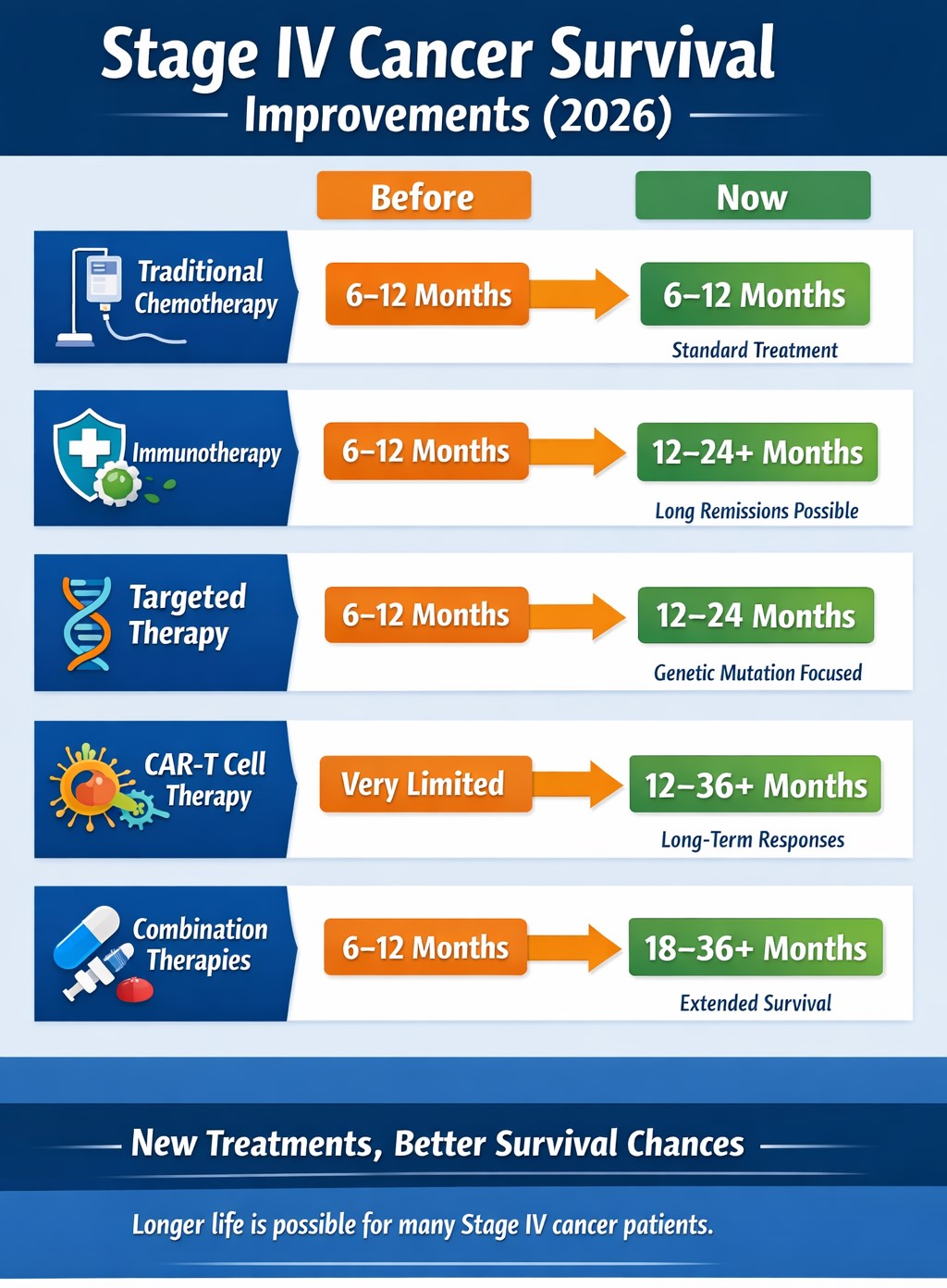
Here’s a simple, human-friendly table showing approximate survival improvements for Stage IV cancer with modern therapies in 2026:
| Treatment Type | Typical Survival Before Modern Therapy | Approximate Survival Now (2026) | Notes |
|---|---|---|---|
| Traditional Chemotherapy | 6–12 months | 6–12 months | Still widely used; less effective for resistant tumors |
| Immunotherapy | 6–12 months | 12–24 months or longer | Some patients achieve multi-year remission, especially in melanoma or lung cancer |
| Targeted Therapy | 6–12 months | 12–24 months | Works well if tumor has specific genetic mutations |
| Engineered Cell Therapy (CAR-T) | Very limited | 12–36+ months | Early trials show long-term survival in some patients with previously untreatable cancers |
| Combination Therapies (immunotherapy + targeted therapy) | 6–12 months | 18–36+ months | Can significantly extend survival for select cancers |
Key takeaway:
- Stage IV cancer is rarely fully cured, but modern therapies have roughly doubled or tripled survival for many patients.
- Some individuals respond exceptionally well, achieving long-term remission that was previously almost impossible.
Bottom line
While Stage IV cancer remains challenging, new therapies in 2026 have significantly increased survival and given hope for durable remission in a growing number of patients.
7. Is robotic surgery safe for elderly patients?
Actually, robotic surgery is often safer for elderly patients than traditional surgery. Because the incisions are tiny, there is much less strain on the heart and lungs. There is also significantly less blood loss, which reduces the need for transfusions. Elderly patients also recover much faster, which prevents complications like pneumonia or blood clots from bed rest. Many of our older people health check-ups lead to successful robotic interventions. It allows older individuals to undergo necessary cancer removals that were previously considered too “high risk” for their age group.
8. Can I get a second opinion on 2026 cancer treatments online?
Yes, telemedicine is now a standard part of the patient journey. You can send your scans and pathology reports digitally to experts around the world. They will review your case and help you compare new methods for cancer treatment 2026 that might not be available in your home country. This gives you peace of mind before making a big decision. Most second opinions are completed within 48 to 72 hours. This is especially helpful if you are considering traveling for treatment. It ensures that the trip is necessary and that you have a plan before you even board the plane.
9. What is “Liquid Biopsy” and why is it used in 2026?
A liquid biopsy is a simple blood test that can detect cancer or other diseases by looking for tiny traces of tumor DNA, cells, or other markers floating in your bloodstream. Unlike traditional biopsies, which require removing a piece of tissue from a tumor, a liquid biopsy is minimally invasive—just a quick blood draw.
Why it’s used in 2026
- Early detection – It can sometimes find cancers before symptoms appear, giving doctors a head start on treatment.
- Monitoring treatment – Doctors can see in real time if a therapy is working by tracking tumor DNA in the blood.
- Detecting recurrence – After treatment, liquid biopsies can catch cancer returning much earlier than imaging scans.
- Guiding personalized therapy – By analyzing the tumor DNA in your blood, doctors can choose treatments that are more likely to work for your specific cancer.
Why it matters
Liquid biopsy is like having a window into your body’s fight against cancer without surgery. It’s faster, safer, and can be repeated often, making it an increasingly important tool in 2026 for personalized cancer care.
10. How do I prepare for international travel for cancer treatment?
Preparation starts with gathering all your medical records in digital format. You should also ensure your passport is valid for at least six months. WMedTour handles the rest, including hospital bookings and local transport. If you are in a delicate condition, we arrange for an air ambulance with a specialized oncology nurse. We also help with visa invitation letters to speed up the process. Preparing mentally for the journey is also important. Knowing that you are traveling for the most advanced care available can provide a significant psychological boost to your healing process.
11. What are Carbon Ion therapies and are they better than traditional radiation?
Carbon ion therapy is a type of advanced radiation treatment that uses carbon ions instead of the traditional X-rays (photons) used in conventional radiation therapy. It’s part of a broader category called particle therapy, which also includes proton therapy.
Here’s a detailed breakdown:
How Carbon Ion Therapy Works
- Carbon ions are heavier particles compared to photons.
- They deposit most of their energy at a precise depth in the tumor (this is called the Bragg peak), minimizing damage to surrounding healthy tissue.
- Carbon ions have higher biological effectiveness, meaning they are more likely to break DNA in cancer cells and kill them, even in tumors resistant to conventional radiation.
Advantages Over Traditional Radiation
- Precision targeting
Carbon ions can focus energy on tumors with minimal exposure to nearby healthy tissue, which reduces side effects. - Better for resistant tumors
Certain tumors like pancreatic cancer, sarcomas, and recurrent head and neck cancers are often resistant to conventional X-ray radiation. Carbon ions are more effective at killing these cells. - Fewer treatment sessions
Because of their high effectiveness, fewer sessions may be required compared to traditional radiation. - Lower risk of long-term toxicity
The reduced damage to surrounding tissue can mean less risk of secondary cancers or organ damage over time.
Limitations / Challenges
- Availability: Carbon ion therapy requires extremely expensive and specialized equipment, so it’s only available in a few centers worldwide.
- Cost: Treatment is significantly more expensive than traditional radiation.
- Long-term data: While studies are promising, there is less long-term outcome data compared to conventional radiation.
Bottom Line
Carbon ion therapy is often superior to traditional X-ray radiation for:
- Tumors resistant to conventional radiation
- Tumors close to sensitive organs
- Pediatric tumors (to reduce long-term side effects)
However, for many common cancers, traditional radiation remains effective, widely available, and much cheaper. Carbon ion therapy is a specialized tool for difficult-to-treat cases rather than a blanket replacement for all cancers.
12. Is there a “cure” for cancer in 2026?
As of 2026, there is no single universal “cure” for cancer that works for all types of the disease. However, significant progress has been made, and many cancers can now be effectively treated, controlled, or even eliminated in individual patients depending on the type, stage, and other factors.
What “cure” means in cancer
The word cure in cancer is complicated because cancer isn’t one disease — it’s a group of hundreds of diseases. For some cancers, long‑term remission (no detectable disease for many years) is considered a cure. For others, treatment may control the disease for a long time but not completely eliminate every cancer cell.
Major advances as of 2026
1. Targeted therapies
Drugs designed to specifically block cancer growth pathways have transformed treatment for many cancers (e.g., certain lung, breast, and blood cancers).
2. Immunotherapy
Treatments that help the immune system recognize and destroy cancer cells have led to durable remissions in cancers like melanoma, lung cancer, and some blood cancers.
3. Precision medicine
Genetic profiling of tumors allows doctors to tailor therapy to specific mutations in a patient’s cancer, improving outcomes.
4. Early detection
Blood tests and imaging improvements are catching some cancers earlier when they are easier to treat.
Where we still struggle
- Many cancers remain difficult to cure, especially aggressive or late‑stage solid tumors (like pancreatic or some brain cancers).
- Metastatic disease (cancer that has spread) is often still very challenging to eradicate completely.
- Drug resistance can develop, meaning tumors stop responding to treatments that initially worked.
Hopeful trends
Researchers are exploring:
- Next‑generation immunotherapies
- Synthetic biology and engineered cell therapies
- Personalized vaccines
- Better early detection tools
Bottom line
While there is no one cure for cancer yet, many cancers are now highly treatable and in some cases curable. Survival rates continue to improve, and ongoing research is rapidly expanding the number of cancers that can be effectively controlled or eradicated in individual patients.
Get Your Personalized Treatment Comparison Today