🚀 Cutting-Edge Technologies in Diagnosis and Treatment 2026
📋 Executive Summary
The year 2026 marks a historic turning point in healthcare. We are witnessing the seamless integration of Artificial Intelligence (AI), nanomedicine, and remote robotic interventions. This guide provides a comprehensive look at Cutting-Edge Technologies in Diagnosis and Treatment 2026. You will discover how early-stage cancer detection has become a reality through liquid biopsies. We also explore how robotic platforms are revolutionizing fields from
cardiac surgery to
neurosurgery.
- AI-powered diagnostic tools are reducing error rates by over 40%.
- Personalized genomics allows for “designer” treatments tailored to individual DNA.
- Global medical hubs in 2026 offer these advanced technologies at competitive prices.
👥 Who is This For?
This analysis serves two primary audiences. Firstly, it is for patients seeking the most advanced options for complex conditions. For example, individuals looking for the latest in
oncology treatment or
orthopedic innovations will find actionable data here. Secondly, this is for medical professionals and health administrators. They need to understand the shifting landscape of Cutting-Edge Technologies in Diagnosis and Treatment 2026 to remain competitive in the global market.
🧬 Diagnostic Breakthroughs in 2026
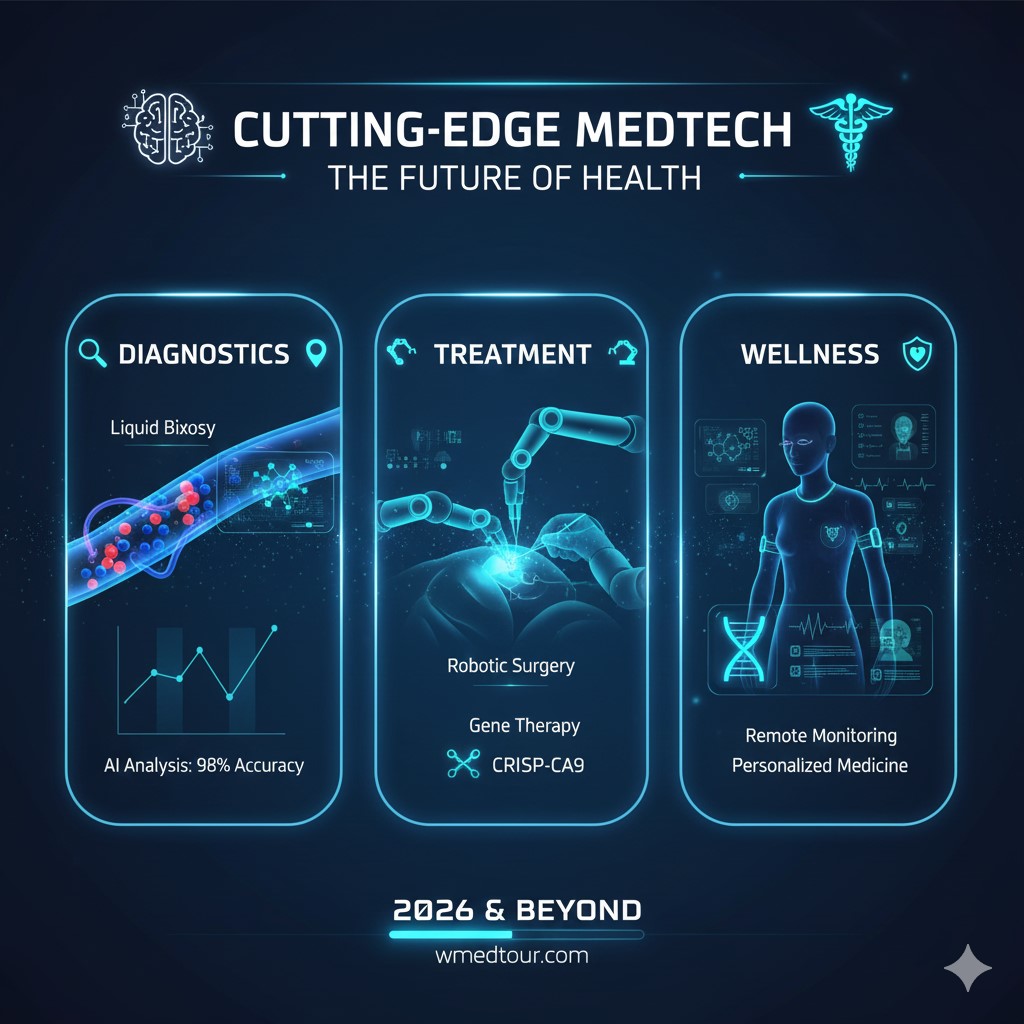
In 2026, the mantra “prevention is better than cure” has a technological backbone. Diagnostic accuracy has reached unprecedented levels. This is largely due to the widespread adoption of multi-omic testing and AI imaging.
🔬 Liquid Biopsies and Nano-Sensors
Traditional tissue biopsies are invasive and often painful. However, in 2026, liquid biopsies have become the standard for
cancer screening. By analyzing circulating tumor DNA (ctDNA) in a simple blood draw, doctors can catch malignancies months before they show up on an MRI. This technology is a cornerstone of Cutting-Edge Technologies in Diagnosis and Treatment 2026.
🤖 AI-Integrated Imaging
Radiology is undergoing a massive transformation. AI algorithms now pre-scan
angiography and CT results. They flag micro-abnormalities that the human eye might miss. Furthermore, these tools help in
ophthalmology to predict retinal diseases years in advance.
Pros and Cons of AI Diagnostics
- Pros: Rapid results, extremely high accuracy, and reduced workload for clinicians.
- Cons: High initial implementation costs and the need for massive high-quality datasets.
💉 Advanced Treatment Modalities
Moving beyond diagnosis, Cutting-Edge Technologies in Diagnosis and Treatment 2026 includes radical new ways to treat chronic illnesses. We are moving away from “one-size-fits-all” medicine toward high-precision interventions.
🦾 Robotic and Minimally Invasive Surgery
Robotic platforms have become more dexterous. In 2026,
robotic-assisted urological surgery is no longer an outlier. It is the preferred method for delicate procedures like
prostatectomy. These robots allow for smaller incisions, which means patients experience significantly less pain.
🧬 Gene Therapy and CRISPR-Cas9
Gene editing is finally maturing. In 2026, researchers are using these tools to treat inherited disorders. From blood diseases to certain types of
hemato-oncology conditions, the ability to rewrite genetic code is changing lives. This is a primary pillar of Cutting-Edge Technologies in Diagnosis and Treatment 2026.
📊 Comparison: Traditional vs. 2026 Cutting-Edge Approaches
| Feature | Traditional Method | 2026 Cutting-Edge Tech |
|---|---|---|
| Diagnostic Speed | Days to Weeks | Minutes to Hours (AI-driven) |
| Invasiveness | High (Open Surgery/Biopsy) | Ultra-Low (Liquid Biopsy/Robotics) |
| Personalization | Generic Protocols | Genomic-Tailored (Precision Medicine) |
| Recovery Time | Weeks of Hospitalization | Often Same-Day or 48-Hour Discharge |
🌍 The Patient Roadmap to Modern Healthcare
Accessing Cutting-Edge Technologies in Diagnosis and Treatment 2026 requires a clear plan. Follow this roadmap to ensure you get the best care possible.
- Consultation: Start with a
telemedicine consultation to review your history with a global expert. - Diagnosis: Opt for advanced screenings like
molecular diagnostics to pinpoint the exact nature of your condition. - Location Selection: Research
all locations that specialize in your required technology. - Travel & Logistics: For urgent cases, consider specialized transport such as
air ambulance services. - Procedure: Undergo treatment using the latest
general surgery or specialized robotic techniques. - Recovery: Follow up via digital health platforms to monitor your progress remotely.
📉 Cost Analysis: The Value of Innovation
While Cutting-Edge Technologies in Diagnosis and Treatment 2026 may seem expensive, the long-term savings are immense. Reduced hospital stays and fewer complications lower the total “lifetime cost” of the disease.
| Technology Type | Estimated Global Avg (2026) | Hospital Days Saved |
|---|---|---|
| Robotic Orthopedic Surgery | $12,000 – $18,000 | 3 – 5 Days |
| AI-Enhanced Cardiac Checkup | $800 – $1,500 | N/A (Prevents Crisis) |
| Nanomedicine Treatment (per cycle) | $5,000 – $9,000 | Reduces Side Effects |
🏨 Recovery & Medical Tourism
In 2026, treatment is only half the journey. The other half is recovery. Global hubs like
Turkey and
Iran have built specialized resorts. These facilities focus on postoperative care while allowing you to enjoy local culture. For example, recovering from
plastic surgery in a high-end Istanbul clinic combines medical safety with world-class hospitality. This trend is a major component of Cutting-Edge Technologies in Diagnosis and Treatment 2026.
📖 Case Study: Mr. Al-Sayed’s Heart Recovery
Mr. Al-Sayed suffered from a complex arrhythmia. Traditionally, this would require invasive chest surgery. However, in 2026, he traveled to a specialized center for
arrhythmia surgery using a new non-invasive ablation robot. The AI mapped his heart in 3D during the procedure. Consequently, the surgeon fixed the issue in 45 minutes. Mr. Al-Sayed was walking the next day. He saved nearly $25,000 by choosing a medical tourism route over local private options in his home country.
❓ Frequently Asked Questions (FAQ)
Is AI diagnosis safe in 2026?
Absolutely. AI tools in 2026 are highly regulated by international bodies. These algorithms act as a “second pair of eyes” for doctors. They undergo rigorous clinical trials before deployment. Therefore, they enhance safety by providing a data-driven perspective that complements human intuition. Most Cutting-Edge Technologies in Diagnosis and Treatment 2026 utilize AI to reduce human fatigue and error.
How does robotic surgery differ from laparoscopic surgery?
Robotic surgery and laparoscopic surgery are both minimally invasive techniques, meaning they avoid large incisions, but they differ significantly in technology, precision, and surgeon control. Let’s break it down clearly:
- Surgeon Control and Technology
- Laparoscopic surgery:
- The surgeon manually operates long, thin instruments inserted through small incisions.
- The surgeon views the area on a 2D screen from a camera (laparoscope).
- Precision depends entirely on the surgeon’s skill and hand steadiness.
- Robotic surgery:
- The surgeon sits at a console and controls robotic arms that hold instruments.
- The system provides 3D high-definition visualization and magnification.
- Robotic arms have wristed instruments that can rotate more than a human wrist, allowing finer movements.
- The robot can filter out hand tremors, increasing precision.
- Precision and Complexity
- Laparoscopic surgery: Great for many procedures, but complex maneuvers in tight spaces can be challenging.
- Robotic surgery: Better for delicate or complex surgeries, such as prostatectomy, cardiac procedures, or pelvic organ prolapse repair, because the robot can reach angles that are hard for straight laparoscopic tools.
- Recovery and Outcomes
Both are minimally invasive, so:
- Smaller incisions → less pain, less scarring, quicker recovery.
- Robotic surgery may reduce bleeding and complications in complex cases due to higher precision.
- Operative time may be longer for robotic surgery, especially during setup.
- Cost
- Robotic surgery is more expensive due to the robotic system and maintenance.
- Laparoscopic surgery is generally cheaper and more widely available.
Summary Table
| Feature | Laparoscopic Surgery | Robotic Surgery |
| Surgeon control | Direct manual | Remote via console |
| Visualization | 2D | 3D HD magnified |
| Instrument flexibility | Straight instruments | Wristed, multi-angle |
| Precision | High, limited by skill | Very high, tremor-free |
| Complexity | Good for standard procedures | Better for complex/delicate surgeries |
| Cost | Lower | Higher |
Are liquid biopsies as accurate as traditional ones?
Liquid biopsies are promising but not yet fully equivalent to traditional (tissue) biopsies in most cases. Accuracy depends on the type of cancer, the stage, and what is being tested. Let’s break it down carefully:
- What They Are
- Traditional biopsy: Involves removing a tissue sample directly from the tumor. It provides definitive histology, allowing pathologists to see the tumor structure, type, and mutations.
- Liquid biopsy: Uses a blood (or sometimes other bodily fluids) sample to detect circulating tumor DNA (ctDNA), RNA, or tumor cells. It’s less invasive and can be repeated more easily.
- Accuracy
- Sensitivity (detecting cancer when it’s present) can be lower in liquid biopsies, especially in early-stage cancers, because the amount of tumor DNA in the blood may be very small.
- Specificity (avoiding false positives) is usually high, but rare errors can occur from DNA mutations not related to cancer (clonal hematopoiesis).
- Liquid biopsies are better at monitoring treatment response or detecting recurrence than at initial diagnosis.
- For some cancers like lung, colorectal, or breast cancer, liquid biopsies can reliably detect certain mutations, but they usually complement, not replace, tissue biopsies.
- Advantages of Liquid Biopsies
- Minimally invasive → less risk, easier to repeat.
- Can detect tumor heterogeneity (mutations from different tumor sites) better than a single tissue sample.
- Can monitor treatment response in real-time.
- Limitations
- Less sensitive for small or early tumors.
- Cannot always provide detailed histology or the tumor microenvironment information.
- Not yet universally accepted as a standalone diagnostic tool.
- Practical Takeaway
- Liquid biopsy: Excellent for mutation profiling, monitoring therapy, and detecting recurrence.
- Tissue biopsy: Still the gold standard for initial diagnosis and when precise histology is needed.
Can I access these technologies in developing countries?
Yes, because of medical tourism. Countries like Iran and India have invested heavily in Cutting-Edge Technologies in Diagnosis and Treatment 2026. You can find
top-tier doctors in these regions using the same equipment as Western hospitals. This democratizes high-end healthcare for patients worldwide.
What is the role of 3D printing in 2026 healthcare?
3D printing is revolutionizing
orthopedic surgery. Surgeons can now print custom titanium implants that fit a patient’s bone structure perfectly. This is also used in
dental care for personalized crowns and bridges. It is one of the most visible Cutting-Edge Technologies in Diagnosis and Treatment 2026.
Is gene therapy available for common diseases?
Gene therapy is available for some diseases, but it’s still mostly limited to rare genetic disorders or very specific conditions, not the common diseases most people think of like diabetes, heart disease, or common infections. Here’s a detailed breakdown:
- What Gene Therapy Is
- Gene therapy involves modifying or replacing faulty genes to treat or prevent disease.
- Delivery methods include viral vectors, CRISPR-based editing, or mRNA techniques.
- Diseases Gene Therapy Can Treat
Currently, gene therapy is approved mostly for rare or severe conditions:
| Type | Examples | Notes |
| Genetic blood disorders | Sickle cell disease, beta-thalassemia | Patient’s bone marrow cells are modified to produce normal hemoglobin. |
| Rare immune deficiencies | Severe combined immunodeficiency (SCID) | Can “fix” immune cells to function properly. |
| Certain inherited eye diseases | Leber congenital amaurosis | Delivered via eye injection; can restore vision. |
| Some cancers | CAR-T cell therapy for leukemia/lymphoma | Patient’s immune cells are engineered to attack cancer. |
- What Gene Therapy Is Not Yet Used For
- Common diseases like:
- Diabetes (Type 1 or 2)
- Heart disease
- Alzheimer’s or Parkinson’s
- Most infections
- Research is ongoing, but these conditions are complex, often involving multiple genes and environmental factors, which makes gene therapy much harder.
- Limitations
- Very expensive and often available only in specialized centers.
- Long-term safety data is still limited for many therapies.
- Risk of immune reactions or unintended genetic changes.
- Future Outlook
- Gene therapy research is expanding rapidly, with clinical trials for conditions like muscular dystrophy, certain cancers, and metabolic disorders.
- The hope is that over the next 5–10 years, more “common” diseases could become candidates, especially if gene-editing tools like CRISPR become safer and more precise.
Does insurance cover these advanced technologies?
Coverage varies significantly. Many international insurance providers now recognize the cost-benefit of robotic surgery and AI diagnostics. However, you should check with your provider specifically regarding “innovative therapies.” If coverage is denied, medical tourism remains a viable way to access these Cutting-Edge Technologies in Diagnosis and Treatment 2026 affordably.
What is nanomedicine?
Nanomedicine is a branch of medicine that uses nanotechnology—extremely tiny materials measured in nanometers (billionths of a meter)—to diagnose, treat, or prevent diseases. It’s essentially the application of microscopic technology at the molecular or cellular level in healthcare.
Here’s a detailed breakdown:
- What Makes It “Nano”
- 1 nanometer (nm) = 1 billionth of a meter.
- Nanomedicine works at the scale of molecules, proteins, DNA, and cells, allowing precision that traditional medicine can’t achieve.
- Applications of Nanomedicine
- Drug delivery
- Nanoparticles can carry drugs directly to target cells or tissues, increasing effectiveness and reducing side effects.
- Example: Cancer drugs delivered via nanoparticles to attack tumors while sparing healthy tissue.
- Diagnostics
- Nanoscale materials can detect disease markers earlier than conventional tests.
- Example: Nanoparticles that bind to cancer cells for early imaging or detection.
- Therapies
- Gene therapy enhancement: Nanoparticles can safely deliver DNA or RNA to cells.
- Photothermal therapy: Nanoparticles absorb light and convert it to heat to destroy cancer cells.
- Regenerative medicine
- Nanomaterials can help repair tissues or organs, like scaffolds for growing new cells in wound healing.
- Advantages
- Precision targeting → fewer side effects.
- Early detection → better outcomes.
- Improved solubility and stability of drugs.
- Can tackle diseases that are hard to treat conventionally, like certain cancers or brain disorders.
- Limitations and Challenges
- Safety: Long-term effects of nanoparticles in the body are still under study.
- Cost: High production and testing costs.
- Regulatory hurdles: Nanomedicines require strict evaluation before approval.
- Real-World Examples
- Cancer treatments: Liposomal doxorubicin (a nanoparticle-based chemo drug).
- mRNA vaccines: COVID-19 vaccines use lipid nanoparticles to deliver mRNA safely.
- Targeted imaging agents: Nanoparticles for MRI or PET scans to visualize tumors.
How has telemedicine improved in 2026?
Telemedicine now integrates with wearable devices. Your doctor can monitor your vitals in real-time from across the globe. This is essential for preoperative and postoperative care. It bridges the gap for those seeking Cutting-Edge Technologies in Diagnosis and Treatment 2026 abroad.
Is digital health data secure?
Data security has improved with blockchain technology in 2026. Patient records are encrypted and decentralized. This ensures that only authorized personnel can access your medical history. Security is a vital part of the infrastructure for Cutting-Edge Technologies in Diagnosis and Treatment 2026.
What is “Precision Medicine”?
It is healthcare tailored to you. It uses your genetics, environment, and lifestyle to choose the best treatment. In 2026, this approach is replacing traditional generic treatments. It is the philosophy behind Cutting-Edge Technologies in Diagnosis and Treatment 2026.
How do I choose the best clinic for these technologies?
Look for international accreditations. Read patient reviews and check the success rates for specific procedures. Our
about us section explains how we vet hospitals for the highest standards. Finding the right provider is the final step in the roadmap for Cutting-Edge Technologies in Diagnosis and Treatment 2026.
⚠️ Medical Disclaimer
The content on this website is for informational purposes only. It is not intended to be a substitute for professional medical advice, diagnosis, or treatment. Always seek the advice of your physician or other qualified health provider with any questions you may have regarding a medical condition. Do not disregard professional medical advice or delay in seeking it because of something you have read here.
🔗 External Resources
To learn more about the scientific foundations of these technologies, please visit the following university and research portals:
Next Step: Would you like me to generate a personalized cost estimate for a specific cutting-edge treatment in 2026?