Egg Donation IVF: Your Path to Parenthood
A compassionate guide to building your family with donor eggs
If you’re considering egg donation IVF, you’re likely on a journey filled with hope, questions, and maybe some uncertainty. We want you to know: you’re not alone. Thousands of families have walked this path before you, and we’re here to guide you through it with honesty, empathy, and the practical information you need.
What Exactly is Egg Donation IVF?
At its heart, egg donation IVF is about creating life through collaboration. When using your own eggs isn’t an option, donor eggs from a carefully screened young woman can offer dramatically higher chances of success. The process involves fertilizing these donor eggs with sperm in a lab, then transferring the resulting embryo to your uterus.
What many find most beautiful about this process is that you still get to experience pregnancy – feeling those first kicks, watching your body change, and ultimately giving birth to your child. While the genetics come from the donor and your partner (or a sperm donor), you become the biological mother through pregnancy.
Who Chooses This Path?
People come to egg donation IVF for many reasons, and all are valid:
- Women over 40 facing age-related fertility decline
- Those with premature ovarian failure or diminished ovarian reserve
- People who carry genetic conditions they don’t want to pass on
- Women who’ve had multiple failed IVF cycles with their own eggs
- Same-sex male couples and single men building families
- Anyone for whom traditional IVF hasn’t worked
Remember This
Choosing donor eggs isn’t “giving up” – it’s making a conscious, loving choice to build your family in a different way. Many parents who’ve gone through this say they feel an even deeper appreciation for the miracle of their child.
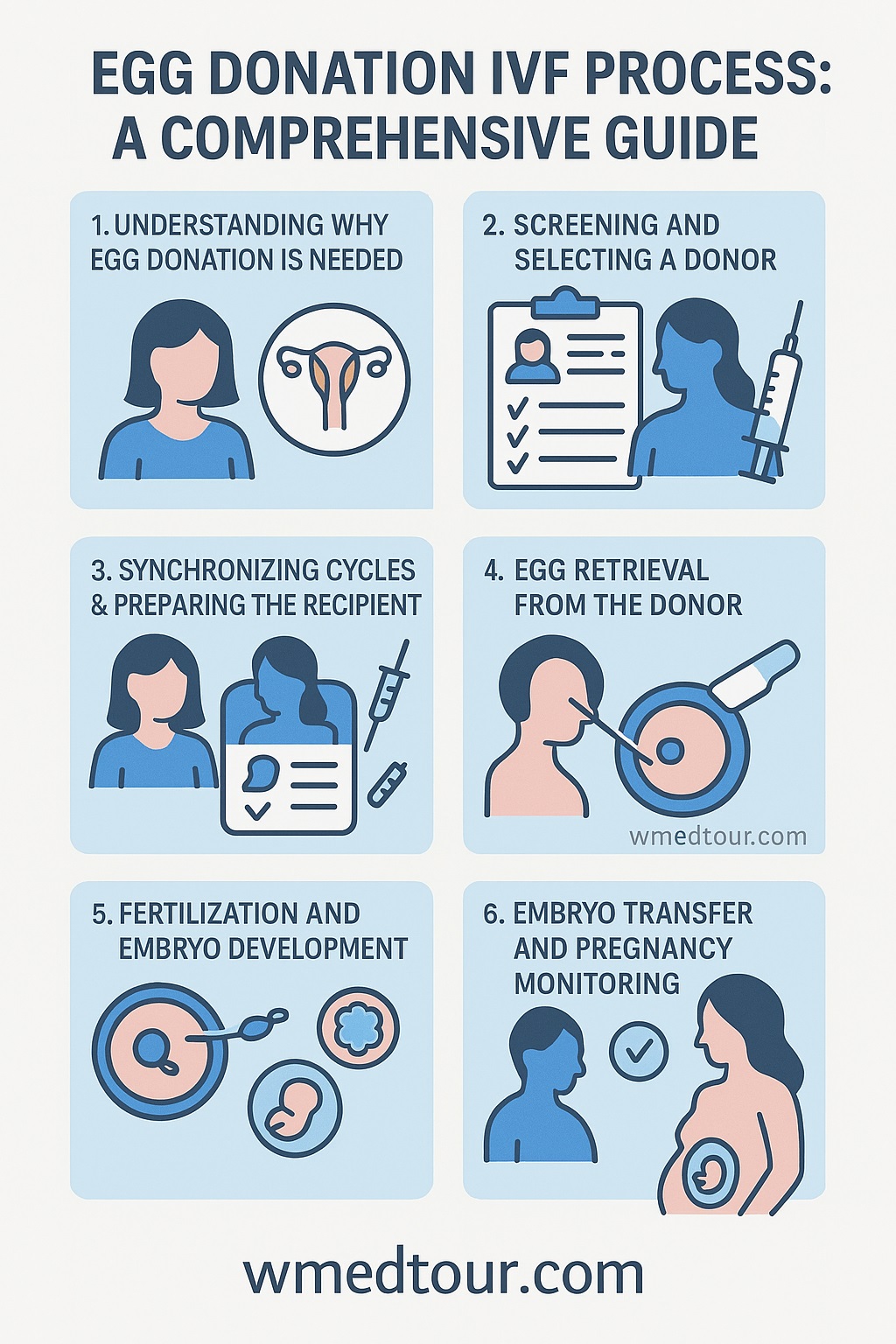
The Journey, Step by Step
While every clinic has slightly different protocols, here’s what you can generally expect:
1. The Consultation & Decision
You’ll meet with a fertility specialist who understands the emotional weight of this decision. They’ll review your history, explain the process, and help you understand if this is right for you. Bring your questions – there are no silly ones here.
2. Finding Your Donor
This is often the most emotional part. You’ll review donor profiles that include physical characteristics, medical history, education, and sometimes personal essays. Take your time. Some parents look for donors who resemble them; others prioritize health history above all.
3. Synchronizing Cycles
If using fresh eggs, your menstrual cycle and the donor’s will be synchronized using medication. With frozen eggs (increasingly popular), this step is simpler.
4. The Donor’s Retrieval & Your Preparation
While the donor undergoes egg retrieval, you’ll take estrogen and progesterone to prepare your uterine lining – creating a welcoming environment for the embryo.
5. Fertilization & Transfer
The eggs are fertilized with sperm (often using ICSI for best results), grown for 3-5 days in the lab, then transferred to your uterus in a quick, painless procedure.
6. The Two-Week Wait & Beyond
The hardest part for many: waiting about two weeks for a pregnancy test. Then, if successful, you begin a carefully monitored pregnancy.
Emma & Raj’s Story
“After four failed IVF cycles with my own eggs, we felt completely drained. The suggestion of donor eggs initially felt like admitting defeat. But our doctor gently explained it wasn’t about failure – it was about choosing the best path to our baby.
Choosing a donor felt surreal at first, like online dating but for genetics. We found a donor who shared my love of music and Raj’s curly hair. When we saw the positive pregnancy test, we both cried – not just from happiness, but from relief that this long journey might finally be leading us to our child.
Our daughter is now two. Does she look like me? Not exactly. But she has my laugh and Raj’s stubborn streak. She’s unquestionably, completely ours.”
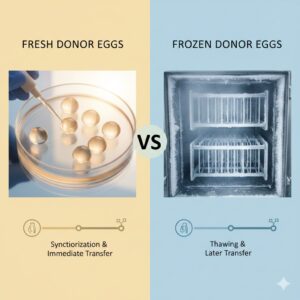
Fresh vs. Frozen Donor Eggs: What’s Best for You?
This is one of the biggest practical decisions you’ll make. Here’s a straightforward comparison:
| Consideration | Fresh Donor Eggs | Frozen Donor Eggs |
|---|---|---|
| Timing | Requires synchronizing both your cycles – adds complexity | Start whenever you’re ready – much simpler scheduling |
| Availability | Depends on donor’s schedule and cycle | Eggs are ready immediately from the bank |
| Cost | Typically higher (donor compensation + retrieval costs) | Usually more affordable (eggs already retrieved) |
| Success Rates | Historically slightly higher, but the gap is closing fast | Excellent and improving every year |
| Number of Eggs | You get all eggs from one cycle (usually 10-20) | You purchase a specific number (often 6-8) |
Our honest take: For most people today, frozen eggs offer the best balance of convenience, cost, and success rates. The technology has improved so much that many clinics now achieve identical results with frozen eggs.
The Emotional Landscape
Let’s talk honestly about feelings, because they matter as much as medical details.
The Hard Parts
Many women grieve the loss of a genetic connection to their child. There might be jealousy toward the donor, anxiety about disclosure, or fear about bonding. These feelings are completely normal and valid.
The Beautiful Parts
Many parents discover unexpected joys: the relief of moving forward after years of struggle, the special bond that comes from choosing this path intentionally, and the freedom from worrying about age-related genetic issues.
Getting Support
Don’t go it alone. Consider:
- Counseling: Most good clinics require or strongly recommend it
- Support groups: Connecting with others on the same journey is invaluable
- Open conversations: With your partner, trusted friends, or family
A Perspective That Helps
Think of egg donation not as replacing your genetics, but as adding another person’s generous gift to your family story. Many cultures celebrate the idea that it takes a village to raise a child – in your case, that village includes a donor who made your family possible.
Your Questions, Answered Honestly
Will I bond with a baby that’s not genetically mine?
Absolutely. Bonding happens through pregnancy, birth, and the thousand daily interactions of parenting. Genetics don’t determine love – ask any adoptive parent.
Should we tell our child about the donation?
Most experts now recommend openness from an early age. Children handle age-appropriate truth much better than discovering secrets later. There are wonderful children’s books that explain donor conception in beautiful ways.
What if our families don’t understand?
This can be tough. Some families need education, others need time. What matters most is that you and your partner are united in your decision. The love for your child usually helps everyone else come around.
How do we handle the financial aspect?
Egg donation IVF is significant financially (typically $20,000-$40,000). Many clinics offer financing, and there are grants and loans specifically for fertility treatments. Be upfront with your clinic about your budget.
What about leftover embryos?
You can freeze them for future siblings, donate to another family (embryo adoption), donate to science, or (depending on local laws) let the clinic handle them according to their protocols. This is a deeply personal decision.
Is success guaranteed?
No fertility treatment offers guarantees, but egg donation IVF has the highest success rates of any ART procedure – often 60% or higher per transfer for live births. Much depends on your overall health and the clinic’s expertise.
Finding the Right Clinic & Support
The clinic you choose makes all the difference. Look for:
- Experience: How many egg donation cycles do they do annually?
- Success rates: Ask for their live birth rates with donor eggs
- Donor pool: Do they have a diverse selection of well-screened donors?
- Emotional support: Do they offer counseling and support groups?
- Communication: Do they answer questions patiently and clearly?
Many people consider traveling for treatment – whether for more affordable options, access to specific donors, or legal considerations in different countries. If you’re considering this, research thoroughly and work with a reputable medical tourism facilitator.
Ready to Explore Your Path Forward?
Making this decision takes courage, but it doesn’t have to feel lonely. At Wmedtour, we’ve helped hundreds of people navigate egg donation IVF with compassion and practical support.
We can connect you with vetted clinics that specialize in donor egg treatments, help you understand costs and logistics, and provide the emotional support you need along the way.
Start Your Conversation with Us
No pressure, just information and support when you’re ready.