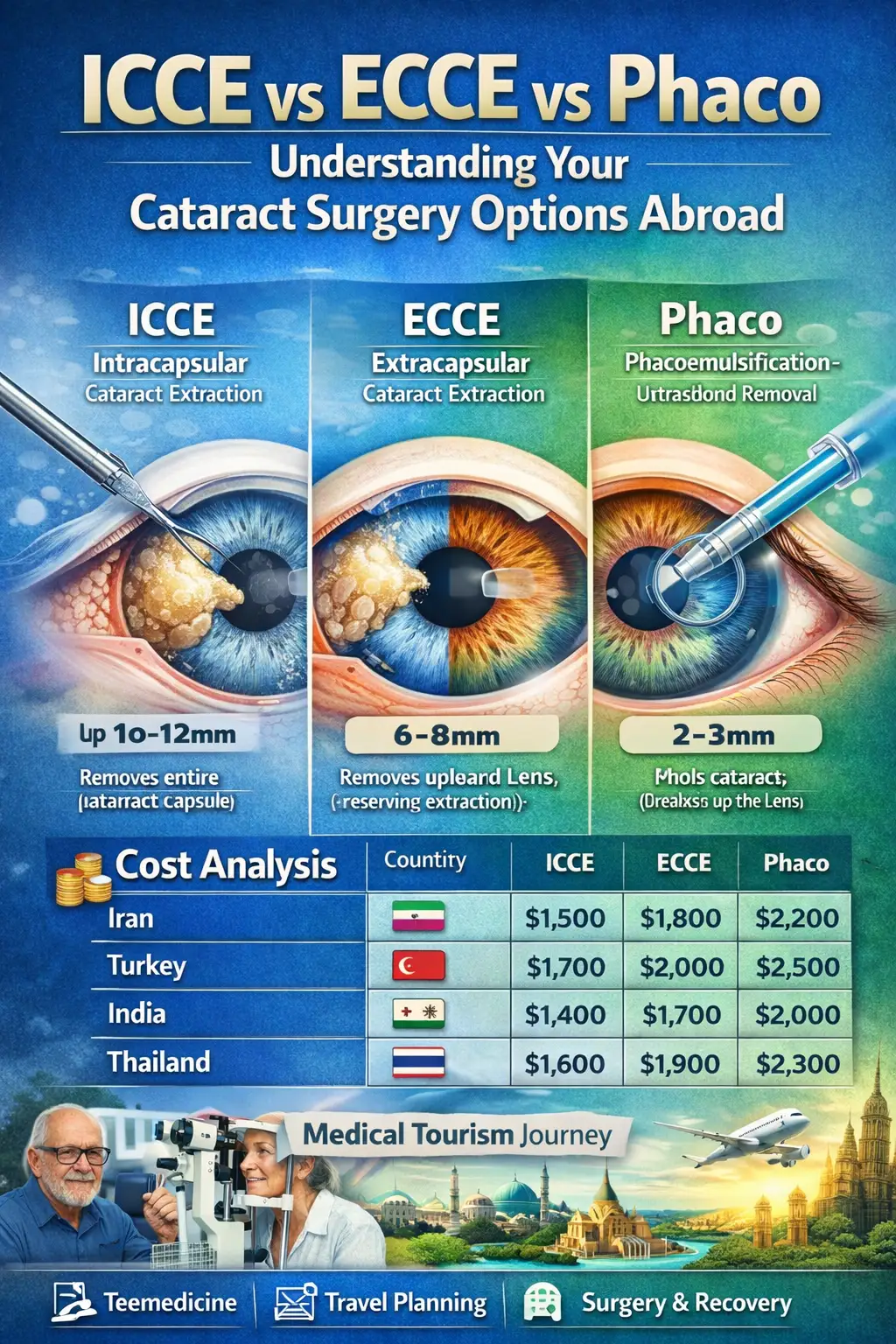
👁️ ICCE vs ECCE vs Phaco: Understanding Your Cataract Surgery Options Abroad
📄 Executive Summary
Considering cataract surgery abroad? Understanding the differences between ICCE, ECCE, and Phaco is critical. This guide explores:
- The pros and cons of each cataract surgery technique.
- Cost analysis and international price comparison.
- Patient roadmap: travel, surgery, and recovery abroad.
- Recovery time, tourism options, and best practices for international patients.
- FAQs to make informed choices about cataract surgery overseas.
🧠 Understanding Cataract Surgery Techniques
ICCE (Intracapsular Cataract Extraction) 🏥
ICCE is the oldest method of cataract removal, where the entire lens and capsule are removed. While rare today, it may still be used in severe or complex cases.
- Pros: Effective for extremely advanced cataracts.
- Cons: Higher complication rate, longer recovery, and larger incision.
- Typical Recovery: 6–12 weeks.
ECCE (Extracapsular Cataract Extraction) 👁️
ECCE involves removing the lens while leaving the elastic capsule intact, making it safer than ICCE. Modern variants, like Manual Small Incision Cataract Surgery (MSICS), improve recovery.
- Pros: Safer than ICCE, suitable for dense cataracts.
- Cons: Larger incision than Phaco, slightly longer healing.
- Typical Recovery: 4–6 weeks.
Phacoemulsification (Phaco) 💻
Phaco is the most advanced and widely used technique. It uses ultrasound to break up the lens, allowing small incision surgery and faster recovery.
- Pros: Small incision, rapid recovery, minimal scarring.
- Cons: Requires specialized equipment and skilled surgeons.
- Typical Recovery: 1–2 weeks.
📊 Comparative Table: ICCE vs ECCE vs Phaco
| Feature | ICCE | ECCE | Phaco |
|---|---|---|---|
| Incision Size | 10–12 mm | 6–8 mm | 2–3 mm |
| Recovery Time | 6–12 weeks | 4–6 weeks | 1–2 weeks |
| Suitability | Advanced/Complicated Cataracts | Dense/Mature Cataracts | Most Cataracts |
| Complication Risk | High | Moderate | Low |
| Cost (International Average) | $1,500–$2,500 | $1,800–$3,000 | $2,000–$4,000 |
💡 Case Study: Ahmed’s Cataract Surgery Journey
Ahmed, 62, traveled from Oman to Iran for cataract surgery. He had a mature cataract unsuitable for Phaco. After consulting with WMedTour experts, he chose ECCE. Surgery lasted 45 minutes. Ahmed recovered in 4 weeks and combined his trip with cultural tours in Tehran and Shiraz, experiencing a seamless medical tourism journey.
👥 Who is This For?
- International patients seeking affordable cataract surgery abroad.
- Patients with dense or complex cataracts.
- Medical tourists balancing cost, quality, and recovery time.
- Individuals prioritizing quick return to work and lifestyle.
🛣️ The Patient Roadmap: Step by Step
- Initial consultation via telemedicine.
- Pre-operative assessment and required tests (lab and imaging).
- Travel planning: visa, flights, accommodation (recommendations available on Iran tours or Oman tours).
- Surgery day: registration, anesthesia, procedure.
- Post-op monitoring in hospital or clinic.
- Recovery at hotel or nearby accommodation.
- Follow-up consultations and removal of sutures if needed.
- Return home with instructions and ongoing virtual follow-up.
💰 Cost Analysis Table
| Country | ICCE | ECCE | Phaco |
|---|---|---|---|
| Iran | $1,500 | $1,800 | $2,200 |
| Turkey | $1,700 | $2,000 | $2,500 |
| India | $1,400 | $1,700 | $2,000 |
| Thailand | $1,600 | $1,900 | $2,300 |
⏱️ Recovery & Tourism Tips
Phaco patients can enjoy sightseeing within days. ECCE and ICCE require gentler activity. Recommended tips:
- Wear protective eye shields while traveling.
- Avoid dusty or humid environments.
- Schedule short cultural or leisure activities during recovery.
- Ensure travel insurance covers post-op complications.
❗ Medical Disclaimer
This article is for informational purposes only. All patients must consult their ophthalmologist and travel medical advisor before surgery. Surgical outcomes, risks, and recovery may vary by individual.
❓ Frequently Asked Questions (FAQs)
- What is the difference between ICCE, ECCE, and Phaco?
- Perfect — this is the core of modern cataract surgery terminology. Let’s break it down clearly, especially for complex eyes:
🔹 1️⃣ ICCE (Intracapsular Cataract Extraction)
How it works:
- Removes the entire lens including its capsule in one piece.
- Requires a large incision (10–12 mm or more).
- Usually manual, no laser used.
Pros:
- Useful if the capsule is completely destroyed or the lens is fully dislocated.
Cons:
- High complication risk: vitreous loss, retinal detachment, astigmatism, infection.
- Slow visual recovery.
- IOL placement more complicated (anterior chamber or sutured).
Use today: Rare, only for last-resort or extreme cases.
🔹 2️⃣ ECCE (Extracapsular Cataract Extraction)
How it works:
- Removes the lens nucleus and cortex, but leaves the posterior capsule intact.
- Requires a larger incision than phaco, usually 8–10 mm.
- Often manual, sometimes assisted by instruments or laser for precision.
Pros:
- Capsule is preserved → allows standard IOL implantation.
- Safer than ICCE, fewer complications.
Cons:
- Bigger incision → slower healing and more astigmatism than phaco.
- Longer recovery than modern phaco.
Use today:
- Sometimes used in very hard or advanced cataracts, or where phaco equipment isn’t available.
🔹 3️⃣ Phacoemulsification (Phaco)
How it works:
- Uses ultrasound energy to break up the lens nucleus into tiny pieces.
- Lens fragments are removed through a tiny self-sealing incision (2–3 mm).
- Capsule is preserved for stable IOL placement.
- Can be assisted by femtosecond laser for corneal incisions, capsulorhexis, and lens fragmentation.
Pros:
- Small incision → fast recovery, minimal astigmatism.
- Very safe, even in complex eyes with additional tools (capsular rings, hooks).
- Predictable IOL placement.
- Minimal inflammation.
Cons:
- Requires specialized equipment and surgeon training.
Use today:
- Standard of care worldwide, including for complex eyes, trauma, and high-risk cataracts.
🔹 Quick Comparison Table
Feature ICCE ECCE Phaco Capsule Removed Preserved Preserved Incision size Very large Large Tiny Lens removal Whole lens Lens nucleus + cortex Ultrasound fragments Laser No Rarely Often (optional) Recovery Slow Moderate Fast Complication risk High Moderate Low IOL support AC or sutured Standard in capsule Standard in capsule Use today Rare / last-resort Sometimes Standard ✅ Key Takeaways
- ICCE = old, risky, last-resort.
- ECCE = safer, preserves capsule, sometimes used for very hard lenses.
- Phaco = modern standard, safe, fast recovery, tiny incision.
- Which surgery is fastest for recovery?
- The fastest recovery is by far modern phacoemulsification (phaco) surgery.
Here’s a clear breakdown:
🔹 Recovery Speed Comparison
Surgery Type Incision Healing Vision Stabilization Glasses Needed Phaco Tiny (2–3 mm) Usually a few days 1–4 weeks Sometimes for reading only ECCE Large (8–10 mm) Weeks 2–6 weeks Often needed for distance and near ICCE Very large (10–12 mm+) Weeks to months 4–8+ weeks Usually needed for distance & near 🔹 Why Phaco Recovers Fast
- Tiny incision → less trauma to cornea and sclera.
- Capsule preserved → stable IOL, less inflammation.
- Minimal sutures or self-sealing wound → reduces astigmatism and discomfort.
- Advanced tools (ultrasound, optional laser) → precise, efficient, minimal manipulation.
✅ Key Takeaway
- Phaco: Fastest recovery, lowest complications, standard today.
- ECCE: Moderate recovery, sometimes used for very hard cataracts.
- ICCE: Slowest recovery, only used when capsule can’t be preserved.
- Which method is most affordable for international patients?
- When it comes to cost for international patients, the picture is influenced by surgery type, technology required, and post-op care. Here’s a clear comparison:
🔹 Cost Comparison (International Patients)
Surgery Type Equipment / Tech Needed Typical Cost Notes ICCE Minimal (manual instruments) Lowest Rarely performed today, mostly in low-resource settings. High risk may increase follow-up costs. ECCE Moderate Low–Moderate Larger incision, less equipment than phaco. Used for very hard cataracts or limited resources. Phaco / Laser-assisted Advanced machines, optional femtosecond laser Moderate–High Fast recovery reduces accommodation costs, fewer complications → less follow-up cost. 🔹 Key Considerations for International Patients
- ICCE may seem cheap upfront, but:
- Higher risk of complications → extra surgeries, long recovery
- Longer follow-up care → can increase overall cost
- ECCE is a middle ground:
- Less equipment needed than phaco
- Moderate recovery, moderate cost
- Phaco is more expensive initially, but:
- Faster recovery → less time off work or travel
- Lower complication rate → fewer follow-ups
- Better visual outcomes → often reduces long-term costs
✅ Bottom Line
- ICCE: Cheapest initially, but riskier and slower recovery.
- ECCE: Affordable alternative if phaco isn’t available or lens is extremely hard.
- Phaco: Slightly more expensive, best value overall due to safety, fast recovery, and fewer complications.
- ICCE may seem cheap upfront, but:
- Is Phaco available in Iran, India, and Turkey?
- Yes — modern phacoemulsification cataract surgery is widely available in Iran, India, and Turkey.
🇮🇷 Iran
- Phaco is commonly performed in major eye hospitals and teaching centers in Tehran and other cities.
- Iran attracts international patients for phaco surgery due to experienced surgeons and competitive pricing.
🇮🇳 India
- Phaco cataract surgery is standard practice across India, offered in both public and private hospitals.
- India is one of the world’s largest providers of modern cataract surgery, with widespread access even in regional cities.
🇹🇷 Turkey
- Phacoemulsification is readily available in advanced ophthalmic clinics and hospitals, including internationally accredited centers.
- Cataract surgery packages for international patients frequently include phaco as the main procedure.
🧠 Summary
- Iran: Phaco widely used in major hospitals and medical tourism hubs.
- India: Phaco is the dominant modern cataract technique across urban and regional centers.
- Turkey: Phaco is routinely offered with modern equipment, often as part of medical tourism programs.
- Can I combine cataract surgery with tourism?
- Yes, especially with Phaco, patients can enjoy cultural tours during recovery, as shown in patient case studies.
- Are follow-up visits mandatory?
- Yes, at least 1–2 follow-ups are required, but virtual consultations are available via telemedicine.
- Is cataract surgery covered by insurance abroad?
- Coverage depends on the country and insurance provider. International patients often pay out-of-pocket.
- Can patients with dense cataracts still get Phaco?
- Yes — patients with dense (very hard or advanced) cataracts can still undergo phacoemulsification, but there are a few important considerations:
🔹 How Dense Cataracts Affect Phaco
- Harder lens nucleus
- Dense cataracts require more ultrasound energy to break up the lens.
- This can increase surgery time and slightly raise the risk of corneal swelling or endothelial cell stress.
- Increased technical difficulty
- Surgeons may use special techniques such as chopping the lens into smaller fragments (phaco-chop) or using advanced phaco machines with higher efficiency.
- Capsular support must be carefully preserved, especially in complex eyes.
- Longer recovery for the cornea
- Slightly more post-op swelling is common, so vision may take a few extra days to stabilize compared to softer lenses.
🔹 Modern Strategies for Dense Cataracts
- Modified phaco settings to reduce ultrasound trauma
- Mechanical or femtosecond laser-assisted fragmentation to pre-soften the lens in some centers
- Use of viscoelastic substances to protect the cornea and capsule
- In extreme cases where phaco is very risky, ECCE may still be considered, but phaco is attempted first in most modern centers
✅ Key Takeaways
- Dense cataracts are not a contraindication for phaco.
- Recovery may be slightly slower and the surgery a bit more technically challenging, but modern phaco is safe and effective even for very hard lenses.
- Experienced surgeons and proper pre-op planning are critical for good outcomes in dense cataracts.
- Harder lens nucleus
- What are the risks of ICCE?
- ICCE (Intracapsular Cataract Extraction) carries significantly higher risks than modern cataract surgery because it removes the entire lens along with its capsule and requires a large incision. Here’s a detailed breakdown:
🔹 Major Risks of ICCE
Complication Why It Happens Severity / Notes Retinal detachment Loss of lens capsule support → vitreous traction Relatively common, vision-threatening Vitreous loss No capsule barrier → vitreous can prolapse into anterior chamber Can lead to further complications like retinal tears Corneal edema / decompensation Large incision and prolonged surgery Can slow recovery and affect visual clarity Astigmatism Sutured large incision May require corrective glasses for months Infection (endophthalmitis) Large wound increases risk Rare but potentially severe, can threaten vision IOL-related issues No capsule support → anterior chamber or sutured IOL may dislocate May require secondary surgery Cystoid macular edema Trauma to vitreous and retina Can delay vision recovery Prolonged inflammation Larger surgical trauma Requires longer post-op medication and monitoring 🔹 Why Risks Are Higher Than Modern Surgery
- Large incision → more trauma, slower healing, higher infection risk
- Capsule removed → no natural support for lens → unstable IOL, retinal traction
- Vitreous disturbance → increases risk of retinal complications
- Slower recovery → more time for post-op complications to appear
✅ Key Takeaways
- ICCE is high-risk and rarely used today.
- Modern cataract surgery (phaco or ECCE) is much safer, even in complex eyes.
- ICCE is typically reserved for situations where the capsule is completely destroyed or the lens is dislocated, not as a first-choice procedure.
- How long should I stay abroad for recovery?
- The length of stay abroad after cataract surgery depends on the type of surgery (ICCE vs ECCE vs Phaco), complexity of the eyes, and your personal healing response. Here’s a clear guideline:
🔹 Modern Phaco / ECCE (Capsule-Preserving Surgery)
Factor Recommendation Initial recovery Most patients feel comfortable in 1–3 days for daily activities. Travel / flying Short flights: 1–3 days; Long/international flights: 1 week recommended to allow eyes to stabilize and prevent infection. Full visual stabilization 1–4 weeks (may be slightly longer for complex eyes). Follow-up Usually 1–2 visits after surgery, often on day 1 and after 1 week. Summary: Staying 7–10 days abroad is usually enough for modern phaco or ECCE, including follow-up visits.
🔹 ICCE (Capsule Removed)
Factor Recommendation Initial recovery Larger incision → more discomfort, vision slower to improve. Travel / flying Minimum 2–4 weeks, sometimes longer depending on healing and IOL placement. Full visual stabilization 4–8 weeks or more. Follow-up Multiple visits required due to higher complication risk. Summary: ICCE requires a longer stay abroad, often 3–4 weeks, to ensure proper healing and manage complications if they occur.
🔹 Key Considerations for International Patients
- Follow surgeon instructions — some complex eyes may need longer observation.
- Access to emergency care — ensure the hospital/clinic abroad can manage complications before flying back.
- Activity restrictions — avoid heavy lifting, bending, or rubbing eyes while abroad.
- Travel insurance / medical coverage — important in case follow-up care is needed after returning home.
✅ Quick Rule of Thumb
Surgery Type Recommended Stay Abroad Modern Phaco 7–10 days ECCE 7–14 days ICCE 2–4+ weeks - Are there alternatives to surgery for cataracts?
- Absolutely — let’s go into detail.
Cataracts are a clouding of the natural lens inside the eye. Once the lens becomes significantly opaque, surgery is the only treatment that can restore clear vision. However, before surgery becomes necessary, there are some non-surgical measures that can help improve vision or delay progression, though they do not remove the cataract.
🔹 Non-Surgical Measures
- Prescription glasses or contact lenses
- Can improve vision temporarily by correcting refractive errors caused by the cataract.
- For early cataracts, updated glasses may allow you to see clearly enough to continue daily activities.
- Magnifying lenses and better lighting
- Reading glasses or magnifiers help with near vision tasks.
- Bright, focused lighting can reduce glare and make vision clearer, especially for reading or fine work.
- Anti-glare measures
- Sunglasses or lenses with anti-glare coatings reduce sensitivity to bright sunlight and night driving difficulties.
- Lifestyle adjustments
- Reduce activities that strain the eyes in poor lighting.
- Manage coexisting health conditions (like diabetes) that can accelerate cataract progression.
- Medication and supplements (limited effect)
- Some antioxidants (vitamins C, E, lutein) may slightly slow progression in early stages, but they cannot reverse cataracts.
🔹 Limitations of Non-Surgical Measures
- None of these measures remove the cloudy lens — vision will gradually worsen over time.
- Non-surgical options are only temporary solutions to improve quality of life until surgery becomes necessary.
- Once cataracts interfere significantly with driving, reading, or daily life, surgery is the only effective option.
✅ Key Takeaways
- Surgery is the definitive treatment — it actually removes the cataract and restores vision.
- Non-surgical measures are supportive: glasses, lighting, anti-glare lenses, magnification, lifestyle changes, and antioxidants.
- They can delay the impact of cataracts, but cannot stop progression indefinitely.
- Prescription glasses or contact lenses
- Which international destination offers best value?
- Here’s a clear overview of best-value international destinations for cataract surgery, without sources:
🌍 Top Value Destinations for Cataract Surgery
🇮🇳 India — Most Affordable Overall
- Offers some of the lowest prices for modern cataract surgery (phaco).
- High-quality care with experienced surgeons in major hospitals.
- Many hospitals offer tiered pricing depending on lens type and facility level.
- Best for: patients who want excellent value and are comfortable with a slightly longer international trip.
Value rank: ⭐⭐⭐⭐
🇮🇷 Iran — High Value with Low Costs
- Known for very competitive pricing with skilled ophthalmologists.
- Cost-effective packages often include pre- and post-op care, making overall treatment affordable.
- Many clinics provide international patient services (consultations, follow-ups, logistics).
- Best for: patients focused on maximizing cost savings while retaining strong clinical quality.
Value rank: ⭐⭐⭐⭐
🇹🇷 Turkey — Moderate Cost + High Quality
- Offers modern facilities, including laser-assisted surgery and premium IOLs.
- Costs are higher than India or Iran but still much lower than Western Europe or North America.
- Hospitals provide international patient services (airport pickup, accommodation, English-speaking staff).
- Best for: patients who want a blend of quality, experience, and shorter travel times from Europe/Middle East.
Value rank: ⭐⭐⭐
🧠 Summary — Best Value Overall
Destination Affordability Quality Value for International Patients India ⭐⭐⭐⭐ High Excellent Iran ⭐⭐⭐⭐ High Excellent Turkey ⭐⭐⭐ Very High Very Good ✅ Key Takeaways
- India and Iran generally offer the best value for international cataract surgery due to low costs plus quality care.
- Turkey provides modern facilities and shorter travel but is slightly more expensive.
- Always check clinic accreditation, surgeon experience, and what’s included in the package, as these impact overall value.
🌐 Related Articles & Internal Links
- Ophthalmology Department Overview
- Cataract Surgery Services
- About WMedTour
- Contact WMedTour
- Medical Tourism FAQ
- Telemedicine Consultation
- Iran Tours for Patients
- Oman Tours for Patients
- Hospitals in Iran
- Hospitals in Turkey
- Corneal Surgery Services
- Eyelid Surgeries
- Glaucoma Surgery
- Oculoplastic Surgery
- General Medical Articles
- Eye Checkup Services
- Find Eye Surgeons