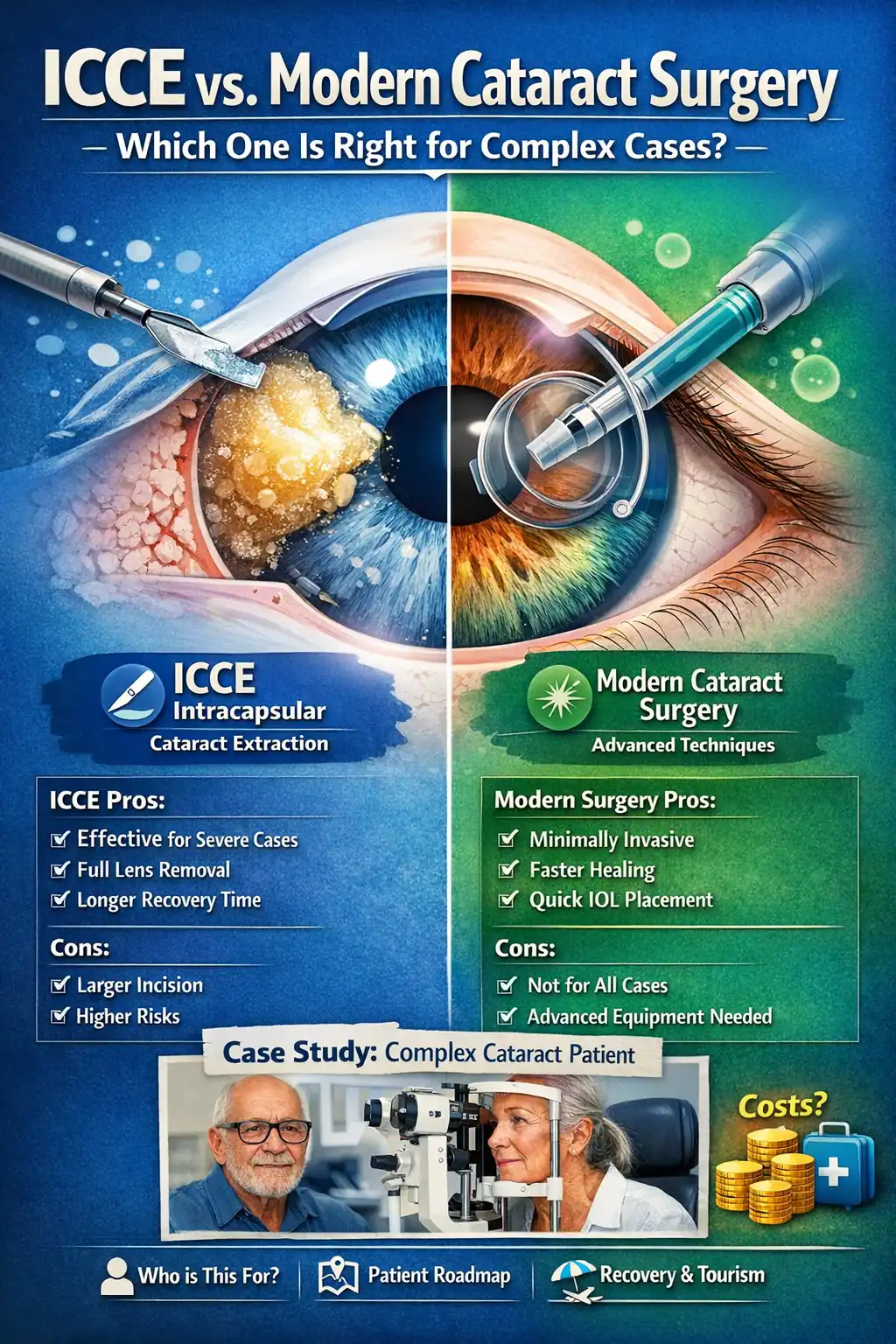
👁️ ICCE vs Modern Cataract Surgery – Which One Is Right for Complex Cases?
Website: WMEDTOUR Medical Tourism Platform
📌 Executive Summary
Choosing between ICCE vs Modern Cataract Surgery can feel overwhelming, especially for patients with complex eye conditions. Cataracts often develop with age, trauma, or systemic disease. While modern techniques dominate today, some complicated cases still require older surgical methods. Therefore, understanding both options helps patients and professionals make safer decisions.
Modern cataract surgery uses tiny incisions and advanced lenses. As a result, recovery is faster and complications drop. However, ICCE, or Intracapsular Cataract Extraction, may still serve as a solution when the lens capsule cannot support an artificial lens. This guide explains when each method works best, who qualifies, how recovery differs, and what international patients should expect.
🔍 Understanding Cataracts in Complex Cases
A cataract clouds the natural lens of the eye. Vision becomes blurry, dull, and sensitive to light. Most cataracts develop slowly. However, complex cataracts behave differently. They may follow eye trauma, previous surgery, genetic disorders, or advanced systemic disease.
In these cases, surgeons must evaluate more than just the cloudy lens. They also assess the capsule, retina, cornea, and eye pressure. Because of these extra risks, the choice between ICCE vs Modern Cataract Surgery becomes more important.
🧠 What Is ICCE (Intracapsular Cataract Extraction)?
ICCE is one of the earliest cataract surgery techniques. Surgeons remove the entire lens together with its surrounding capsule. They perform the procedure through a large incision. Then, they may implant an anterior chamber lens or recommend special glasses or contact lenses.
Advantages of ICCE
- Useful when the lens capsule is severely damaged
- Helpful after eye trauma
- Suitable when zonular support is lost
- Effective for certain pediatric or genetic disorders
Disadvantages of ICCE
- Large incision required
- Longer recovery time
- Higher risk of retinal detachment
- Greater astigmatism after surgery
- Less predictable visual outcomes
Although ICCE sounds outdated, surgeons still use it selectively. According to academic ophthalmology sources such as Johns Hopkins Medicine, ICCE may remain necessary when capsule preservation is impossible.
⚙️ What Is Modern Cataract Surgery?
Modern cataract surgery usually means phacoemulsification or femtosecond laser-assisted surgery. Surgeons break the lens into tiny fragments using ultrasound or laser energy. They then remove the pieces through a very small incision. Afterward, they place an artificial intraocular lens inside the preserved capsule.
Advantages of Modern Cataract Surgery
- Small incision with faster healing
- Minimal pain and inflammation
- Lower infection risk
- More accurate visual correction
- Wide range of premium lens options
Disadvantages of Modern Cataract Surgery
- Not suitable if capsule support is absent
- Requires advanced equipment
- May be difficult after severe trauma
Institutions like Stanford Medicine report that over 95% of cataract surgeries worldwide now use modern methods due to safety and precision.
⚖️ ICCE vs Modern Cataract Surgery – Key Comparison
| Factor | ICCE | Modern Cataract Surgery |
|---|---|---|
| Incision Size | Large | Very Small |
| Capsule Preservation | No | Yes |
| Recovery Time | Longer | Faster |
| Astigmatism Risk | Higher | Lower |
| Lens Implant Position | Anterior or alternative | Posterior chamber |
| Use in Trauma Cases | Often necessary | Sometimes limited |
| Technology Required | Basic surgical tools | Advanced equipment |
👤 Who Is This For?
This guide helps several groups:
- Patients with traumatic cataracts
- Individuals with previous eye surgery complications
- Older adults with zonular weakness
- Medical professionals comparing surgical options
- International patients seeking treatment abroad
If you explore options through our Ophthalmology Department, specialists assess your scans before recommending ICCE vs Modern Cataract Surgery.
🧭 The Patient Roadmap
Step 1: Initial Evaluation
Doctors perform vision tests, corneal scans, retinal imaging, and ultrasound. They check capsule stability. They also evaluate systemic health.
Step 2: Surgical Planning
Surgeons decide whether the capsule can hold an artificial lens. If not, they may recommend ICCE. Otherwise, modern surgery becomes the first choice.
Step 3: Travel & Coordination
International patients often combine treatment with recovery travel. Our Global Medical Tourism Guide explains documentation and timelines.
Step 4: Surgery Day
Modern surgery usually takes 15–25 minutes. ICCE may take longer due to incision size.
Step 5: Recovery & Follow-Up
Follow-ups include eye pressure checks and retina monitoring. Travel patients may use telemedicine follow-ups through online consultations.
💰 Cost Analysis Table
| Country | Modern Surgery Cost | ICCE Cost | Notes |
|---|---|---|---|
| India | $900 – $1,800 | $700 – $1,200 | High surgical volume |
| Iran | $800 – $1,500 | $600 – $1,100 | Advanced ophthalmic centers |
| Oman | $1,500 – $2,800 | $1,200 – $2,000 | Premium private care |
| Europe | $3,000 – $5,000 | Rarely offered | Higher hospital costs |
Patients often combine eye surgery with general evaluations through our Health Checkup Department.
🏖️ Recovery & Tourism
Modern surgery patients resume normal activities within days. ICCE recovery may take weeks. Therefore, travel patients usually stay longer after ICCE.
Many patients choose recovery-friendly cities listed in our global locations directory. Calm environments support healing. Follow-up clinics remain accessible.
🧪 Case Study: A Complex Trauma Patient
Ahmed, age 62, suffered eye trauma in a car accident. The injury damaged his lens capsule. Surgeons in his home country hesitated. He contacted WMEDTOUR and shared scans.
Specialists determined that modern cataract surgery would not hold the lens safely. Therefore, they recommended ICCE with an anterior chamber lens. Ahmed traveled for surgery. Recovery took four weeks. However, his vision improved significantly. He now uses mild glasses only.
📊 Pros and Cons Summary
ICCE Pros
- Solves extreme capsule damage
- Useful after trauma
- Less equipment dependent
ICCE Cons
- Slower healing
- Higher complication rates
- Visual correction may be limited
Modern Surgery Pros
- Fast recovery
- Precise visual outcomes
- Lower surgical trauma
Modern Surgery Cons
- Not ideal for capsule loss
- Requires advanced facilities
❓ Frequently Asked Questions
Is ICCE still performed today?
Short answer: Yes — but very, very rarely.
ICCE (Intracapsular Cataract Extraction) is almost obsolete in modern ophthalmology, especially in well-equipped surgical centers. But it hasn’t disappeared completely.
👁️ Why It’s NOT Common Anymore
Modern cataract surgery (phacoemulsification and advanced ECCE) is safer and better because it:
- Uses tiny incisions
- Preserves the lens capsule to support an intraocular lens (IOL)
- Has faster healing
- Causes less astigmatism
- Has lower complication rates
So in routine and even most complex cases, surgeons strongly prefer modern techniques.
⚠️ When ICCE Might Still Be Used
ICCE is now more of a last-resort or special-situation procedure.
1️⃣ Severely Traumatized Eyes
If the lens capsule is already destroyed from injury, there may be nothing left to preserve, making ICCE necessary.
2️⃣ Very Advanced Lens Dislocation
In conditions like:
- Marfan syndrome
- Homocystinuria
- Severe zonular weakness
If the lens is completely dislocated into the vitreous or extremely unstable, removing it whole can be safer.
3️⃣ Resource-Limited Settings
In some parts of the world where:
- Phaco machines aren’t available
- Surgical tools are limited
ICCE may still be performed because it doesn’t require advanced technology.
4️⃣ Dropped or Luxated Lens During Surgery
In rare intraoperative complications where the lens falls back and cannot be safely emulsified, surgeons may convert to a more ICCE-like removal.
🚫 Why Surgeons Avoid ICCE When Possible
Removing the capsule creates long-term challenges:
- No natural support for an IOL
- Higher risk of retinal detachment
- More vitreous-related complications
- Greater chance of corneal damage
- Longer recovery
Patients often need anterior chamber IOLs or sutured/scleral-fixated lenses, which are more complex.
Which is safer, ICCE or modern surgery?
Modern cataract surgery is far safer than ICCE — especially in complex eyes.
Here’s the clear comparison 👇
🛡️ Overall Safety
| Factor | ICCE | Modern Cataract Surgery (Phaco/ECCE) |
|---|---|---|
| Surgical control | Lower | Much higher |
| Tissue trauma | High | Minimal |
| Healing time | Long | Fast |
| Predictability | Lower | Very predictable |
Modern techniques are designed to be precise and minimally invasive, which dramatically improves safety.
⚠️ Risk of Major Complications
| Complication | ICCE Risk | Modern Surgery Risk |
|---|---|---|
| Retinal detachment | Higher | Lower |
| Vitreous loss | Common | Uncommon |
| Corneal swelling/damage | More frequent | Less frequent |
| Severe inflammation | More likely | Less likely |
| Infection (endophthalmitis) | Higher (larger wound) | Lower (small incision) |
Because ICCE removes the entire capsule, the eye loses an important internal barrier and support structure — and that increases risk.
👁️ Lens Implant Safety
- Modern surgery: The artificial lens (IOL) usually sits safely inside the natural capsule → stable, centered, long-term success
- ICCE: No capsule remains → IOL must be placed in the anterior chamber or sutured, which has more long-term risks
🧠 What About Complex Eyes?
Even in difficult situations (weak zonules, trauma, pseudoexfoliation):
- Surgeons try very hard to use modern capsule-preserving methods
- Special tools (capsular tension rings, hooks, sutured support) make modern surgery safer than ICCE in most of these cases
ICCE is used only when modern surgery is no longer possible, not because it is safer.
✅ Final Verdict
Modern cataract surgery is significantly safer than ICCE in terms of:
✔ Lower complication rates
✔ Better visual outcomes
✔ Faster recovery
✔ More stable lens implantation
ICCE is a last-resort technique, not a safer alternative.
If ICCE is being considered, it’s usually because the eye’s anatomy or damage has already made the case extremely high-risk — not because ICCE itself is the safer option.
Why would a surgeon choose ICCE?
Great question — because today, choosing ICCE is never the first plan. It’s more like a “no better option left” decision.
A surgeon would choose ICCE only when preserving the capsule is impossible or more dangerous than removing everything.
Here are the real-world reasons 👇
🔴 1️⃣ The Lens Capsule Is Already Ruined
Modern surgery depends on keeping the capsule intact. If it’s gone, ICCE may be the safest route.
This happens in:
- Severe eye trauma (ruptured globe, penetrating injury)
- Previous complicated surgery where the capsule tore badly
- Hypermature (very advanced) cataracts where the capsule is fragile and breaking apart
If there’s no capsule support left, removing the whole lens may prevent further damage.
🔴 2️⃣ The Lens Is Completely Dislocated
If the lens is floating or has fallen backward into the vitreous cavity:
- Trying phaco can cause retinal tears, bleeding, or vitreous traction
- Removing the lens in one piece (ICCE-style or via lensectomy) may be safer
Seen in conditions like:
- Marfan syndrome
- Homocystinuria
- Severe pseudoexfoliation
- Advanced zonular dialysis
🔴 3️⃣ Extreme Zonular Weakness
When the fibers holding the lens are almost totally gone:
- Capsular tension rings and hooks may not be enough
- The capsule may collapse during surgery
- Attempting modern surgery can spiral into dangerous complications
In these rare cases, removing the entire lens–capsule complex is more controlled.
🔴 4️⃣ Intraoperative Disaster (Unplanned Conversion)
Sometimes surgery starts as modern phaco, but things go wrong:
- Capsule tears 360°
- Lens becomes unstable
- Nucleus drops or is about to drop
- Vitreous prolapse becomes severe
The surgeon may convert to ICCE to regain control and protect the retina.
🔴 5️⃣ Lack of Equipment (Some Regions)
In low-resource settings where:
- No phaco machine
- Limited surgical tools
ICCE may still be performed because it requires less technology, though this is becoming less common worldwide.
⚖️ Important Perspective
A surgeon does not choose ICCE because it’s better.
They choose it because:
Keeping the capsule would create more risk than removing everything.
It’s a damage-control strategy, not a preferred technique.
Is recovery longer after ICCE?
Yes — recovery after ICCE is significantly longer than after modern cataract surgery.
Here’s why and what to expect:
🕒 Recovery Comparison
| Aspect | ICCE | Modern Cataract Surgery (Phaco/ECCE) |
|---|---|---|
| Wound healing | Large incision → longer healing (weeks to months) | Tiny incision → usually heals in days |
| Visual recovery | Slow, often weeks to months | Rapid, often days to a week |
| Astigmatism | High risk due to large incision | Minimal, self-sealing incision |
| Inflammation & discomfort | More post-op inflammation, more eye drops needed | Less inflammation, easier post-op care |
| Follow-up surgery | Often requires complex IOL placement later | IOL placed immediately in a stable position |
🔹 Why ICCE Slows Recovery
- Large corneal or scleral incision
→ Needs sutures, more trauma, slower healing - Capsule removed
→ No natural support for lens → may need anterior chamber or scleral-fixated IOL, which adds complexity and more follow-ups - Higher complication risk
→ More chances of swelling, bleeding, retinal issues, which delays vision stabilization
💡 Typical Timeline
- Modern phaco: Most patients see functional vision within a few days.
- ICCE: Visual recovery can take weeks, and final vision may take months, depending on IOL placement and healing.
Bottom line: ICCE is not only more invasive and risky, but it also requires a much longer recovery period compared to modern cataract surgery, even in complex eyes.
Can both eyes be treated at once?
In almost all cases, both eyes are not treated at the same time, whether it’s ICCE or modern cataract surgery. Here’s the reasoning:
🔹 Modern Cataract Surgery
- Usually done one eye at a time
- Allows healing and assessment of outcome in the first eye
- Reduces risk of bilateral complications like infection or severe inflammation
- Interval between surgeries: Typically 1–4 weeks, sometimes longer for complex eyes
- Exceptions:
- In rare situations with limited access to care (e.g., remote areas) or certain health conditions, some surgeons may operate on both eyes same day—but this is uncommon and carefully weighed against risk.
🔹 ICCE
- Same principle applies: one eye at a time
- ICCE is more invasive, with larger incisions and higher complication risk
- Treating both eyes simultaneously would dramatically increase risk of bilateral vision-threatening complications, like infection or retinal detachment
- Surgeons almost always wait for full recovery of the first eye before considering the second
⚖️ Key Takeaways
- One-eye-at-a-time is standard for safety in both ICCE and modern surgery.
- Modern surgery allows faster sequential treatment due to quicker healing.
- ICCE has longer recovery, so the second eye may be delayed by several weeks to months.
Do I need glasses after surgery?
Whether you need glasses after ICCE or modern cataract surgery depends on a few factors: the type of lens implanted, your eye anatomy, and whether both eyes are treated. Here’s the breakdown:
🔹 Modern Cataract Surgery (Phaco / ECCE)
- With standard monofocal IOL
- Usually set for distance vision
- Reading or close work → glasses still needed
- With multifocal or accommodating IOL
- Can reduce or eliminate need for glasses
- May not be perfect for all lighting conditions or very fine print
- If one eye is treated first
- Glasses may be needed for balance until both eyes are done
🔹 ICCE
- Capsule is removed, so lens support is lost
- Usually requires anterior chamber or sutured IOL
- Glasses are often still needed, sometimes more than after modern surgery, especially for:
- Reading
- Near work
- Correcting astigmatism (large incision can induce it)
- Recovery is slower → prescription may change over time
🔹 Special Considerations for Complex Eyes
- If you have high astigmatism, prior trauma, or other eye disease, glasses are more likely to be needed after either surgery.
- Modern surgery allows more precise IOL selection, reducing dependency on glasses compared to ICCE.
✅ Bottom Line
- Modern cataract surgery: Many patients still need glasses for reading, but distance vision is often restored.
- ICCE: Glasses are more likely needed for both near and distance vision due to capsule removal and larger incisions.
Is laser used in ICCE?
No — laser is not used in ICCE.
Here’s why:
🔹 ICCE Basics
- ICCE (Intracapsular Cataract Extraction) involves removing the entire lens, including its capsule, in one piece.
- It’s done with manual surgical instruments (scissors, forceps, large incision) because:
- The lens is removed whole, not fragmented
- Precision cutting of the capsule isn’t needed — it’s all removed anyway
- There’s no small incision or delicate capsular work that lasers could help with
🔹 Modern Cataract Surgery and Laser
- Femtosecond laser is used in modern surgery for:
- Making precise corneal incisions
- Creating a capsulorhexis (round opening in the lens capsule)
- Fragmenting the lens for safer phaco removal
- Laser relies on preserving the capsule, which ICCE does not do
- That’s why ICCE predates laser technology and hasn’t adapted to it
✅ Key Point
ICCE is fully manual and mechanical — lasers have no role because the procedure removes the entire capsule anyway, unlike modern laser-assisted cataract surgery where capsule preservation is essential.
Are complications common?
C
Yes — complications are significantly more common with ICCE than with modern cataract surgery, especially in complex eyes.
Here’s a breakdown:
🔹 ICCE Complications
Because ICCE removes the entire lens and capsule through a large incision, it carries higher risk:
| Complication | Why It Happens | How Often |
|---|---|---|
| Retinal detachment | Loss of capsule support + vitreous traction | Relatively common compared to modern surgery |
| Vitreous loss | No capsule barrier → vitreous can prolapse into the anterior chamber | High |
| Corneal edema / decompensation | Large incision + longer surgery | More frequent |
| Astigmatism | Large, sutured incision | Common |
| Infection (endophthalmitis) | Big wound | Higher than modern surgery |
| IOL-related issues | No capsular support → anterior chamber or sutured IOL may dislocate | More frequent |
| Cystoid macular edema | Trauma to vitreous and retina | Higher than modern surgery |
Bottom line: ICCE has a long list of potential complications, and the risk is amplified in complex eyes (trauma, weak zonules, dislocated lens).
🔹 Modern Cataract Surgery Complications
- Modern phaco/ECCE is much safer, even in complex eyes
- Risks are lower because:
- Small incision → less trauma
- Capsule preserved → stable IOL support
- Less vitreous disturbance
| Complication | Frequency |
|---|---|
| Retinal detachment | Rare |
| Vitreous loss | Rare, usually manageable |
| Infection | Very rare |
| Astigmatism | Minimal |
| Macular edema | Rare |
✅ Key Point
Complications are common with ICCE relative to modern surgery, and that’s why ICCE is now a last-resort procedure, used only when preserving the capsule is impossible or the lens is extremely unstable.
How many days after surgery Can I travel ?
The answer depends on which type of cataract surgery you had (ICCE vs modern) and whether your eyes are complex, but here’s a practical guideline:
🔹 Modern Cataract Surgery (Phaco / ECCE)
- Typical recovery: Very fast, small incision
- Travel (short flights / driving):
- Usually safe 1–3 days after surgery if there are no complications
- Longer flights / international travel:
- Many surgeons recommend waiting 1 week to allow the eye to heal and prevent infection or sudden pressure changes
- Precautions:
- Wear protective glasses on planes
- Avoid rubbing the eyes
- Carry prescribed eye drops
🔹 ICCE
- Typical recovery: Much slower, large incision, higher risk of complications
- Travel (short or long flights):
- Usually recommended to wait at least 2–4 weeks
- Healing must be confirmed by the surgeon
- The risk of wound leakage, retinal problems, or IOL instability is higher if you travel too early
- Precautions:
- Avoid any activity that increases eye pressure (lifting, straining, coughing)
- Keep the eye protected and follow strict post-op drops schedule
🔹 Key Considerations
- Complex eyes (trauma, dislocated lens, weak zonules) may require longer observation before travel.
- Surgeon clearance is essential — even if you feel fine, the eye may not be fully stable.
- Insurance / emergency access: If you travel early, make sure you can reach an ophthalmologist quickly if a complication arises.
✅ Quick Rule of Thumb
| Surgery Type | Minimum Wait Before Travel |
|---|---|
| Modern phaco / ECCE | 1–3 days (short trips), 1 week (long flights) |
| ICCE | 2–4 weeks, sometimes longer depending on healing |
Is surgery painful?
No, local anesthesia keeps patients comfortable.
How long does vision take to stabilize?
How long your vision takes to stabilize after cataract surgery depends heavily on the type of surgery and the complexity of your eyes. Here’s a clear breakdown:
🔹 Modern Cataract Surgery (Phaco / ECCE)
- Initial improvement: Often within 1–2 days, most patients notice clearer vision quickly.
- Vision stabilization:
- Most patients: 1–4 weeks for vision to fully settle.
- Complex eyes (trauma, weak zonules, prior retinal issues): may take 4–6 weeks.
- Factors affecting stabilization:
- Minor corneal swelling (edema)
- Residual astigmatism
- Eye drops or inflammation
- IOL position (usually stable immediately if in the capsule)
🔹 ICCE
- Initial improvement: Slower, may take several days to a week due to larger incision and inflammation.
- Vision stabilization:
- Typically 4–8 weeks, sometimes longer for complex eyes.
- Healing is slower because:
- Large incision
- Capsule removed → anterior chamber or sutured IOL may take time to settle
- Higher inflammation risk
- Factors affecting stabilization:
- Sutures inducing astigmatism
- Post-op inflammation
- IOL placement (less stable without capsule)
🔹 Quick Comparison Table
| Surgery Type | Initial Clear Vision | Full Stabilization | Notes |
|---|---|---|---|
| Modern phaco / ECCE | 1–2 days | 1–4 weeks | Faster if eye is healthy |
| ICCE | Several days | 4–8+ weeks | Slower due to incision & IOL placement |
✅ Key Point
- Modern cataract surgery gives faster and more predictable visual recovery, even in complex eyes.
- ICCE takes longer to stabilize vision, and glasses may be needed longer due to induced astigmatism or IOL positioning.
Where can I get evaluated?
You can start with our consultation team.
⚠️ Medical Disclaimer
This article provides educational information only. It does not replace professional medical advice. Always consult an ophthalmologist for diagnosis and treatment decisions.
🔗 Explore More Departments