✨Mini Tummy Tuck vs. Full Tummy Tuck: Which One Do You Actually Need? 🤔
📝Executive Summary: Key Takeaways
- The decision between a Mini Tummy Tuck and a Full Tummy Tuck (Abdominoplasty) fundamentally depends on the extent and location of excess skin, fat, and muscle laxity.
- A Mini Tummy Tuck addresses only the area below the belly button (navel). It is ideal for patients with minor skin laxity and a small “pooch” of fat. It often omits significant muscle separation (diastasis recti) repair.
- A Full Tummy Tuck offers a comprehensive solution. Surgeons treat the entire abdominal area (above and below the belly button). This involves full skin removal and essential muscle repair for a dramatically flatter and firmer core.
- The full procedure requires a longer recovery, and the resulting scar is significantly larger. However, the aesthetic transformation is more complete for candidates with moderate to severe concerns.
- The most crucial step is a thorough consultation with a board-certified plastic surgeon. They help you determine which procedure—the Mini Tummy Tuck vs. Full Tummy Tuck—will best achieve your specific aesthetic and functional goals.
🩺Understanding the Core Difference in Abdominoplasty
The quest for a flatter, firmer midsection often leads individuals to explore abdominoplasty, more commonly known as a tummy tuck. However, this is not a one-size-fits-all procedure. The primary choice you and your surgeon will face is the Mini Tummy Tuck vs. Full Tummy Tuck. These two surgical techniques share the goal of improving abdominal contour. Yet, they vastly differ in scope, correction offered, and recovery profile. Therefore, understanding these fundamental distinctions is essential for making an informed decision.
Many people struggle with loose skin and weak abdominal muscles, especially women after pregnancy or individuals after major weight loss. This condition, medically known as diastasis recti (separation of the rectus abdominis muscles), cannot be fixed through diet and exercise alone. Consequently, the degree of correction you require dictates whether you need a minimal or a comprehensive approach. We must choose between the Mini Tummy Tuck vs. Full Tummy Tuck.

🌟The Full Tummy Tuck: A Comprehensive Core Transformation
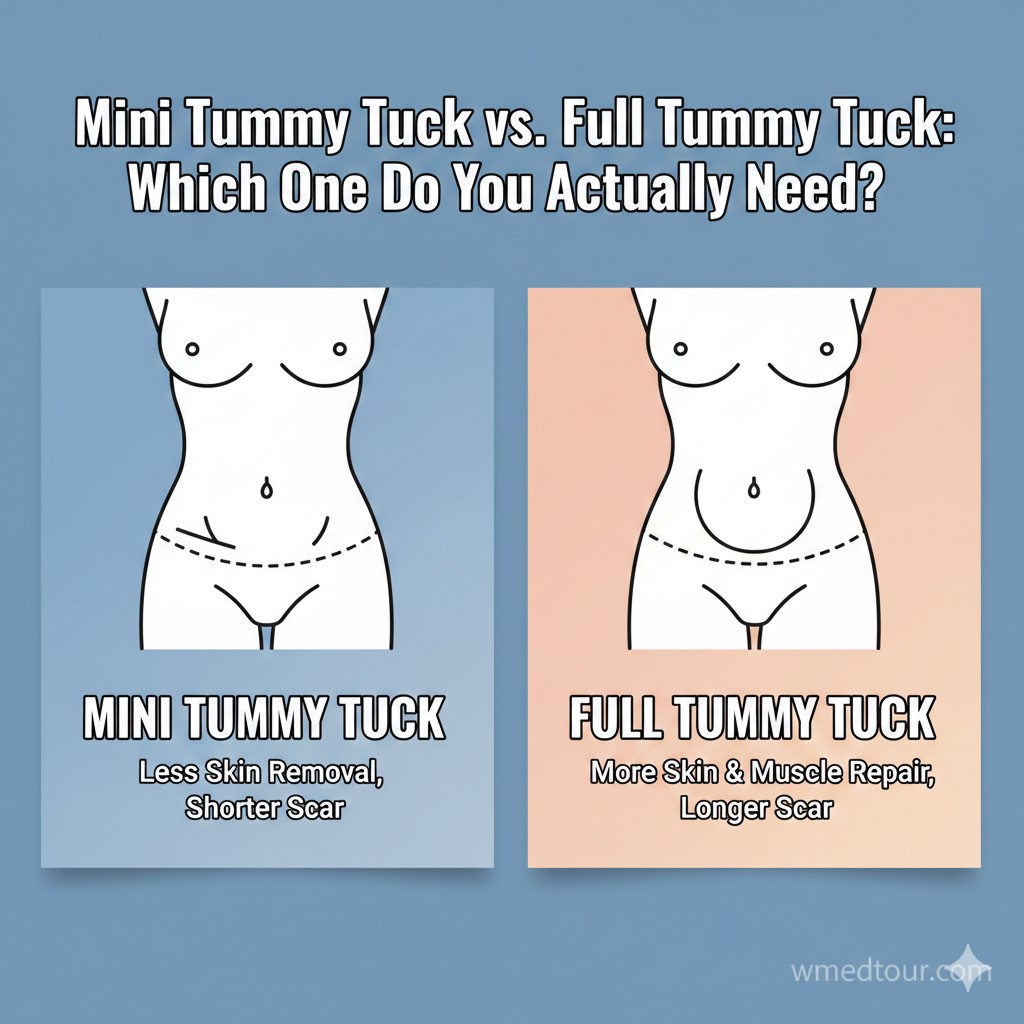
The Full Tummy Tuck, or standard abdominoplasty, serves patients with significant aesthetic and functional issues across their entire abdomen. This comprehensive procedure is highly effective. Furthermore, it addresses all three major components of abdominal deformity: excess skin, localized fat deposits, and muscle laxity. As a result, it remains the gold standard for achieving a dramatic, total transformation. Image of full tummy tuck procedure
The surgeon makes a large, horizontally curved incision from hipbone to hipbone, just above the pubic area. Doctors also make a second incision around the belly button. Importantly, this incision allows the surgeon to lift the entire skin flap up to the ribs. The exposed abdominal wall muscles are then tightened and sutured together. This is a crucial step for addressing diastasis recti and restoring core strength. Finally, the surgeon trims the excess skin, pulls the remaining skin down, and creates a new opening for the belly button. This process delivers a significantly flatter abdomen. Given the extent of this surgery, the recovery is naturally more intensive.
✅Pros of a Full Tummy Tuck
- Total Correction: It addresses the entire abdomen (above and below the navel).
- Muscle Repair: It is essential for correcting moderate to severe diastasis recti.
- Dramatic Results: You get the greatest degree of skin and fat removal, yielding a very flat and taut look.
- Belly Button Recontouring: Surgeons can reposition or reshape the navel for a more youthful appearance.
❌Cons of a Full Tummy Tuck
- Larger Scar: You will have a long, noticeable scar that runs hip-to-hip. However, surgeons usually place it low enough to be hidden by underwear or a bikini bottom.
- Longer Recovery: You require a longer recovery time, typically 4–6 weeks off work, due to the extensive muscle repair.
- Higher Cost: It is generally associated with a higher cost due to the surgery’s complexity and length. For global pricing insights, our guide on Aesthetic Surgeries in Turkey 2025 can help.
🤏The Mini Tummy Tuck: Targeted Lower Abdomen Refinement
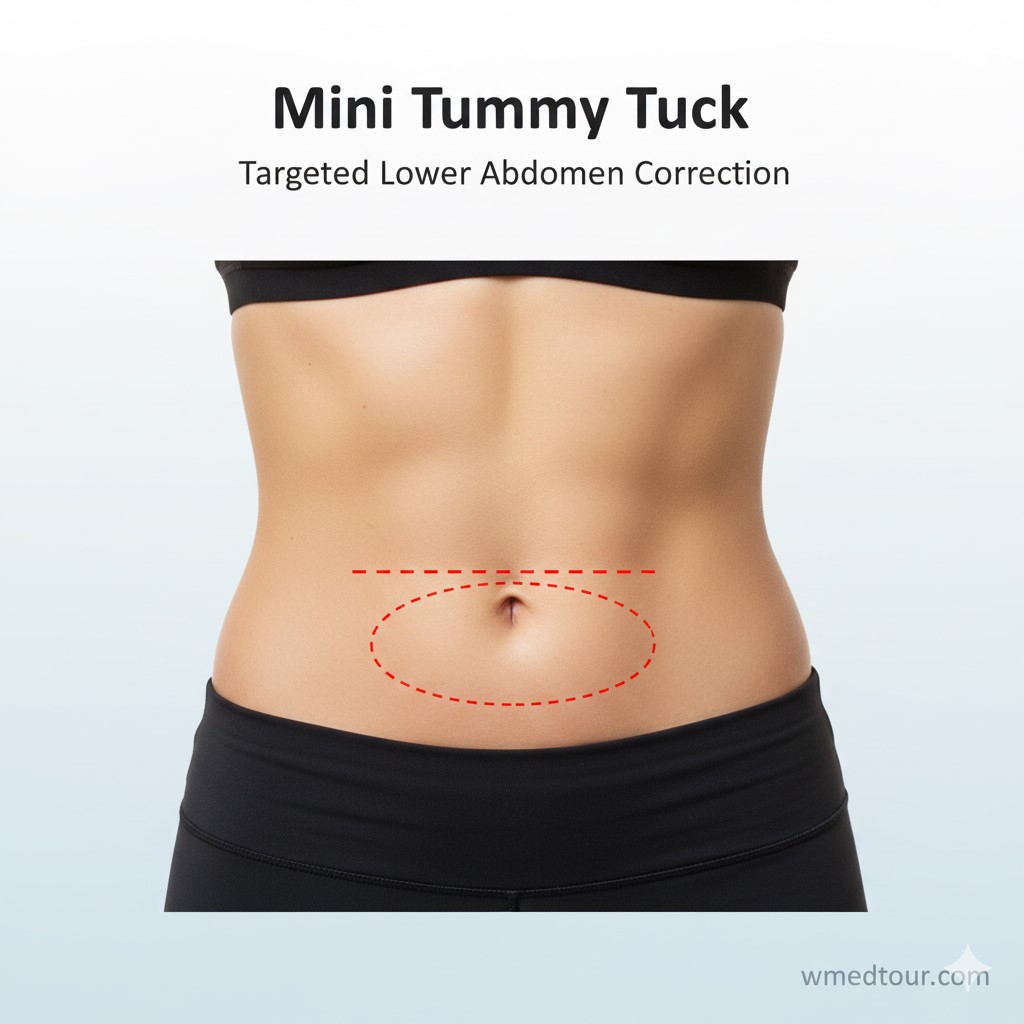
The Mini Tummy Tuck, or partial abdominoplasty, is a less invasive procedure. Surgeons design it for a very specific type of patient. Primarily, it focuses exclusively on the area below the belly button. Consequently, it serves as an excellent choice for individuals who are in good shape but have a small amount of loose skin or fat localized in the lower abdomen. People often call this a “pooch.”
The incision represents the key distinction. In a Mini Tummy Tuck, the incision is significantly shorter than in the full version; it is about the length of a C-section scar. Crucially, surgeons make no incision around the belly button. Thus, the navel remains in its original position, though the skin may pull it down slightly. Because correction is limited to the lower abdominal wall, the surgeon removes only a minimal amount of skin. Muscle repair is often limited or omitted entirely since patients typically do not need it for the entire wall. Therefore, if you have significant muscle separation above the navel, a Mini Tummy Tuck will likely disappoint you. Candidates for this procedure must have mild skin laxity and minimal to no issues above the navel. Image of mini tummy tuck procedure
✅Pros of a Mini Tummy Tuck
- Shorter Scar: You have a much shorter scar, similar to a small C-section scar.
- Quicker Recovery: The recovery period is considerably shorter, often just 1–2 weeks, as surgical trauma is less severe.
- Lower Risk: The procedure generally involves a lower risk of complications compared to the more extensive full version.
- Navel Preservation: The surgeon makes no incision around the belly button.
❌Cons of a Mini Tummy Tuck
- Limited Correction: It only addresses the area below the belly button. It cannot correct loose skin or muscle laxity in the upper abdomen.
- No Major Muscle Repair: It usually does not provide the extensive muscle tightening needed for significant diastasis recti correction.
- Less Dramatic Results: The overall transformation is less dramatic. It suits only minor contour issues.
🌐Insights from Global Plastic Surgery
Surgeons in many medical tourism regions, such as Turkey or Iran, use advanced techniques to optimize scar placement and minimize recovery. They apply these techniques for both the Mini Tummy Tuck vs. Full Tummy Tuck. For instance, the use of progressive tension sutures, a common technique in high-volume clinics, can reduce the risk of seroma (fluid accumulation). Moreover, it helps distribute tension for a finer scar line. Furthermore, combining the procedure with liposuction—often called a Lipoabdominoplasty—is a widespread practice. This combination achieves better contouring, especially around the flanks and hips. If you’re considering global options, exploring guides on Medical Travel Turkey 2025 or Plastic Surgery in Dubai 2025 can offer cost and quality perspectives.
🎯Who is This For?: Identifying the Ideal Candidate
✅Ideal Candidate for a Mini Tummy Tuck
The Mini Tummy Tuck is for the patient who almost likes their body shape but needs minor, targeted refinement. Typically, this person:
- Has a small “pooch” or bulge of skin and fat localized only below the navel.
- Shows minimal to no muscle laxity (diastasis recti).
- Is close to their ideal body weight and plans to maintain it.
- Possesses good skin elasticity above the belly button.
- Accepts that the correction will be subtle and focused on the lower abdomen.
If your primary issue is a modest amount of loose skin or fat that won’t respond to exercise in the area a small bikini bottom hides, the Mini Tummy Tuck vs. Full Tummy Tuck question points toward the mini option.
👑Ideal Candidate for a Full Tummy Tuck
The Full Tummy Tuck is for the patient who requires a significant overhaul of their entire midsection. This is often the case for individuals who:
- Have undergone significant weight loss (e.g., bariatric surgery patients).
- Have experienced multiple pregnancies, leading to substantial loose skin and fat.
- Suffer from moderate to severe diastasis recti (muscle separation) above and below the navel.
- Have excessive loose skin that sags and hangs over the pubic area.
- Desire the most dramatic and comprehensive tightening and contouring.
If your abdomen has a substantial amount of excess skin and noticeable muscle separation, especially above the belly button, the Full Tummy Tuck is the only effective solution. It delivers a truly flat and firm result. Consult a professional to compare the Mini Tummy Tuck vs. Full Tummy Tuck for your specific needs.
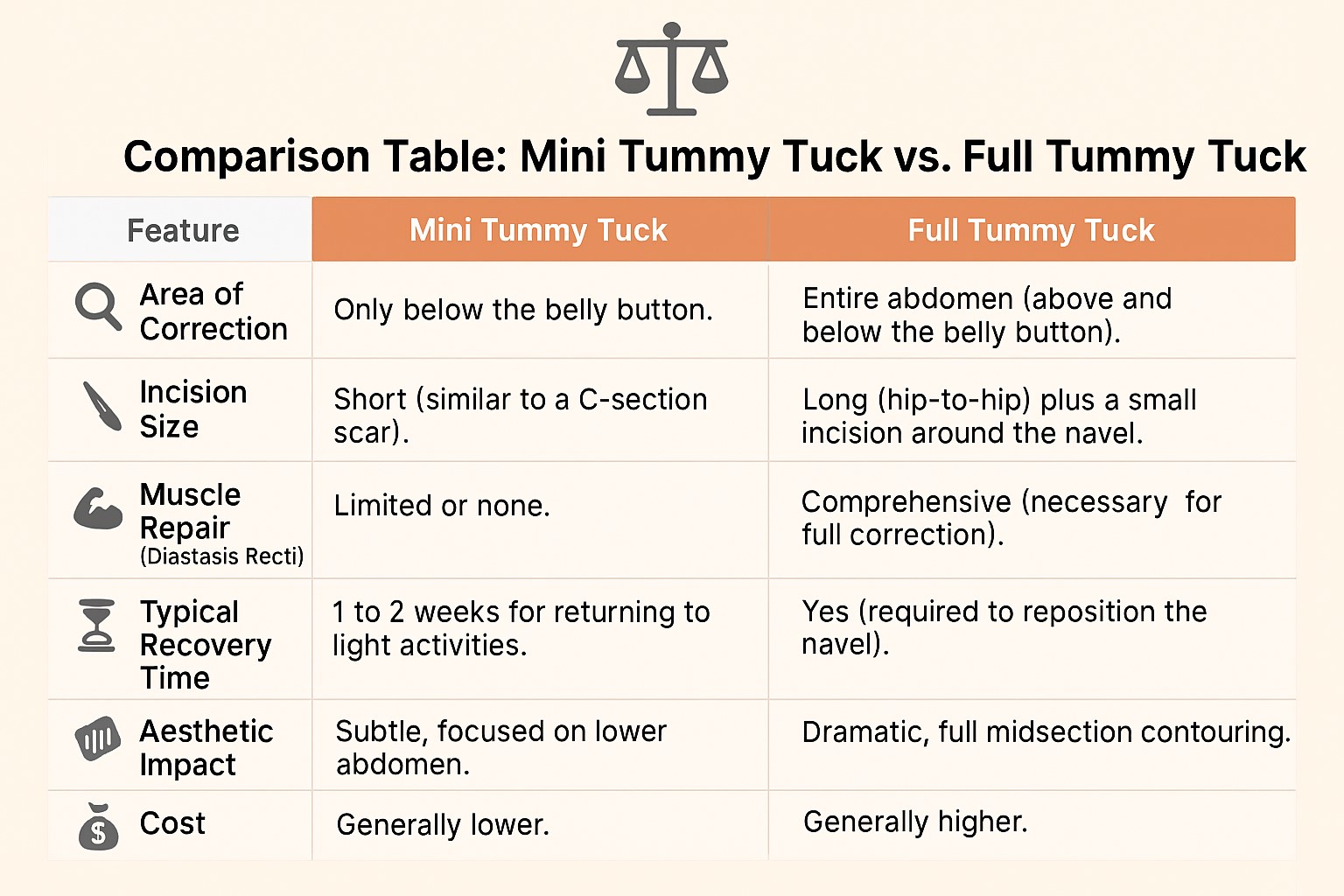
⚖️Comparison Table: Mini Tummy Tuck vs. Full Tummy Tuck
| Feature | Mini Tummy Tuck | Full Tummy Tuck |
|---|---|---|
| 🔍Area of Correction | Only below the belly button. | Entire abdomen (above and below the belly button). |
| 🔪Incision Size | Short (similar to a C-section scar). | Long (hip-to-hip) plus a small incision around the navel. |
| 💪Muscle Repair (Diastasis Recti) | Limited or none. | Comprehensive (necessary for full correction). |
| ⏳Typical Recovery Time | 1 to 2 weeks for returning to light activities. | 4 to 6 weeks for returning to light activities; longer for strenuous exercise. |
| 🩹Navel Repositioning | No (skin may pull it down slightly). | Yes (required to reposition the navel). |
| 📈Aesthetic Impact | Subtle, focused on lower abdomen. | Dramatic, full midsection contouring. |
| 💰Cost | Generally lower. | Generally higher. |
Furthermore, surgical centers specializing in complex procedures maintain consistently high standards for pre-operative assessment and post-operative care. This commitment applies whether the patient needs a Joint Replacement or Advanced Neuro-Oncology Treatment. Therefore, always prioritize the surgeon’s expertise. The quality of care remains constant across all procedures.
📝Case Study: Deciding Between Mini Tummy Tuck vs. Full Tummy Tuck
👩💼Case Study 1: Sarah, The Working Mother
Sarah is a 35-year-old mother of two and a busy professional. She recently lost 15 pounds through consistent diet and exercise, reaching her target weight. Her main concern is residual laxity and a persistent “pouch” of skin and fat right below her belly button, which hangs slightly over her old C-section scar. Importantly, her surgeon noted she has minimal diastasis recti and no significant loose skin above her navel. Sarah is keen to minimize her time off work, which is why the less invasive option is appealing.
➡️Surgical Recommendation & Rationale
Recommendation: Mini Tummy Tuck (possibly with concurrent liposuction, as seen in procedures like Tummy Tuck with Liposuction).
Rationale: Sarah’s primary issue is localized entirely to the area below the navel. She also has minimal muscle separation. Therefore, a Mini Tummy Tuck is the most appropriate and proportionate procedure. It effectively removes the targeted excess skin and flattens the “pooch” with a shorter, more manageable scar. Consequently, the shorter recovery time aligns perfectly with her demanding work schedule. She returns to her professional duties much faster than with a full procedure. She does not need the extensive muscle repair or skin excision a Full Tummy Tuck offers. The mini procedure delivers maximum benefit with minimal invasiveness for her specific needs.
👨🦱Case Study 2: David, The Weight Loss Warrior
David is a 48-year-old man who successfully lost 100 pounds over two years and feels proud of his achievement. However, he now has a large amount of redundant, hanging skin (dermatolax) across his entire abdomen, present both above and below his navel. Crucially, the skin fold is so large that it causes chafing and hygiene issues. Furthermore, his abdominal muscles feel significantly separated and weak, which his doctor confirmed as severe diastasis recti.
➡️Surgical Recommendation & Rationale
Recommendation: Full Tummy Tuck (Abdominoplasty). This may extend to a Belt Lipectomy if skin laxity reaches significantly to the back. This extension is often required after massive weight loss, similar to patients seeking a Body Lift in Dubai).
Rationale: David’s situation involves massive skin excess and severe muscle separation across the entire abdominal wall. The limited scope of a Mini Tummy Tuck would prove insufficient; it would only remove a fraction of the problem. Thus, a Full Tummy Tuck is necessary. It removes the vast amount of redundant skin, tightens the entire abdominal wall muscles back to a functional, flat position, and repositions his navel for a natural contour. Furthermore, the functional benefit of correcting the severe diastasis recti carries equal importance to the aesthetic improvement. When comparing the Mini Tummy Tuck vs. Full Tummy Tuck, David clearly requires the full option.
🩹Recovery and Results: What to Expect
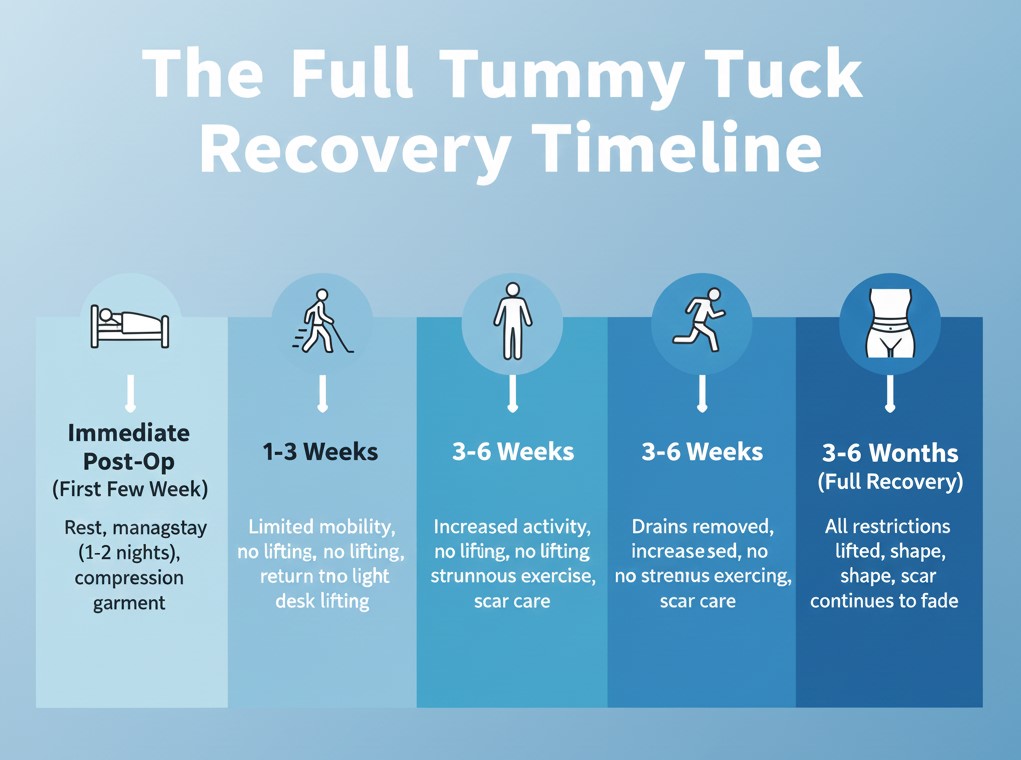
📅The Full Tummy Tuck Recovery Timeline
Recovery from a Full Tummy Tuck demands a significant commitment. You will experience soreness and tightness in the first few days. Initially, you will likely need to walk slightly hunched over to avoid tension on the incision. Doctors often prescribe pain medication and antibiotics to manage discomfort and prevent infection. Typically, surgeons place drains to collect excess fluid and remove them within a week. Furthermore, the first two weeks demand minimal activity and strict adherence to the surgeon’s instructions, including wearing a compression garment 24/7. Most patients return to light, desk-based work after 2–3 weeks. However, you must avoid strenuous exercise for at least 6 weeks. Complete recovery and scar maturation can take up to a year. Since the Full Tummy Tuck is more invasive, understanding the general principles of care for major surgeries proves highly beneficial. These are similar to procedures discussed in Choosing a Surgeon Clinic Abroad.
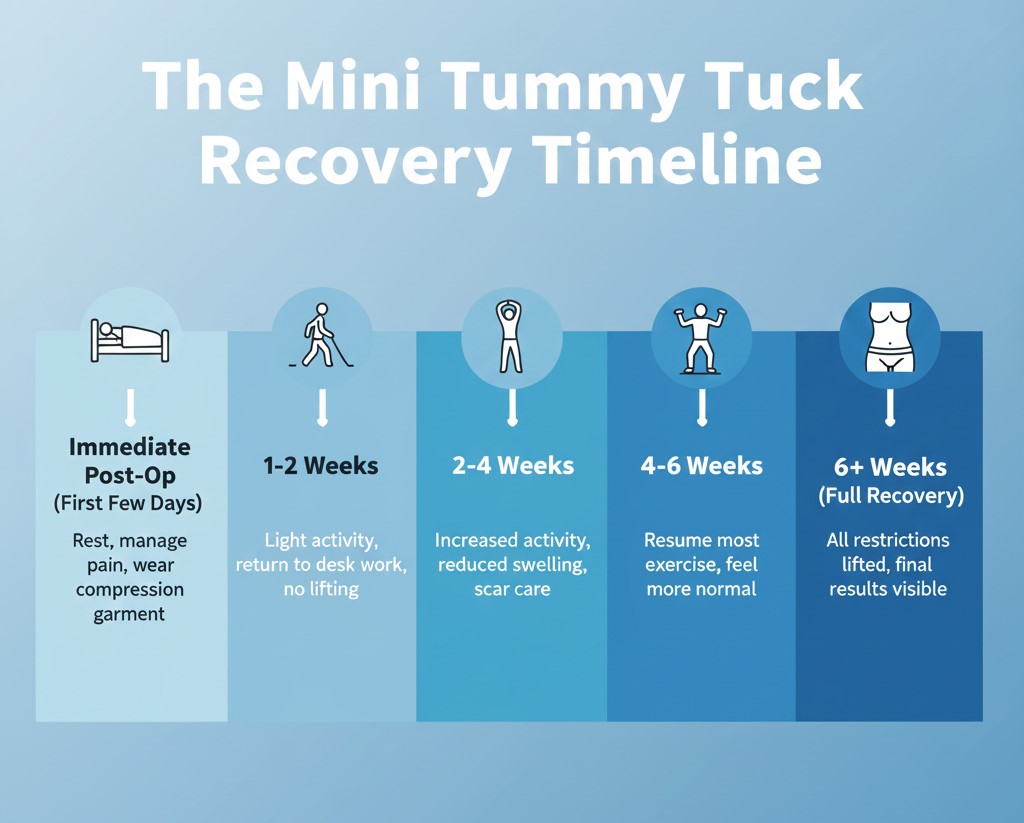
⏱️The Mini Tummy Tuck Recovery Timeline
The recovery process for the Mini Tummy Tuck vs. Full Tummy Tuck is remarkably faster and easier. Patients generally experience less pain and achieve a quicker return to normal posture. Drains are less common in the mini procedure, which simplifies post-operative care. Most patients feel well enough to return to work and light, non-strenuous activities within 7–10 days. Just like the full procedure, you must wear a compression garment to reduce swelling and support the area. However, the limitation on heavy lifting and strenuous exercise is shorter, typically about 4 weeks. Because the surgery is less extensive, the patient journey is often smoother, although vigilance is always required.
✨Longevity of Results
We consider both Mini Tummy Tuck vs. Full Tummy Tuck procedures permanent. This permanence requires the patient to maintain a stable weight and avoid future pregnancies. Significant weight fluctuations or future pregnancies can stretch the skin and muscles, which potentially compromises the surgical results. Therefore, patients must commit to a healthy lifestyle before and after the procedure. This dedication to maintenance is also crucial for the long-term success of other permanent aesthetic procedures, such as Rhinoplasty or a Brachioplasty (arm lift).
❓Frequently Asked Questions (FAQ)
Can a Mini Tummy Tuck fix mild diastasis recti?
A Mini Tummy Tuck can address very mild diastasis recti. However, it only corrects the muscle area directly below the belly button. If muscle separation extends significantly above the navel, you need a Full Tummy Tuck. This procedure achieves proper functional and aesthetic core correction. The mini procedure’s incision simply does not allow access to the upper abdominal muscles.
Is a Mini Tummy Tuck cheaper than a Full Tummy Tuck?
Generally, yes. The Mini Tummy Tuck is less expensive. It involves a shorter operating time, less extensive surgical work (no need for muscle plication in the upper abdomen), and often requires less anesthesia time. However, the final cost also depends on the geographical location and whether you combine it with liposuction.
Will a Mini Tummy Tuck remove my stretch marks?
A Mini Tummy Tuck will remove stretch marks located on the skin surgically excised. This area is primarily the skin between the short lower incision and the belly button. Therefore, stretch marks on the upper abdomen will remain after the procedure.
How long after giving birth can I have a Tummy Tuck?
Doctors generally recommend waiting at least 6 to 12 months after giving birth before undergoing a Tummy Tuck (Mini Tummy Tuck vs. Full Tummy Tuck). This waiting period allows your body weight and abdominal skin to fully stabilize. This maximizes the longevity and quality of the surgical results.
Does a Full Tummy Tuck hurt more than a Mini Tummy Tuck?
Yes, a Full Tummy Tuck typically causes more post-operative pain. This is primarily due to the extensive muscle repair, or plicating, of the abdominal muscles. This tightening creates significant soreness and tightness. The Mini Tummy Tuck, without this extensive muscle work, usually results in less severe pain.
Can I combine either Tummy Tuck with other surgeries?
Yes. Surgeons frequently combine both Mini Tummy Tuck vs. Full Tummy Tuck with other procedures in a “Mommy Makeover.” Examples include breast augmentation or a breast lift. This combination surgery saves on anesthesia and recovery time, although it does increase the total surgery time and initial recovery intensity.
What is the risk of skin necrosis in these procedures?
Skin necrosis (tissue death) is a rare but serious risk in both procedures. However, the risk is slightly higher in the Full Tummy Tuck due to the extensive undermining of the skin flap. Moreover, it is significantly higher in smokers. Therefore, surgeons universally require patients to stop smoking for several weeks before and after surgery. For more on surgical risks, consider reviewing resources like NIH’s information on plastic surgery risks.
How do I choose the right surgeon for my Tummy Tuck?
Always choose a board-certified plastic surgeon. They should have extensive experience performing the specific procedure you require. Look at their before-and-after photos, read patient reviews, and ensure they operate in accredited facilities. You can find further guidance in our Best Plastic Surgeon Dubai Guide, which outlines key vetting criteria.
Will either procedure help with my overall weight loss?
No. A Mini Tummy Tuck vs. Full Tummy Tuck is a body contouring procedure, not a weight loss solution. Surgeons usually recommend patients be at or near their ideal body weight before surgery. The removed skin and fat contribute only a marginal amount to total body weight. Patients requiring significant weight loss should explore other options, such as bariatric surgery.
What is a scar revision for a Tummy Tuck?
Scar revision is a minor follow-up procedure. Surgeons may perform it a year or more after the initial Tummy Tuck. It aims to improve the appearance of the scar, perhaps by thinning it out or making the line smoother. This is a common service offered for both the Mini Tummy Tuck and Full Tummy Tuck scars.
Does the procedure include a “vertical” muscle repair?
Yes, the “muscle repair” performed during a Full Tummy Tuck is technically a *vertical plication* (folding and suturing) of the rectus abdominis muscles. This addresses the vertical separation known as diastasis recti. This is the crucial step for flattening the core and represents a key difference between the Mini Tummy Tuck vs. Full Tummy Tuck.
What is a Fleur-de-Lis Abdominoplasty?
A Fleur-de-Lis Abdominoplasty is an even more extensive version of the Full Tummy Tuck. It includes the standard hip-to-hip incision plus a vertical incision running up the center of the abdomen. Surgeons reserve this for patients with massive weight loss who have both horizontal and vertical skin laxity (excess skin around the circumference). This procedure is for a higher degree of correction, not an alternative to the Mini Tummy Tuck vs. Full Tummy Tuck.
conclusiónFinal Thoughts: Making the Right Choice
The choice between a Mini Tummy Tuck vs. Full Tummy Tuck boils down to a single, critical factor: the extent of your abdominal wall concerns. If you have minimal issues—a small “pooch” below the navel and no muscle separation—the Mini Tummy Tuck provides a targeted correction with a quicker recovery. Conversely, if you have significant loose skin, fat, and, most importantly, muscle separation (diastasis recti) that affects the entire abdomen, the Full Tummy Tuck is the necessary and complete procedure. It offers the most dramatic and long-lasting results. Therefore, choosing the correct procedure is paramount to your satisfaction and safety.
Ultimately, a proper consultation is indispensable. A skilled, board-certified plastic surgeon will perform a physical examination. They assess the laxity of your skin and the degree of your muscle separation. They also discuss your body goals and medical history. This step is also crucial for complex procedures like Bone Marrow Transplant or Aortic Valve Repair. The surgeon recommends the safest and most effective option for you. Do not compromise on finding an expert who can guide you through the intricacies of the Mini Tummy Tuck vs. Full Tummy Tuck decision.
For those considering a Mini Tummy Tuck vs. Full Tummy Tuck abroad, WMedTour connects you with world-class specialists in top-rated international clinics. Contact us today for a personalized consultation and to explore your options.
📚Further Reading and Authoritative Sources