🛡️ Modern Hair Transplant Guide 2026: The Ultimate Path to Restoration
📋 Executive Summary
The landscape of hair restoration has shifted dramatically as we enter 2026. This guide provides a deep dive into the most effective surgical and non-surgical interventions. Key takeaways include:
- AI-Driven Precision: Robotic assistance now ensures 99% graft survival rates.
- Minimal Downtime: Modern DHI techniques allow patients to return to work in 48 hours.
- Global Accessibility: High-quality care is now affordable through strategic medical tourism.
- Hybrid Approaches: Combining PRP therapy with FUE is the new gold standard for density.
Welcome to the most comprehensive resource for hair restoration in 2026. If you are reading this, you are likely looking for more than just a quick fix. You want a permanent solution that looks natural and feels like you. At WMedTour, we understand that hair loss impacts your confidence and professional presence. Consequently, we have compiled the latest data, clinical insights, and patient experiences to help you navigate this life-changing journey.
👨⚕️ Who is This For?
This modern hair transplant guide is specifically designed for a wide range of individuals. Whether you are a young professional experiencing early thinning or a veteran looking to reclaim your hairline, the technology of 2026 has something for you.
Target Profiles
- Early-Stage Thinner: Individuals noticing a receding hairline or thinning crown who want to prevent further loss.
- Advanced Loss Patients: Those requiring large-scale graft counts (4,000+) who need high-efficiency techniques.
- Corrective Surgery Seekers: Patients who had subpar results in the past and require modern revision.
- Busy Professionals: People who need rapid recovery times and discreet procedures.
The choice to undergo a procedure is personal. However, the availability of advanced skin and hair treatments makes this the best time in history to act. If you have been waiting for the “perfect” technology, 2026 marks that milestone.
🚀 The Evolution of Techniques in 2026
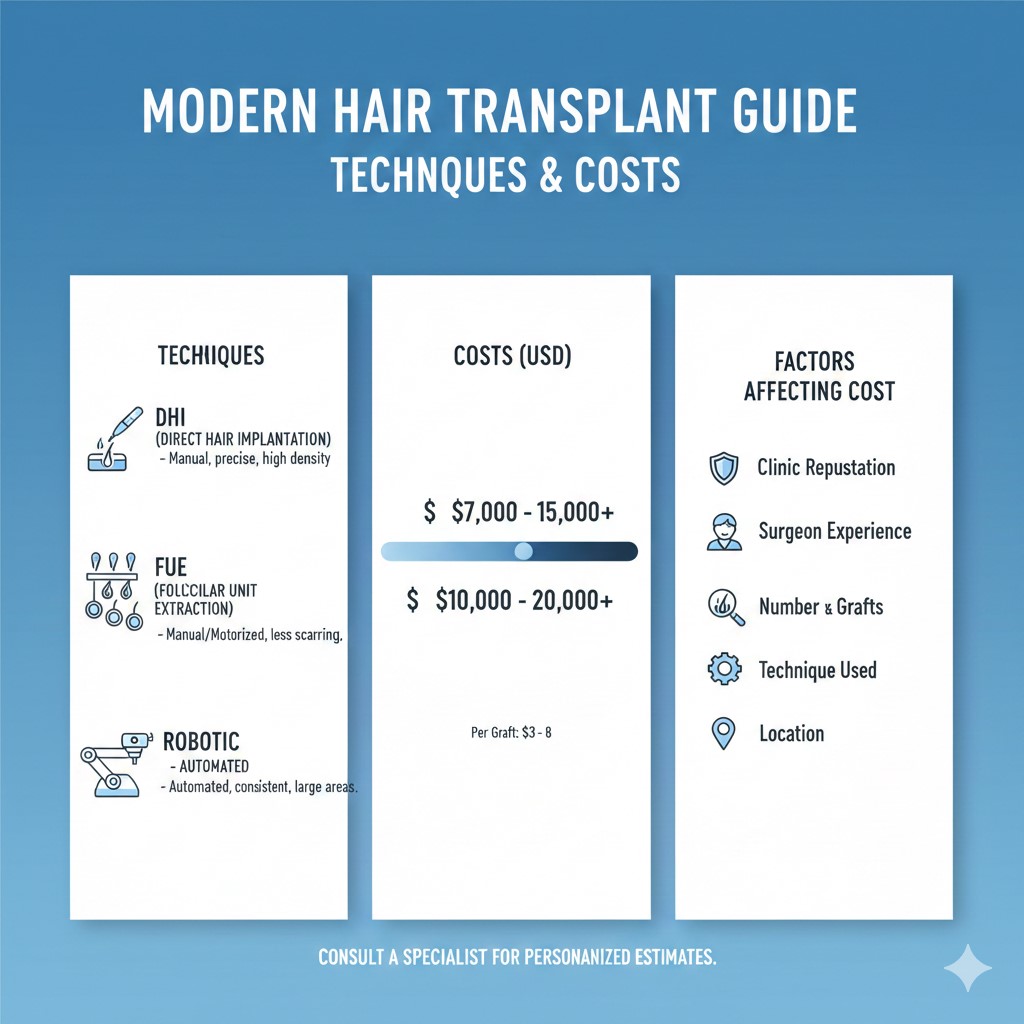
In 2026, we no longer talk about “strips” of skin. Instead, we focus on micro-precision and cellular health. The primary methods used today are FUE (Follicular Unit Extraction) and DHI (Direct Hair Implantation), but with a futuristic twist.
1. Robotic FUE with AI Integration
Follicular Unit Extraction has evolved. Modern systems now use artificial intelligence to scan the donor area and select only the healthiest, most robust follicles. This reduces donor site trauma significantly. Furthermore, the precision of robotic arms ensures that the angle of the graft matches your natural growth pattern perfectly.
Pros:
- Virtually no visible scarring in the donor area.
- Maximum graft survival rate due to minimal handling.
- Customizable density based on AI scalp mapping.
Cons:
- Typically higher cost than manual FUE.
- Requires a completely shaven donor area in most cases.
2. Nano-DHI (Direct Hair Implantation)
DHI has become the preferred choice for those seeking high density without shaving their entire head. By using a specialized “Choi Implanter Pen,” the surgeon can place follicles directly into the recipient area. In 2026, “Nano-DHI” uses even smaller needles, meaning inflammation is almost non-existent. This is often paired with PRP therapy to accelerate healing.
Pros:
- No-shave options are widely available.
- Extremely natural-looking hairline design.
- Fastest recovery time among all surgical options.
Cons:
- Procedure takes longer than standard FUE.
- Limited to a certain number of grafts per session.
📊 Comparison of Top 2026 Methods
| Feature | Robotic FUE | Nano-DHI | Stem Cell Hybrid |
|---|---|---|---|
| Best For | Large areas | Hairline precision | Thinning hair |
| Recovery | 5-7 Days | 2-3 Days | 1-2 Days |
| Scarring | None (Micro-dots) | Zero visible | None |
| Shaving Required | Yes (Donor) | No (Optional) | No |
🗺️ The Patient Roadmap: From Consultation to Full Growth
Embarking on a hair transplant is a journey of patience. We have outlined a standard 12-month roadmap based on 2026 clinical standards from reputable institutions like Harvard Medical School.
Phase 1: Discovery and Planning
Everything starts with a telemedicine consultation. You will provide photos, discuss your medical history, and set realistic goals. During this time, your surgeon will determine if you are a candidate for surgery or if non-surgical options are better suited.
Phase 2: The Procedure Day
On the day of the procedure, you will arrive at the clinic. Modern clinics now offer “entertainment suites” where you can watch movies or work while the grafts are being extracted. Local anesthesia is administered, ensuring a painless experience. The process can take anywhere from 4 to 8 hours depending on the graft count.
Phase 3: The “Ugly Duckling” Stage (Weeks 2-8)
This is the hardest part for most patients. The transplanted hairs will fall out. Do not panic! This is a natural part of the cycle. The follicles are safe beneath the skin; only the shafts are shedding. During this phase, it is crucial to follow the post-operative care instructions carefully.
Phase 4: The Transformation (Months 6-12)
By month six, you will see noticeable growth. By month twelve, your new hair will be fully matured. You can cut, style, and dye it just like your original hair. For many, this is the moment where they finally feel like themselves again.
🌟 Case Study: Mark’s 2026 Hair Journey
Let’s look at Mark, a 34-year-old software engineer from the UK. Mark had been losing hair for five years and felt his appearance didn’t match his energetic personality. He decided to explore options through medical tourism in Iran, a leading hub for hair restoration.
The Plan: Mark received 3,500 grafts via Nano-DHI. He chose a package that included luxury accommodation and local transport.
The Result: Six months later, Mark’s hairline was restored. He noted, “The best part wasn’t just the hair; it was the seamless process. I felt like a VIP from the moment I landed until I flew back.” This hypothetical journey reflects the real-world experiences of thousands who choose global destinations for their care.
💰 2026 Cost Analysis Table: A Global Comparison
One of the biggest factors in modern hair transplants is cost. While quality is paramount, the price variation between countries is significant. Below is a breakdown of estimated costs for a standard 3,000-graft procedure in 2026.
| Destination | Est. Cost (USD) | Includes |
|---|---|---|
| USA / UK | $12,000 – $20,000 | Surgery only |
| Iran | $1,500 – $2,300 | VIP Package & Hotel |
| India | $2,000 – $4,000 | Treatment & Support |
| Turkey | $2,500 – $5,000 | Full Concierge |
🏖️ Recovery & Medical Tourism: The “Vacation” Strategy
In 2026, the concept of a “Hair-cation” is trending. Instead of hiding at home during the initial healing phase, patients are choosing to recover in beautiful locations. For instance, many patients visiting Oman or Iran spend their first few days enjoying low-intensity sightseeing.
However, you must be careful. Sunlight and swimming are strictly forbidden for the first two weeks. Therefore, a recovery-focused itinerary usually involves visiting museums, enjoying gourmet dining, and relaxing in high-end hotels. This approach reduces the stress of the procedure and turns a medical necessity into a pleasant memory.
If you require specialized transport during your trip, services like air ambulances are available for high-need patients, though rarely required for hair transplants.
❓ Frequently Asked Questions (FAQ)
1. Is the procedure painful in 2026?
No. With advanced local anesthetics and needle-free injection systems, most patients feel nothing after the initial numbing. You can even sleep through the process.
2. How long do I need to stay off work?
For Nano-DHI, most people return to office work in 2 to 3 days. For robotic FUE, a week is recommended to allow the donor area to heal fully.
3. Will my hair look “pluggy” or unnatural?
Absolutely not. 2026 technology focuses on “irregular hairline design” which mimics the natural chaos of a real hairline. The days of doll-like hair are long gone.
4. Can women get hair transplants too?
Yes. Female hair restoration is a rapidly growing field. Women often benefit from DHI since it doesn’t require shaving the entire head.
5. What is the success rate of grafts in 2026?
In top-tier clinics, graft survival rates now exceed 95-98% thanks to specialized storage solutions and AI-guided extraction.
6. Are there any long-term side effects?
When performed by a qualified certified doctor, long-term risks are negligible. Minor temporary swelling or itching is common in the first week.
7. Can I use body hair for my transplant?
Yes, BHT (Body Hair Transplant) is a viable option for those with limited scalp donor sites, often using chest or beard hair.
8. Do I need to take medication after the surgery?
Most surgeons recommend continuing Finasteride or Minoxidil to prevent the loss of your *original* (non-transplanted) hair.
9. How do I choose the best clinic abroad?
Look for international certifications (like ISHRS) and check their doctor profiles for extensive case galleries.
10. Does insurance cover hair transplants?
Generally, no, as it is considered a cosmetic procedure. This is why many seek more affordable options through medical tourism.
11. What is the “Stem Cell Hybrid” method?
It involves injecting stem cells derived from your own fat or hair follicles to boost the thickness of the transplanted area.
12. When can I exercise again?
Light walking is fine after 3 days. However, heavy weightlifting and intense cardio should wait for at least 14 to 21 days.
Medical Disclaimer: The information provided in this Modern Hair Transplant Guide 2026 is for educational purposes only. It is not intended as a substitute for professional medical advice, diagnosis, or treatment. Always seek the advice of your physician or another qualified health provider with any questions you may have regarding a medical condition. Never disregard professional medical advice or delay in seeking it because of something you have read in this article. If you have a medical emergency, call your doctor or emergency services immediately. For a personalized assessment, please book a consultation with our team.
✨ Final Thoughts
The Modern Hair Transplant Guide 2026 highlights that we are in a golden age of restoration. You no longer have to settle for thinning hair. With the right technique, a skilled surgeon, and a well-planned roadmap, you can achieve a look that transforms your life. Whether you stay local or explore the world of medical tourism, the key is to take the first step. Visit our departments page to see how we can assist you today.