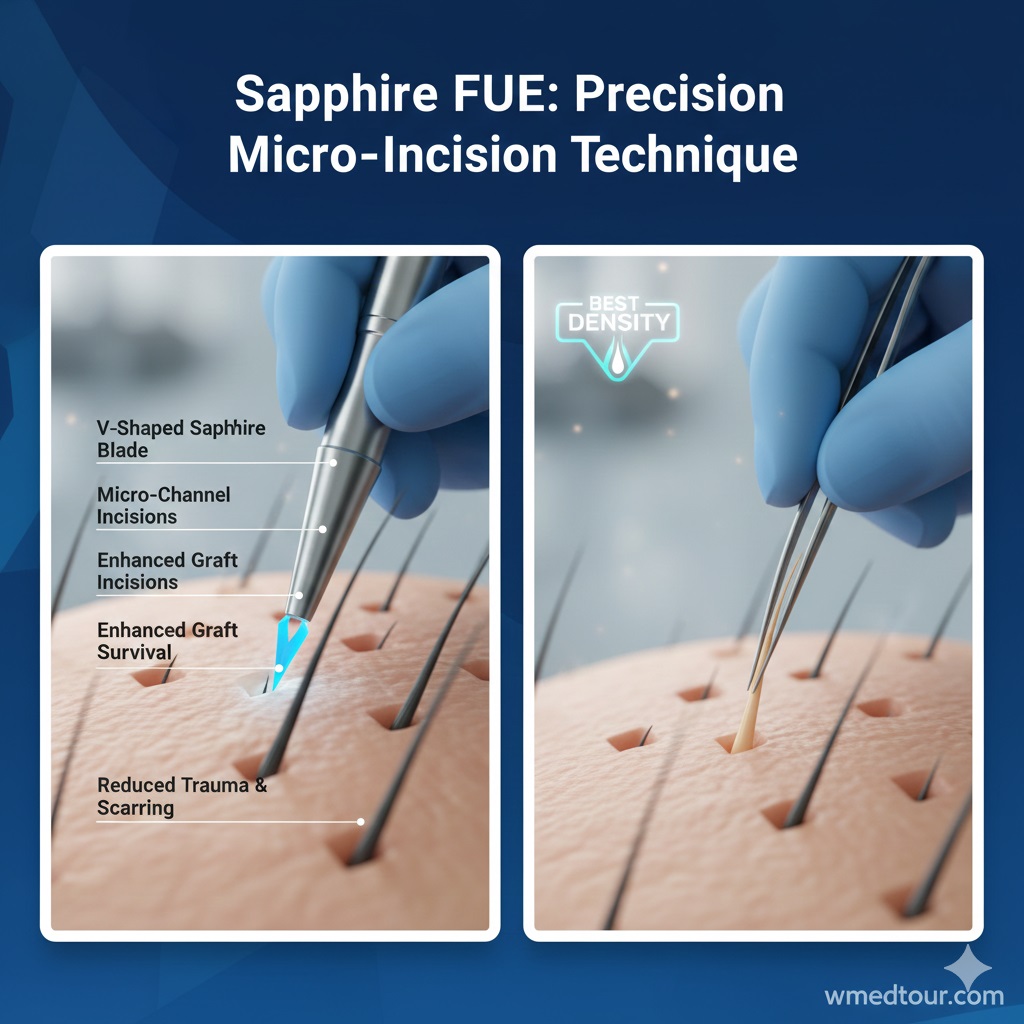
💎 Sapphire FUE or DHI? Which one is better for you? The Ultimate Guide to Choosing Your Hair Transplant Technique 🎯
Executive Summary 💡
Choosing the right hair transplant technique—either the advanced Sapphire FUE or the innovative Direct Hair Implantation (DHI)—is the most critical decision in your restoration journey. Both are modern variations of Follicular Unit Extraction (FUE). However, their methodologies, recovery profiles, and ideal applications differ significantly. Therefore, understanding these nuances is essential for achieving optimal, natural-looking results.
In short, Sapphire FUE excels at creating high-density coverage and defining the hairline on larger transplant areas. This is because it uses precise sapphire blades to create uniform recipient channels. Conversely, DHI offers unmatched graft survival and control over direction and angle. This makes it the preferred choice for smaller, sensitive areas, such as beard or eyebrow restoration. It also maximizes density without requiring you to shave the entire head. Consequently, the question isn’t whether Sapphire FUE or DHI is universally better. It’s which one is better for your specific pattern of hair loss, hair texture, and aesthetic goals. This detailed guide, built for both patients and industry professionals, thoroughly compares these two leading techniques. It helps you confidently answer: Sapphire FUE or DHI? Which one is better for you?
🌱 The FUE Foundation: Understanding Hair Transplant Evolution
Before diving into the specifics of Sapphire FUE or DHI, we must recognize that both techniques evolve from the Follicular Unit Extraction (FUE) method. Traditional FUE involves three primary steps: 1) Extracting follicular units using micro-punches, 2) Creating incisions (channels) in the recipient area, and 3) Implanting the grafts into those channels.
The FUE Revolution and Core Differences 🔄
The FUE technique marked a massive leap forward from the older Follicular Unit Transplantation (FUT) strip method. It eliminated the need for a linear scar, leading to quicker recovery and less noticeable scarring. Now, the distinction among FUE techniques hinges entirely on the tools and methods used during the crucial Incision and Implantation steps.
Typically, the extraction process remains similar, usually involving micro-motors with punches measuring 0.6mm to 1.0mm. However, the true innovation lies in how the grafts are prepared and inserted. For a comprehensive look at the foundation, you might find our guide on FUT vs. FUE vs. DHI success rates very useful. Consequently, understanding the difference in tools is essential for making the right choice between Sapphire FUE or DHI.
💎 Detailed Breakdown of Sapphire FUE
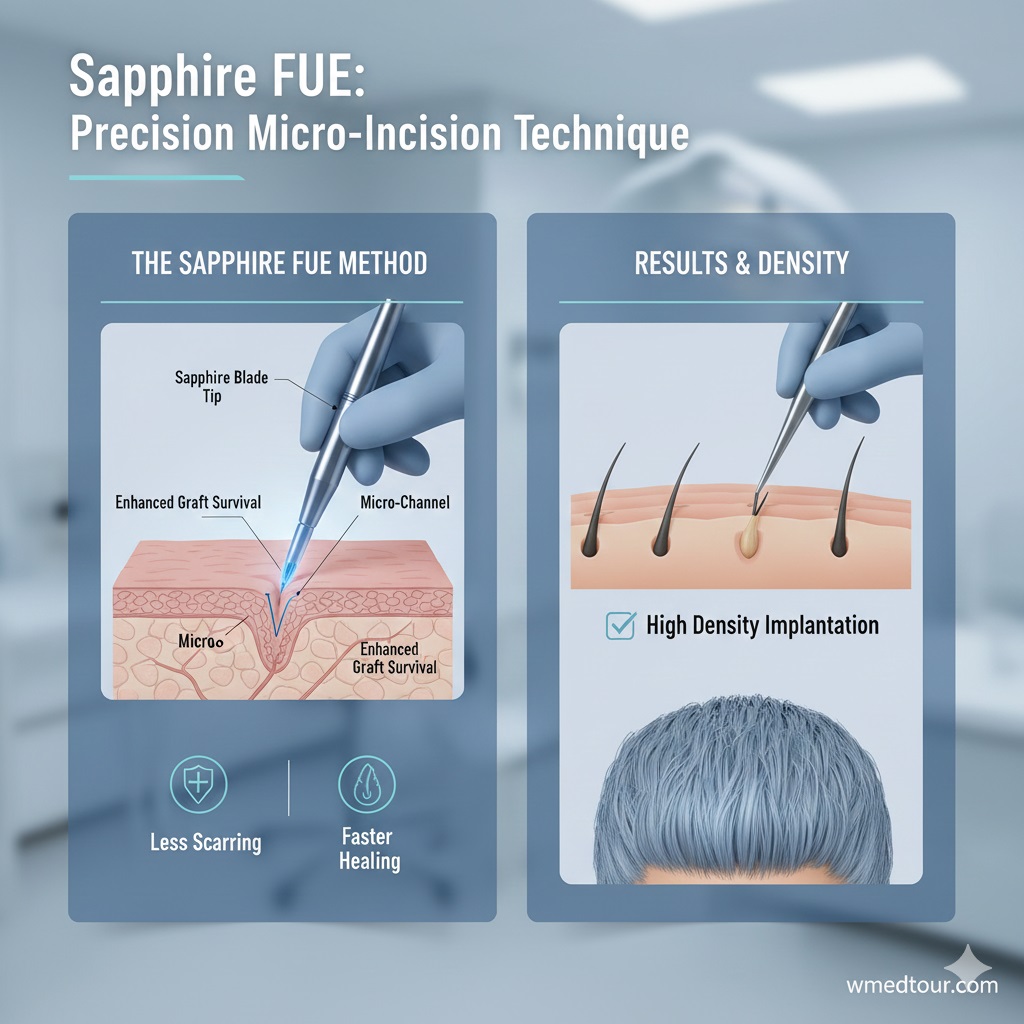
Sapphire FUE is essentially an advanced FUE technique. In this method, the traditional V-shaped metal slit blades used to create the recipient channels are replaced with blades crafted from the precious stone, sapphire. This material innovation is not merely a marketing gimmick; it provides several crucial clinical advantages.
How Sapphire FUE Elevates Incision Quality 🛠️
After extracting the grafts, the surgeon uses extremely sharp, smooth sapphire blades to create micro-incisions in the recipient area. This is the defining factor of Sapphire FUE. These blades allow for:
Precision Micro-channels and Tissue Trauma
The sharpness and smooth surface of sapphire significantly minimize tissue trauma compared to traditional steel slits. Consequently, this leads to faster healing of the recipient site. Furthermore, the specialized sapphire blades reduce the risk of lateral tissue damage and scarring.
Achieving Higher Density Coverage
Since the channels created are smaller and more uniform, the surgeon can safely place grafts closer together. This achieves a high-density look, which is often crucial for blending the hairline naturally. Sapphire blades minimize damage to the existing blood supply, supporting this high density.
Reduced Scarring and Faster Recovery
The V-shaped cuts made by the sapphire tips are minimal. This contributes to better post-operative recovery and less noticeable scarring in the recipient area. Therefore, patients often experience less swelling than with older techniques.
Since the surgeon opens the channels before implantation, the placement process involves using fine forceps to insert the graft into the ready channel. This procedural separation helps maintain speed.
Pros and Cons of Sapphire FUE ➕➖
| Pros of Sapphire FUE | Cons of Sapphire FUE |
|---|---|
| Higher Density: It is excellent for packing many grafts into a large area (e.g., hairline and crown). | Less Control over Angle/Direction: It requires exceptional skill from the surgeon for graft angle, because the channel direction is fixed once the surgeon cuts it. |
| Faster Procedure: The grafts can be implanted quickly once the channels are opened. Consequently, this reduces overall surgery time. | Graft Handling: Grafts spend a longer time outside the body compared to DHI. This increases the time they are exposed to the environment. |
| Minimised Trauma: Sharp sapphire tips reduce lateral damage to surrounding tissue and blood vessels. | Full Shave Usually Required: Surgeons typically require a full shave of the recipient area for clear channel opening and precise placement. |
| Ideal for Large Areas: This is the best method for transplanting 3000+ grafts in a single session. | Risk of Popping: The fixed channel size can sometimes lead to grafts “popping” out if the surgeon does not implant them perfectly. |
In the context of international hair restoration, Sapphire FUE is often the workhorse technique utilized by high-volume clinics. These include medical tourism destinations like Iran and Turkey. They offer excellent results at a more accessible cost. For those exploring options, understanding the entire journey, including recovery, is key—our guide on hair transplant recovery timeline provides crucial information. We also offer more resources on this technique through our dedicated hair transplant procedures page.
📌 Detailed Breakdown of Direct Hair Implantation (DHI)
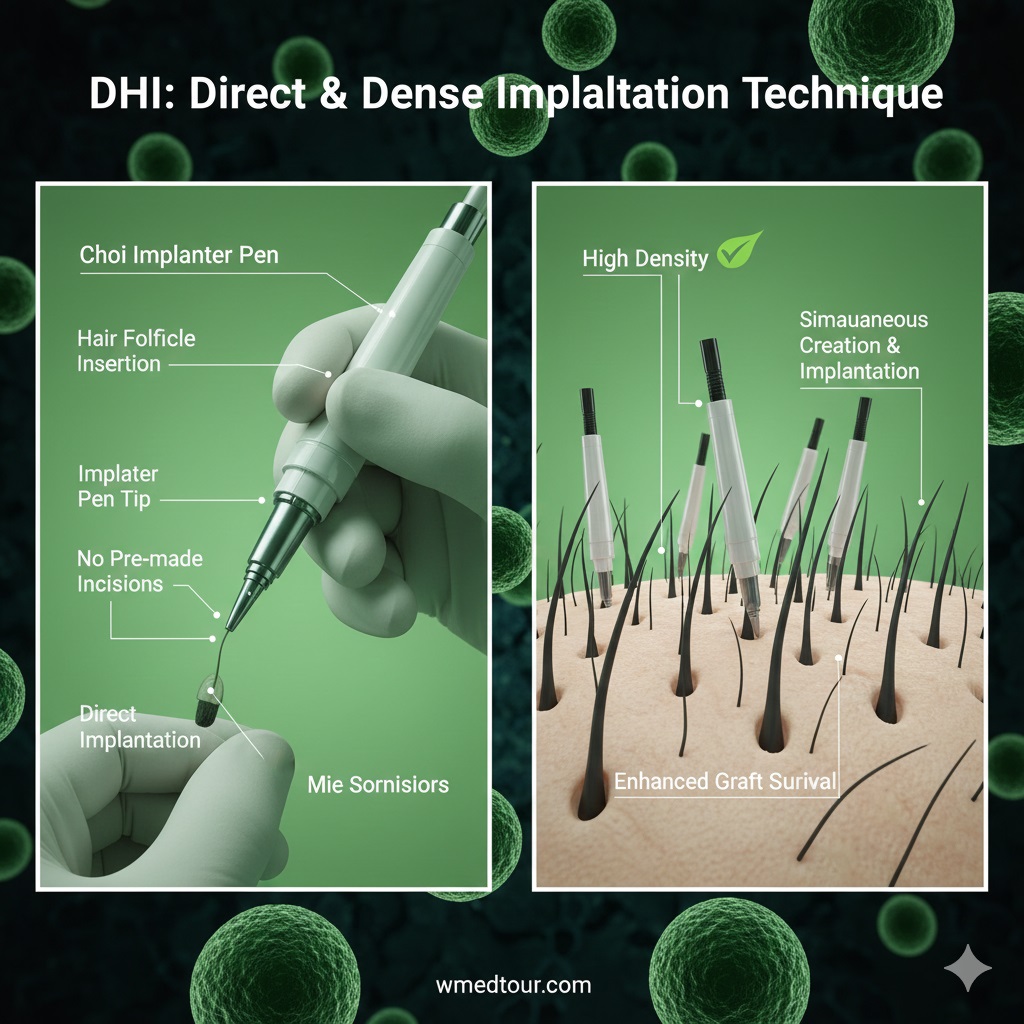
Direct Hair Implantation, or DHI, represents a highly refined version of FUE. It integrates the channel creation and graft implantation into a single step using a specialized tool called the Choi Implanter Pen. This procedural difference truly sets it apart when comparing Sapphire FUE or DHI.
How DHI Offers Integrated Implantation 🖊️
The DHI method eliminates the need for manual, pre-cut recipient channels. Instead, the team loads the grafts one by one into the Choi Implanter Pen. This is often a refined, thin-tipped pen. The surgeon then directly pushes the pen into the recipient skin. The sharp tip of the pen creates the channel and simultaneously implants the graft.
Minimal Out-of-Body Time for Grafts
This immediate implantation drastically reduces the time the delicate follicular unit spends outside the nourishing environment of the body. Theorists suggest this boosts graft survival rates significantly. This is a critical factor for patients concerned about graft yield.
Maximum Control and Aesthetic Precision
The surgeon gains complete, three-dimensional control over the angle (depth), direction, and density of each individual follicle as it is implanted. Consequently, this is crucial for achieving a maximally natural look, especially when weaving new hair between existing strands. It is paramount for intricate work.
Non-Shave Option and Reduced Downtime
In many cases, the team can perform DHI without shaving the recipient area entirely. This offers a major advantage for patients with longer hair who wish to minimize cosmetic downtime. Furthermore, it allows for greater discretion during recovery.
It is important to note that DHI requires specialized training. Also, it is significantly more labor-intensive, often involving a larger team to load the numerous Choi pens used during the procedure.
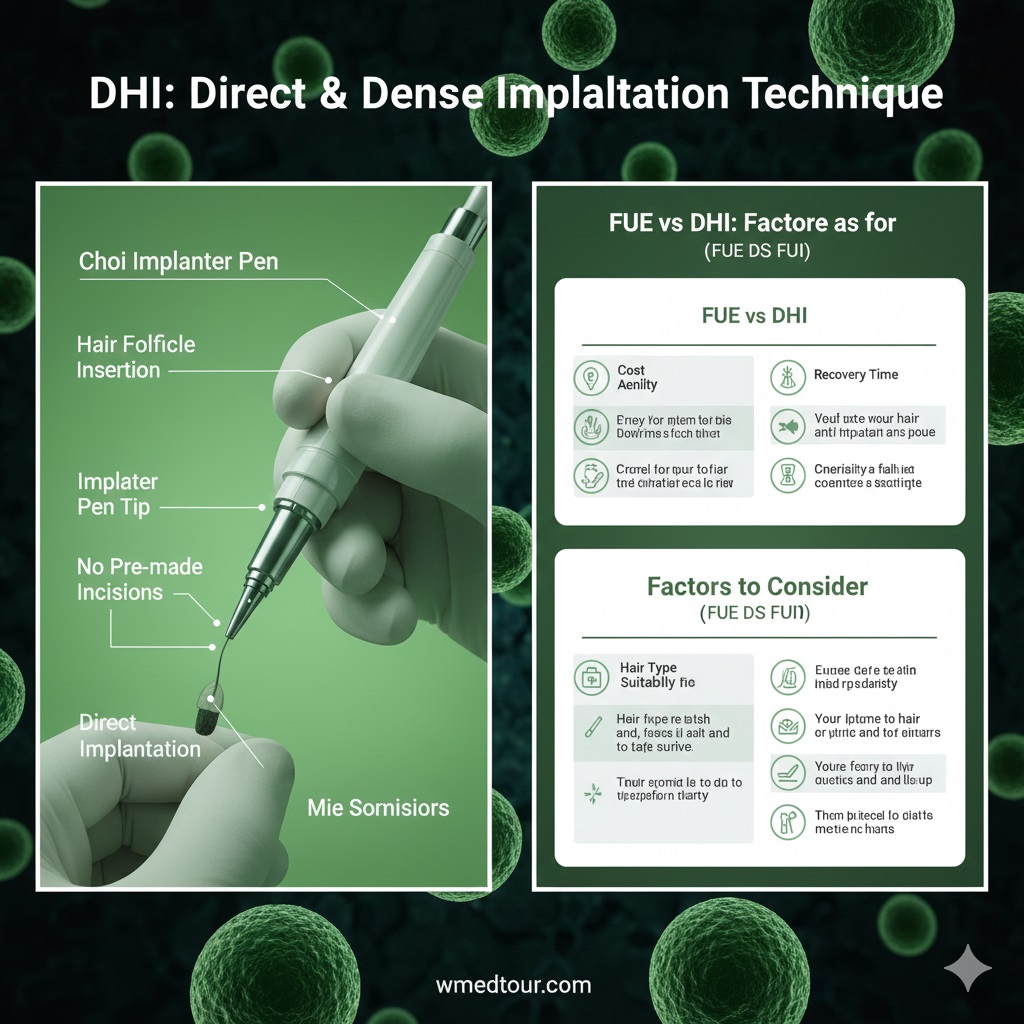
Pros and Cons of DHI ➕➖
| Pros of DHI | Cons of DHI |
|---|---|
| Maximized Graft Survival: Reduced out-of-body time and handling minimize trauma. This potentially leads to a higher yield. | Slower and Costlier: The single-step nature is labor-intensive. This often increases the duration and overall cost of the procedure. |
| Precision in Angle and Direction: It offers unmatched control for natural blending. This is especially crucial for cowlicks or weaving between existing hair. | Surgeon Fatigue: The complex, repetitive nature requires high focus and stamina from the surgeon and the team. This can limit the number of grafts that can be safely transplanted in one session (typically max 2500-3000). |
| Reduced Bleeding and Trauma: The small, precise punches reduce bleeding. They also minimize trauma to the recipient area. | Graft Crushing Risk: If the technician loading the pen is inexperienced, they might damage the follicular unit. |
| No Full Shave Option: This is ideal for patients who want minimal visibility of the procedure (Non-Shave DHI). | Technique Sensitivity: Success relies heavily on the skill and experience of the medical team. This makes clinic selection paramount. |
DHI is a specialty technique. When considering centers abroad, you must verify the surgeon’s experience specifically with the Choi pen. Many clinics in countries like Iran and Turkey now offer DHI, capitalizing on its reputation for high quality and excellent directional control. For more on choosing a reputable clinic, see our guidance on choosing a surgeon and clinic abroad.
⚖️ Sapphire FUE or DHI: The Direct Comparison
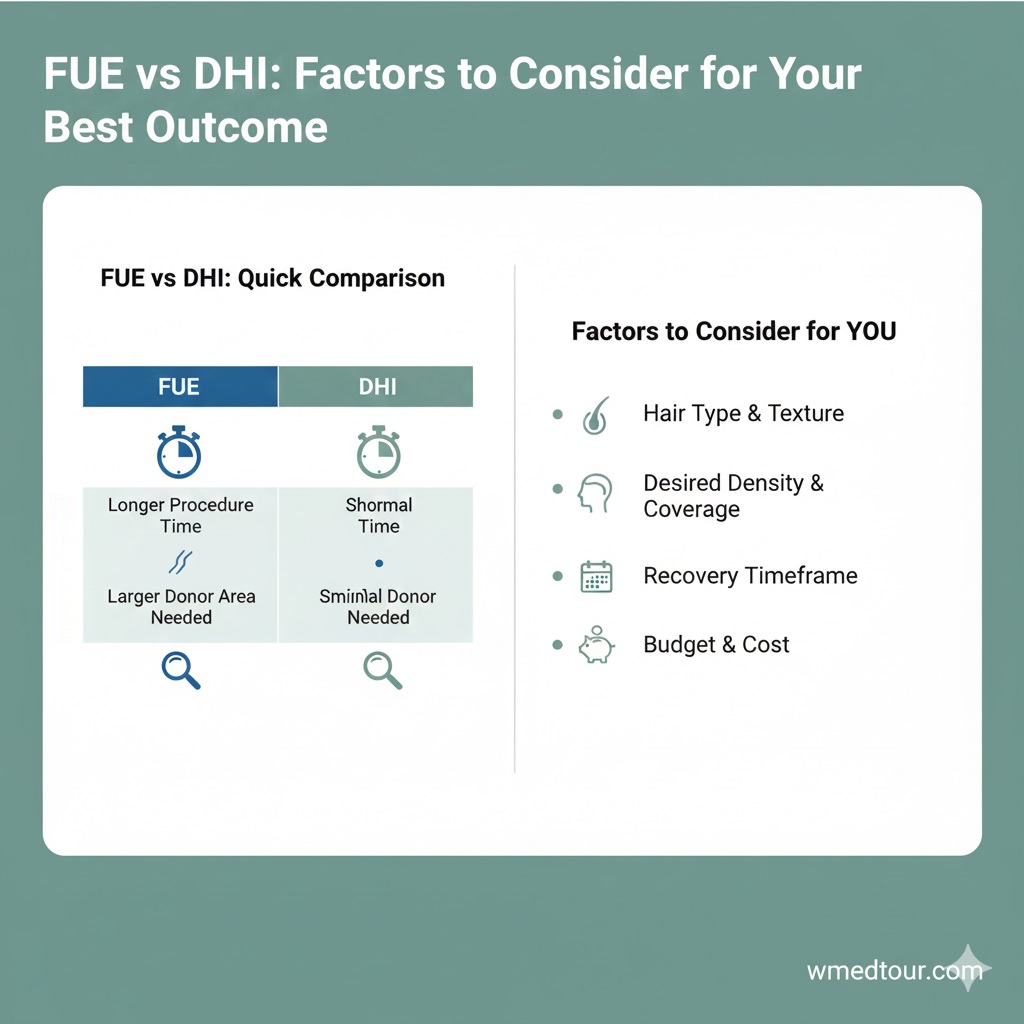
The choice between Sapphire FUE or DHI often comes down to four primary factors: density, area size, cost, and the specific expertise of the surgical team. Here is a direct comparison to help clarify which technique aligns better with different patient profiles.
In-Depth Look at Key Differences
Procedural Steps and Graft Handling
When you compare the two, the method of creating the recipient site is the defining difference. In Sapphire FUE, the site is created first, and then the surgeon places the graft. This is a two-step process. Conversely, in DHI, the Choi Implanter Pen handles both steps simultaneously. Consequently, DHI reduces the time the graft is outside the body. It also maximizes the surgeon’s control over the angle of each individual follicle.
Density and Coverage Efficiency
Because Sapphire FUE creates a fixed channel, it allows for faster implantation once the channels are prepared. This makes it highly efficient for covering large areas. Furthermore, the sapphire blade’s ability to create precise, tiny channels allows for a slightly higher overall density in certain patterns of hair loss than the slightly larger diameter of the Choi pen tips can safely achieve.
Expert Insight: A 2021 study published in the Journal of Cosmetic Dermatology (Nofollow Link) highlighted that DHI shows marginal superiority in graft survival rates due to reduced handling time. However, the aesthetic result for large-area coverage is often dictated more by the surgeon’s skill in channel creation (Sapphire FUE) than the tool used for implantation. Therefore, skill is always more important than the instrument itself.
The Comparison Table
| Feature | Sapphire FUE | DHI (Direct Hair Implantation) |
|---|---|---|
| Recipient Site Tool | Sapphire Blades (V-shaped) | Choi Implanter Pen (Hollow Needle) |
| Procedure Steps | 2 Steps: Channels created, then Grafts implanted. | 1 Step: Channel created & Graft implanted simultaneously. |
| Ideal Coverage Area | Large areas (3000+ grafts), extensive thinning. | Small to Medium areas (up to 2500 grafts), sensitive areas. |
| Graft Survival Potential | Very High. | Potentially Highest (due to minimal out-of-body time). |
| Density Capability | High, excellent for hairline definition. | Excellent, especially when weaving between existing hair. |
| Cost (Rel. to FUE) | Moderate to High. | Typically Higher (due to complexity and labor). |
The choice between Sapphire FUE or DHI should always reflect a blend of clinical needs and personal priorities.
🌍 Global Perspective: Hair Transplant Excellence in Iran and Turkey
When discussing advanced techniques like Sapphire FUE or DHI, global medical tourism destinations play a pivotal role. They offer accessibility and affordability that is often unmatched elsewhere. Both Iran and Turkey have emerged as world leaders in hair restoration. They offer highly skilled surgeons, cutting-edge technology, and costs that are significantly lower than in Western countries.
Iran’s Specialization in High-Density FUE Techniques 🇮🇷
Iran, in particular, offers a high standard of medical care coupled with impressive affordability. Consequently, many reputable Iranian clinics are adopting the latest Sapphire FUE techniques for complex cases involving significant baldness or high-density requirements. Iranian surgeons often excel in creating natural, dense hairlines, leveraging the precision of the sapphire blade.
Quality and Accessibility of Iranian Hair Restoration
The strong focus on high-volume, quality care ensures that patients receive the benefits of the latest protocols, often at a fraction of the price found in Europe. Furthermore, for more on the specifics of medical travel to this region, you can consult our detailed guides on medical tourism in Iran or FUE hair transplant cost in Iran. The medical infrastructure in Iran supports these advanced procedures very well.
Turkey’s Versatility and Innovation
Turkey has long been recognized as a hair transplant powerhouse. It offers both Sapphire FUE and DHI widely. Many clinics in cities like Istanbul have perfected the DHI technique, making it a standard offering for patients seeking minimal-shave options or requiring extremely precise graft placement. This includes specialized procedures like eyebrow or beard transplants. Therefore, patients have the flexibility to choose between Sapphire FUE or DHI based on their surgeon’s recommendation and personal preference for recovery and cost. For those considering this destination, a thorough check of the best clinics is advised; see our guide on best hair transplant clinics in Turkey. You can also review our general guide on medical tourism in Turkey for more context.
Navigating International Hair Transplant Options
Navigating the global landscape of hair restoration requires knowledge of local regulations and the quality of care. For travelers, information on visas and general guidance is paramount—check out our medical visa handbook. Similarly, always ensure your choice of country is guided by quality, not just cost.
🧑 Who is This For? Choosing Your Best Fit
The primary question remains: Sapphire FUE or DHI? Which one is better for you? The answer depends entirely on your specific aesthetic goals, the degree of your hair loss, and the nature of your donor area. Consequently, a personalized assessment is non-negotiable.
Choose Sapphire FUE If… (Large Areas & Density) 📈
Extensive Hair Loss and Coverage
- You have extensive hair loss (Norwood Scale 4 or higher): If you need over 3000 grafts to cover a large bald or thinning area, Sapphire FUE is often the most efficient technique.
- You prioritize high-density coverage: The precise channels created by the sapphire blades allow the surgeon to safely pack more grafts per square centimeter.
Shaving and Cost Factors
- You are comfortable with a full head shave: Sapphire FUE procedures typically require shaving the recipient area for optimal visibility and channel creation.
- You are budget-conscious: In many clinics, Sapphire FUE, while advanced, is slightly less expensive than the more labor-intensive DHI. For further details on cost, you might check our hair transplant cost Turkey guide.
Choose DHI If… (Precision, Minimal Shave & Sensitive Areas) 🖋️
Need for Precision and Discreetness
- You have early-stage hair loss or want maximum density between existing hairs: The DHI pen minimizes damage to existing hair follicles, making it ideal for densification.
- You require exceptional control over the graft angle: This is crucial for creating natural-looking hairlines, sideburns, beards, or eyebrows. We also recommend reading about eyebrow transplants as DHI is often used here.
Graft Survival and Donor Considerations
- You want a non-shave or partial-shave procedure: DHI is the best option for patients who want to minimize visibility of the procedure (Non-Shave DHI).
- You have fragile grafts or a limited donor area: The minimal handling and reduced out-of-body time of DHI may theoretically lead to superior graft survival rates. For information on calculating graft needs, see our graft calculator and cost guide.
🩹 Recovery and Long-Term Results: Sapphire FUE vs. DHI
Beyond the procedure itself, the recovery period and the quality of the final outcome are paramount. Furthermore, while both techniques offer permanent results, the immediate post-operative experience differs slightly.
Post-Operative Recovery Comparison 🕒
The recovery period is generally similar for both, usually spanning 7 to 10 days until the scabs fall off. However, DHI often presents a slightly smoother immediate post-op period in the recipient area.
Healing with Sapphire FUE
Because surgeons open the channels beforehand in Sapphire FUE, the recipient area can sometimes show more swelling and scabbing. Nonetheless, the use of sapphire blades significantly mitigates this compared to older steel blades. It’s important to prepare for temporary swelling.
Healing with DHI
The implanter pen creates a smaller, more circular wound in DHI. This often leads to less visible scabbing and a quicker resolution of swelling. Since the recipient area often doesn’t need to be shaved, the procedure is easier to conceal.
Long-Term Aesthetic Quality 🖼️
In the hands of an equally skilled and experienced surgeon, both techniques can yield phenomenal, indistinguishable results. Therefore, the key aesthetic difference lies in the directional control achieved during implantation.
Aesthetic Outcome of Sapphire FUE
- Sapphire FUE: This method is excellent for overall density and razor-sharp, well-defined hairlines. The success relies entirely on the initial, perfect angling of the sapphire channels.
Aesthetic Outcome of DHI
- DHI: Surgeons often prefer this technique for intricate work. This includes creating a complex whorl pattern in the crown or achieving a subtle, layered effect in the hairline. The independent control over each graft placement provides a significant artistic advantage.
For patients who need to understand the full commitment, our guide on hair maintenance after transplant is highly relevant. Similarly, you can check our Skin and Hair Department for other related services.
📈 Case Study: David’s Decision Between Sapphire FUE or DHI
Understanding the technical differences is one thing. Seeing how they apply to a real-life scenario is another. Let’s consider David’s hair restoration journey.
The Patient Profile and Goals 👤
David, a 35-year-old marketing executive, faced significant hair loss, classifying as a Norwood Scale 5. His primary goal was to restore a solid hairline and cover the crown. He needed an estimated 4,500 grafts. He had a strong donor area and was prepared to shave his head, but his main priority was achieving the highest possible density in the frontal area.
The Consultation and Strategic Choice 🤔
David consulted with a leading surgeon in Iran, a destination known for expertise in large-volume FUE procedures. Consequently, the surgeon recommended Sapphire FUE for several compelling reasons:
The Role of Graft Volume
Sapphire FUE is far more efficient for transplanting 4,500 grafts in a single, safe session compared to the DHI pen method. The lower labor required for channel creation allows for this high-volume capacity.
Density and Coverage Requirements
The precision of the sapphire blades would allow for the necessary high packing density in the hairline, meeting David’s primary aesthetic goal. Furthermore, the two-step process is faster and more manageable for such a large recipient area covering the frontal region and the crown.
The Outcome 🎉
David underwent a successful 4,500-graft Sapphire FUE procedure. The recovery was standard. At 12 months, he achieved the desired high-density, natural-looking hairline and significant coverage in the crown. For a comprehensive look at the results process, our 12-month recovery timeline guide details the stages of growth. In David’s case, the decision between Sapphire FUE or DHI was definitively answered by the sheer volume of grafts needed, which favored the high efficiency of Sapphire FUE.
💡 Final Conclusion: Which is the “Better” Choice?
In the advanced world of hair restoration, the concept of one technique being universally “better” than another is outdated. Instead, the focus has shifted to which method is the most appropriate for the individual patient’s anatomy and aesthetic desires.
The choice of Sapphire FUE or DHI should never be made based on marketing hype. Conversely, it must be the outcome of a detailed consultation with an experienced surgeon. The surgeon must consider the following factors:
- Extent of Baldness: Large areas favor Sapphire FUE’s efficiency.
- Area of Focus: Weaving between existing hair (densification) or non-shave procedures favor DHI’s precision.
- Budget: DHI is generally the premium, higher-cost option. For more cost analysis, see our hair transplant cost UAE comparison.
We highly recommend seeking multiple consultations. Furthermore, ensure your chosen clinic, particularly when traveling abroad, is fully transparent about the experience of the actual surgeon and team in both Sapphire FUE and DHI techniques. For further guidance on global hair restoration options, our best country for hair transplant guide offers additional perspective. Ultimately, the question Sapphire FUE or DHI? Which one is better for you? is answered by a tailored treatment plan, not a general recommendation.
Note: Regardless of the technique selected, the quality of the extraction process (which is FUE in both cases) and the post-operative care remain foundational to the success and longevity of the transplant. Learn about the potential issues in our guide on hair transplant gone wrong signs and revision. Always verify the experience of the surgeon, not just the clinic.
To explore other cosmetic procedures and their costs, you can visit our aesthetic surgeries Turkey guide.
❓ Frequently Asked Questions (FAQ) About Sapphire FUE and DHI
1. Do I need to shave my head for DHI or Sapphire FUE?
For most DHI procedures, you only need to shave the donor area. Furthermore, the recipient area can often remain unshaven (Non-Shave DHI), making it highly discreet. Conversely, Sapphire FUE typically requires a full shave of the recipient area to allow for optimal visibility and channel opening. Therefore, consider your social downtime needs when deciding.
2. Which technique offers a more natural-looking hairline?
Both techniques can provide a highly natural result. However, DHI offers the surgeon greater individual control over the angle and direction of each implanted graft. Consequently, for weaving between existing hair or creating intricate hairline curves, DHI is often preferred. Nonetheless, a skilled surgeon can use Sapphire FUE to create exceptional density and a natural gradient.
3. Is Sapphire FUE less painful than DHI?
Surgeons perform both procedures under local anesthesia, meaning the patient feels no pain during the surgery itself. Post-operatively, pain levels are generally mild and comparable for both techniques. Although, DHI may result in slightly less recipient area trauma and therefore potentially less immediate soreness. Pain medication usually manages any discomfort effectively.
4. Can I combine Sapphire FUE and DHI in one procedure?
Yes, combining the techniques is a highly effective approach known as a ‘hybrid’ transplant. For instance, a surgeon might use Sapphire FUE for the large, high-density crown area. Then, they switch to DHI for the intricate, angle-critical hairline to maximize both efficiency and precision. This hybrid approach offers the best of both worlds.
5. Which technique has a higher graft survival rate?
Both boast very high success rates, typically over 90%. However, DHI is often cited as having a marginally higher theoretical graft survival rate. This is because the graft’s time outside the body (out-of-body time) is minimized. Also, the implanter pen’s one-step action reduces graft handling, which minimizes trauma. Always verify the clinic’s success rates. You can find more information about FUE in our global hair transplant FAQ guide.
6. Why is DHI generally more expensive than Sapphire FUE?
DHI is typically more expensive because it is a more labor-intensive and time-consuming procedure. It requires a specialized team to meticulously load each graft into the Choi pens, resulting in higher operational costs compared to the two-step process of Sapphire FUE. Consequently, DHI requires more human resources and specialized tools.
7. What is the minimum age to be eligible for Sapphire FUE or DHI?
The minimum recommended age is typically 25. Some highly ethical clinics may consider older teenagers (around 21-23) if their hair loss pattern has stabilized. They also require proper counseling. Performing the procedure too early risks the transplanted hair falling out later as the native hair loss progresses. For more on eligibility, see our guide on eligibility for hair transplants.
8. Does the sapphire blade break the follicles during channel creation?
The surgeon designs the sapphire blade to make a very sharp, smooth incision. This minimizes damage to surrounding tissue and blood flow. There is a minimal risk of transection (cutting) the surrounding existing hair. The sapphire blade is far superior to older steel slits in this regard, improving the outcome of Sapphire FUE or DHI choices. The reduced risk of trauma is a key selling point.
9. How long after the procedure will the transplanted hair start to grow permanently?
After a temporary shedding period (shock loss) around 2-4 weeks post-surgery, new, permanent growth typically begins around 3-4 months. Consequently, significant growth is usually visible by 6 months. The final results are seen at 12 to 18 months, as detailed in our guide on understanding long-term hair transplant results.
10. Can DHI be used to fix a poor result from a previous FUE or FUT procedure?
Yes, DHI is exceptionally useful for revision surgery. Its precision allows the surgeon to weave grafts between existing hair or into scar tissue (like an old FUT scar). This improves density and corrects unnatural angles or hairlines left from the previous procedure. Correcting failed results is a specialty, as outlined in our guide on correcting failed FUT scars.
11. What is the role of Platelet-Rich Plasma (PRP) therapy in these procedures?
PRP is often offered as an add-on therapy for both Sapphire FUE and DHI. The patient’s concentrated plasma, rich in growth factors, is injected into the donor and recipient areas. This promotes faster healing, reduces shock loss, and stimulates quicker, healthier growth of the transplanted and existing hair. Consequently, most clinics recommend it.
12. How does hair texture affect the choice between Sapphire FUE and DHI?
Patients with very curly or tightly coiled hair (e.g., Afro-textured hair) might present challenges for both methods. However, DHI, with its hollow needle, requires extremely careful graft loading to prevent damage. This can be difficult with coiled follicles. Conversely, the straight channels of Sapphire FUE are sometimes easier to navigate. Ultimately, the surgeon’s experience with the specific hair type is the determining factor.
13. Which technique is generally recommended for beard or eyebrow transplants?
Surgeons highly recommend DHI for beard and eyebrow transplants. This is because these areas require extreme precision in the angle (grafts must lie flat) and direction. The Choi Implanter Pen provides the necessary control to mimic natural growth patterns perfectly. Furthermore, the ability to perform a non-shave DHI is often beneficial for these small, highly visible areas.
14. Are the tools (sapphire blades and DHI pens) reusable?
No, reputable clinics utilize sapphire blades and Choi Implanter Pen tips as single-use, disposable medical instruments. This strict protocol ensures maximum hygiene, prevents cross-contamination, and guarantees the sharpness and integrity of the instruments for every single patient. Furthermore, this practice is non-negotiable for patient safety.
15. Can I resume exercise immediately after the procedure?
No, you must avoid strenuous exercise, heavy lifting, and activities that cause significant sweating for at least 10 to 14 days after both Sapphire FUE and DHI. Increased blood pressure and sweat can compromise the newly implanted grafts. Walking is acceptable, but you must keep the heart rate down. You can learn more about recovery restrictions in our hair transplant guide.