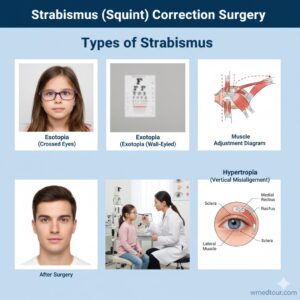
👀 Strabismus (Squint) Correction Surgery: Your Complete Guide to Strabismus Surgery
By WMEDTOUR Team | www.wmedtour.com
The main keyphrase for this article is: Strabismus Surgery. Therefore, we will ensure comprehensive coverage of this topic.
📝 Executive Summary
To begin with, Strabismus (squint) correction surgery is a highly effective procedure. It is used primarily to realign misaligned eyes. In this guide, we offer a comprehensive look at the treatment, recovery, and global options. Essentially, the surgery works by adjusting the tension of the eye muscles. This is precisely why it’s so reliable for both children and adults. Furthermore, the goal is not only cosmetic but also to improve binocular vision.
Key Takeaways:
- ✅ First, Strabismus Surgery involves adjusting the extraocular muscles to achieve proper eye alignment.
- 🌍 Also, it treats both inward (esotropia) and outward (exotropia) misalignment.
- 🥇 More importantly, Iran stands out as a top global destination for high-quality, affordable Strabismus Surgery, especially for international patients.
- ⏱️ Finally, recovery is typically quick. It often takes just a few days, or perhaps a couple of weeks, for most daily activities.
👁️ What is Strabismus Surgery?
In simple terms, Strabismus Surgery, often called squint correction surgery, is a common ophthalmic procedure. It is designed specifically to correct the misalignment of the eyes. To clarify, this condition, known as strabismus, occurs when the eyes do not look in the same direction at the same time. Consequently, the misalignment can be constant or intermittent. It thereby affects vision, depth perception, and appearance.
[Image of eye muscles controlling movement] As a result, the procedure works by surgically strengthening or weakening one or more of the six extraocular muscles. These muscles control eye movement. Therefore, the surgeon aims to restore balance so that both eyes can focus correctly. (Source: American Academy of Ophthalmology).In addition, understanding the delicate nature of the eye muscles is crucial before any procedure. For instance, comparing the expertise required for strabismus correction to that needed for complex corneal surgery highlights the importance of choosing a specialized facility.
⚖️ Types of Strabismus Surgery: Pros and Cons
When you are considering Strabismus Surgery, you must know that the two main approaches are muscle weakening and muscle strengthening.
### Muscle Weakening Procedures (Recession)
Firstly, these procedures loosen the affected muscle. This means moving the muscle’s attachment point further back on the eyeball. In turn, this effectively weakens its pull.
👍 Pros:
Evidently, this technique is highly effective. It corrects inward (esotropia) or outward (exotropia) deviation. Indeed, it is the most common technique in Strabismus Surgery. Furthermore, recovery is generally smooth.
👎 Cons:
However, the effect is permanent. Consequently, precise measurement is crucial. Therefore, re-operation might be necessary if the initial correction is too slight or too strong. Complications are rare, but still, careful planning is essential.
### Muscle Strengthening Procedures (Resection/Tucking)
Alternatively, these procedures involve shortening the muscle. They reattach it in its original location. Subsequently, the shortened muscle exerts a stronger pull, thus correcting the misalignment.
👍 Pros:
Specifically, this is excellent for increasing the tension of a weak muscle. Moreover, it is particularly useful in cases of paralytic strabismus. Additionally, it can be combined with other eye treatments.
👎 Cons:
On the other hand, there is a slightly higher risk of scar tissue formation. This is compared to recession. Yet, overall risks in Strabismus Surgery remain low. Nevertheless, consult our Corneal Surgery section for related post-op care.
Ultimately, the choice between these methods depends entirely on the specific type of strabismus diagnosed by the ophthalmologist. Thus, you should always discuss the options carefully. Finding a top ophthalmologist in Tehran is your first step.Strabismus (Squint) Correction Surgery Arabic Strabismus (Squint) Correction Surgery russian Strabismus (Squint) Correction Surgery english 
🎯 Who is This For?
In essence, Strabismus Correction Surgery is primarily recommended for individuals who meet certain criteria. Initially, non-surgical treatments like glasses or patching are often tried, especially in children. However, surgery becomes the gold standard when the following conditions are met:
- The strabismus is constant and severe. It thus affects binocular vision and depth perception.
- Also, the misalignment persists despite corrective lenses or therapy.
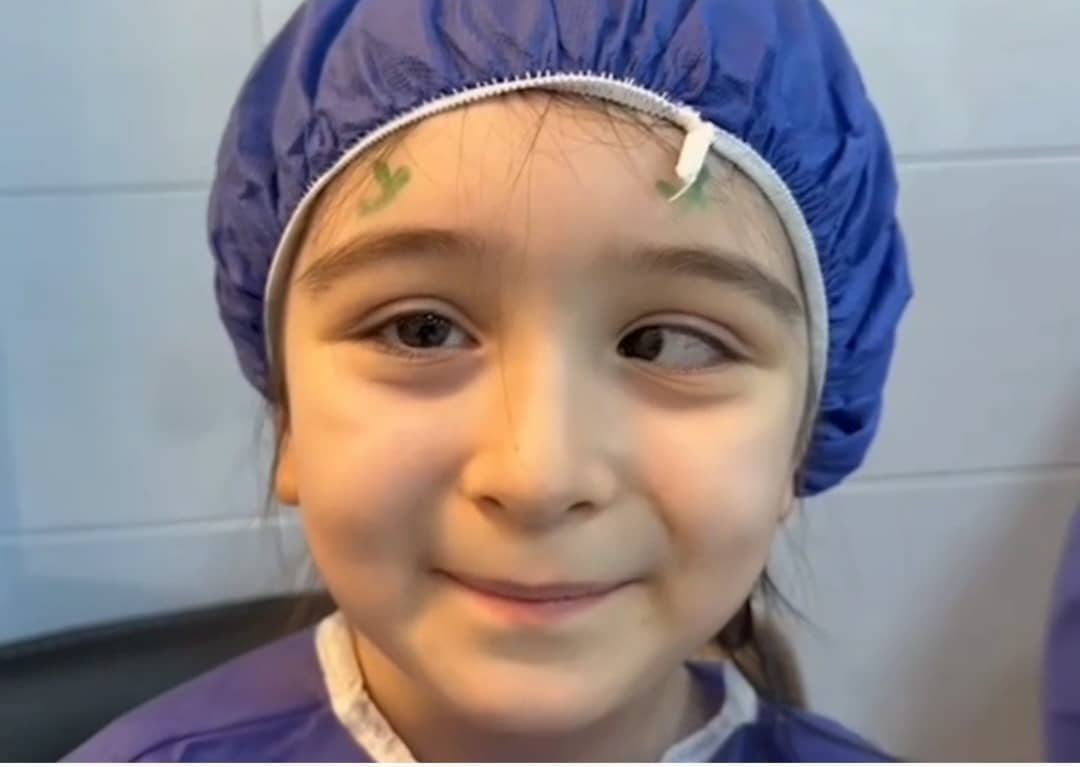
- Furthermore, the condition causes significant cosmetic or psychological distress to the patient. This applies whether a child (as seen in the video) or an adult.
- Lastly, the patient has a form of strabismus that is unlikely to resolve spontaneously, such as paralytic strabismus. Consequently, this condition often requires specialized neuro-ophthalmology assessment.
Crucially, it’s important to remember that age is not usually a barrier. While correction is often performed in early childhood for maximum visual development benefit, similarly, adults also undergo Strabismus Surgery successfully. The goal is to improve alignment and quality of life. Therefore, always ensure you follow a strict pre-travel checklist if seeking treatment abroad.
✈️ Strabismus Surgery in Global Medical Tourism: Why Iran Stands Out
Currently, medical tourists increasingly seek destinations. They look for a perfect blend of high medical standards, experienced surgeons, and cost-effectiveness. When it comes to Strabismus Surgery, it is evident that Iran has firmly established itself as a leading global center.
### Cost and Expertise Advantage
In contrast to many Western countries, the cost of Strabismus Surgery can be prohibitive. Iranian hospitals, conversely, offer world-class treatment at a fraction of the price. Moreover, the country boasts highly specialized eye surgeons. They perform a high volume of these precise operations. This thereby ensures exceptional expertise. This commitment to specialized, affordable care is what makes Iran such a favorable option. It is great for international patients seeking high-quality medical travel in Iran.
### Value Proposition Comparison
Let us now compare the general value proposition:
| Feature | Iran 🇮🇷 (Good Destination) | High-Cost Western Country (Example) |
|---|---|---|
| Surgeon Expertise | High volume, highly specialized training. Many top-tier specialists. | High volume, specialized training |
| Procedure Cost (Estimate) | Extremely Affordable | High to Very High |
| Wait Times | Minimal for international patients. It is thus often faster than seeking treatment in Germany. | Can be significant |
| Medical Regulations | Strict, supportive governmental oversight. See Iran’s regulations. | Highly regulated |
Consequently, many people choose Iran. They choose it because they receive identical or even better quality outcomes for their Strabismus Surgery. This happens while simultaneously making substantial cost savings. Therefore, learn more about getting your medical visa. Also, prepare for your journey with our pre-travel checklists. In addition, we also organize tours to destinations like Turkey, though Iran remains the leader in value for this specialized field.
👧 Case Study: Sara’s Journey to Corrected Vision
Allow us to present a case study: Sara, a 6-year-old girl, suffered from intermittent exotropia (outward squint). This is a condition which you can see corrected in the video example. First, her parents noticed she would frequently tilt her head or perhaps close one eye when focusing. This happened especially while reading or playing. Initially, her local doctor in Eastern Europe prescribed patching. But in spite of this, the condition persisted, thus warranting Strabismus Surgery. Therefore, they began researching international options.
Afterward, reviewing her case, a specialist surgeon in Iran recommended a bilateral lateral rectus muscle recession. This is a classic procedure in Strabismus Surgery. Consequently, Sara and her family traveled to Iran using a specialized medical tour package. The surgery itself was completed in under two hours under general anesthesia. Following the successful procedure, Sara’s eyes were perfectly aligned. Moreover, the recovery was remarkably fast. She was smiling and comfortable the very next day, much like the child in the video. Furthermore, within two weeks, her visual alignment had significantly improved. This thereby boosted her confidence and made focused activities much easier. In conclusion, her parents noted that choosing an expert in pediatric Strabismus Surgery abroad was the best decision for Sara’s future. For more information on ensuring quality, read our guide on choosing a surgeon abroad.
Additionally, for more on complex pediatric procedures, check our guide on CAR-T Therapy for pediatric neuroblastoma.
❓ Frequently Asked Questions (FAQ) about Strabismus Surgery
1. Is Strabismus Surgery painful?
No, the procedure is performed under general anesthesia, so the patient feels no pain during the surgery. Post-operatively, however, patients may experience mild discomfort, redness, and a scratchy feeling. But this is managed effectively with simple pain medication and eye drops.
2. How long does Strabismus Correction Surgery take?
Generally, the surgical time for Strabismus Surgery is relatively short. It often lasts between one and two hours, depending on the number of muscles requiring adjustment.
3. Will I need to stay in the hospital overnight?
In most cases, Strabismus Surgery is performed as an outpatient procedure. This means the patient can go home the same day. Nevertheless, observation periods are standard. This approach is similar to many minimally-invasive urological surgeries.
4. Are the results of Strabismus Surgery permanent?
Yes, the results are typically permanent. Although, a small percentage of patients may require a second, “touch-up” procedure years later if the eye alignment shifts again. (Source: JAMA Ophthalmology). However, this is less common in adults than in children.
5. Can Strabismus Surgery correct vision?
While the primary goal of Strabismus Surgery is to correct eye alignment (the cosmetic and functional goal), it is true that it can often improve binocular function. This is how the eyes work together to create depth perception. Still, it is not a direct replacement for glasses or contact lenses, nor does it correct cataracts or other refractive errors.
6. Is this type of surgery safe for young children?
Yes, it is very safe. Indeed, surgeons often prefer to perform the procedure on children early. This is in order to maximize the potential for developing good binocular vision. Therefore, Pediatric ophthalmologists are highly trained for this. Safety is paramount, just as with pediatric oncology treatments.
7. What is the success rate of Strabismus Surgery?
The initial success rate is very high. Consequently, it often exceeds 80-90% for achieving satisfactory alignment. Nonetheless, success is defined by the treating surgeon based on the specific type and severity of the strabismus.
8. How soon can I return to work or school after Strabismus Surgery?
Most patients, especially adults, can return to work or school within a few days or one week. You must avoid swimming and heavy lifting for a few weeks. This is in order to allow the eye muscles to heal properly. It is much like the restrictions after some facial plastic surgeries.
9. Does the procedure require cutting the eye itself?
No. The surgeon works on the six small muscles. They are located on the outside of the eyeball, not on the inside of the eye or the cornea. Instead, they simply move the point where the muscles attach. This contrasts with procedures like a corneal transplant, which involves deeper structures.
10. Are adjustable sutures common in children?
No, adjustable sutures are usually reserved for older patients (teenagers and adults). These are patients who can cooperate with the post-operative adjustment process while awake. Therefore, Pediatric surgery requires a different approach.
11. What is the typical recovery time before the eyes look completely normal?
The initial redness and swelling typically subside within 2 to 4 weeks. Although most of the swelling disappears after the first week, nonetheless, the eyes continue to heal. They settle into their final position over several months. Thus, you can typically use our directory of hospitals to find facilities that offer comprehensive aftercare.
12. How does medical tourism facilitate Strabismus Surgery?
Medical tourism companies, such as WMEDTOUR, organize the entire process. This includes selecting expert surgeons, arranging travel, managing hospital admission, and providing translation services. This, in turn, streamlines access to high-quality, cost-effective procedures. This applies to Strabismus Surgery in destinations like Iran, where the medical infrastructure is strong. This is detailed in our guide on global medical tourism.
In conclusion, we encourage you to explore all your options. Then make an informed choice for your or your child’s eye health. Furthermore, visit our Contact Us page for personalized assistance. Alternatively, our All Locations page can help you find the best option for your needs. This is whether for Strabismus Surgery or other treatments like Total Knee Replacement (TKR).
Articles |
Departments |
Doctors |
About Us