🕵️ Survival Guide: How to Spot Unlicensed Technicians in Turkey
📋 Executive Summary
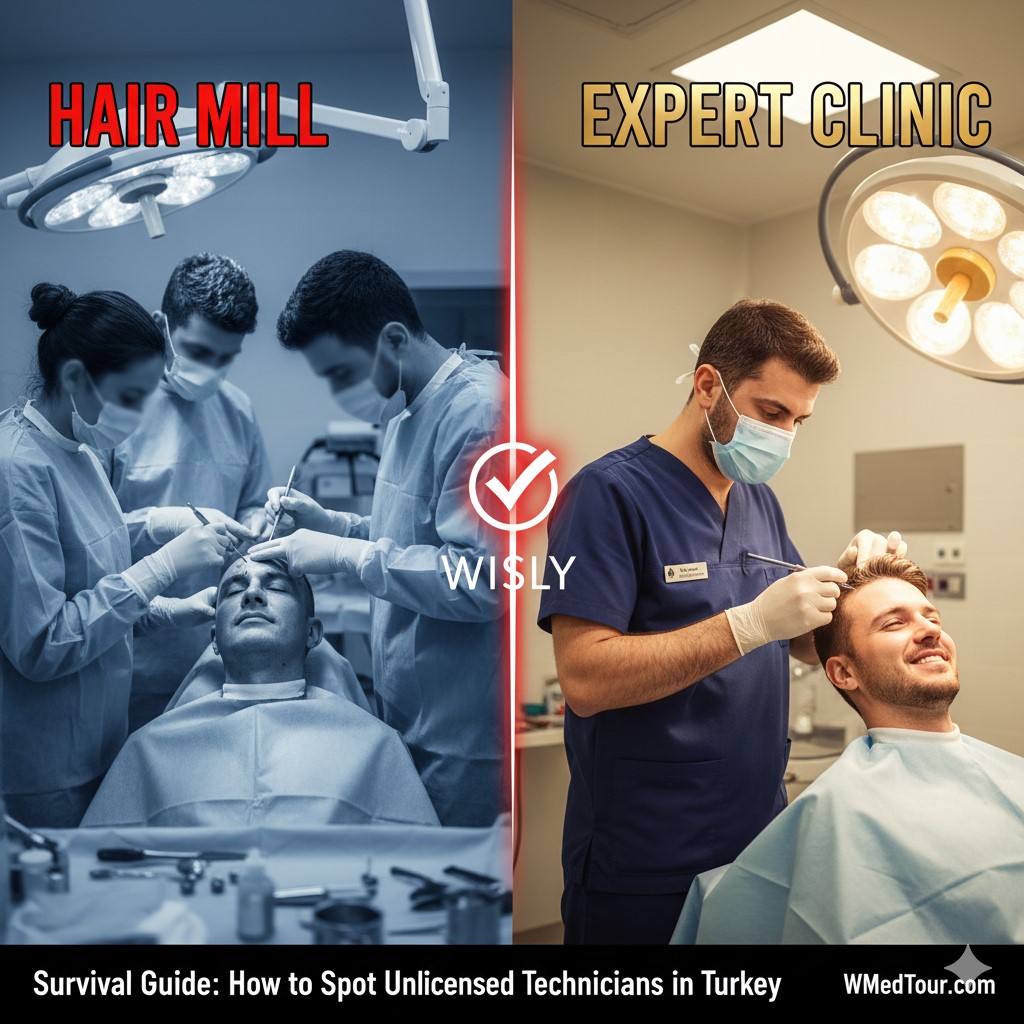
Choosing a hair transplant in Turkey offers incredible value, yet the industry faces a growing challenge: the “Hair Mill.” These are assembly-line clinics where unlicensed technicians, not surgeons, perform the majority of the procedure. This Survival Guide: How to Spot Unlicensed Technicians in Turkey aims to protect your health and your hairline. Consequently, you will learn to identify red flags like “unlimited grafts,” verify clinic licenses, and understand why doctor-led care is non-negotiable. Furthermore, we provide a complete patient roadmap to ensure your journey ends in success rather than scarring.
Turkey has rightfully earned its reputation as a global leader in skin and hair restoration. However, the sheer volume of patients has created a secondary market for low-quality “mills.” These factories prioritize turnover over patient safety. Since your donor hair is a finite resource, a single mistake by an unlicensed worker can be permanent. This guide serves as your shield against malpractice.
🏚️ Understanding the “Hair Mill” Phenomenon
A hair mill is a clinic that schedules a massive number of surgeries per day. Because they lack enough surgeons, they rely on technicians—often individuals without formal medical degrees—to perform the extractions and incisions. Although some technicians are skilled, they lack the medical training to handle surgical complications or understand scalp anatomy deeply. Therefore, the risk of “over-harvesting” or infection increases significantly.
🚩 Major Red Flags: Spotting the Imposters
How do you know if a clinic is a mill? Often, the signs are visible long before you book your flight. It is essential to look beyond the flashy Instagram ads and celebrity endorsements. Below are the most critical warnings to watch for during your research.
1. The “Unlimited Grafts” Promise
Legitimate surgeons, such as those found in our verified doctor database, understand that your donor area has limits. Promising “maximum grafts” regardless of your hair density is a sign of a mill. Technicians in these settings often over-harvest, leaving the back of your head looking like a “moth-eaten” rug. Truly professional care involves a conservative approach that preserves hair for future needs.
2. No Direct Access to the Surgeon
If you only speak with “sales consultants” and never with the doctor, be wary. A safe procedure begins with a telemedicine consultation with the actual surgeon. In mills, the doctor is often just a “ghost” who shows up for a few minutes to draw a line and then leaves the room. You have the right to know exactly who will be making the incisions in your skin.
3. Extremely High Daily Patient Count
A high-quality surgeon typically performs only 1 or 2 surgeries per day. If a clinic mentions having 10 or 20 operating rooms running simultaneously, it is a factory. In such environments, hygiene standards can slip. Furthermore, the specialized attention required for hair transplant procedures is impossible to maintain at such a scale. This volume-based model is the definition of a hair mill.
⚖️ Pros and Cons: Licensed Surgeon vs. Technician
While the price of a technician-led surgery is lower, the true cost is often paid in poor results. Let’s compare the two paths clearly.
✅ Licensed Surgeon Care
- Pro: Anatomical knowledge ensures natural-looking hairline design.
- Pro: Medical accountability and proper handling of complications.
- Pro: Higher graft survival rates due to gentle handling.
- Con: Higher initial financial investment compared to mills.
❌ Unlicensed Technician (Hair Mill)
- Pro: Lower upfront cost and immediate availability.
- Con: Risk of permanent scarring and donor area depletion.
- Con: Unnatural “doll-hair” appearance due to incorrect hair angles.
- Con: No medical recourse if a serious infection occurs.
📊 Comparative Cost Analysis
Quality medicine has a baseline cost. If a price seems too good to be true, it likely is. Here is what you can expect for legitimate care compared to “factory” prices.
| Provider Type | Typical Cost | Key Characteristic |
|---|---|---|
| Professional Clinic (Turkey) | €2,500 – €4,500 | Surgeon-led, In-hospital |
| Hair Mill (Turkey) | €1,200 – €1,800 | Technician-led, Private Office |
| European Clinic | €6,000 – €12,000 | High Overhead Costs |
🗺️ The Patient Roadmap: 5 Steps to Safety
Navigating the Turkish medical landscape requires a plan. Follow this roadmap to avoid the Survival Guide: How to Spot Unlicensed Technicians in Turkey red flags. This path ensures you partner with experts who value your safety.
Step 1: Check for ISHRS Membership
The International Society of Hair Restoration Surgery (ISHRS) is the gold standard. They advocate for “doctor-only” incisions. If your doctor is a member, they have committed to ethical standards. You can verify this on the ISHRS website or by asking our team in the about us section.
Step 2: Verify the Facility License
A legitimate hair transplant should happen in a licensed surgical center or hospital. Many mills operate in apartments or small “boutiques” to avoid government oversight. Check our full list of verified locations to find accredited hospitals. These facilities have emergency protocols and sterile environments.
Step 3: Ask the “Who Does What” Question
Directly ask the clinic: “Which parts of the surgery are performed by the doctor?” In a safe environment, the doctor must perform the extraction and the channel opening (incisions). Technicians may assist with graft sorting and placement. If they say “the team” does everything, walk away. This clarity is vital for your health.
Step 4: Review Independent Patient Journeys
Look for long-term reviews on independent forums, not just the clinic’s own website. Real patients will share their 12-month results. If you are also considering other aesthetic work, check the clinic’s expertise in plastic surgery to gauge their overall medical standing. This gives you a broader view of their professionalism.
Step 5: Demand a Medical Contract
Reputable providers will give you a formal agreement. This document should list the surgeon’s name and the expected number of grafts. It should also outline the post-operative care plan. If a clinic refuses to put their promises in writing, they are likely a mill. You can find more advice on this in our frequently asked questions page.
🙋 Who is This For?
This guide is essential for several groups looking for quality care in Turkey:
- Individual Patients: Those who want a natural look and want to avoid the “Turkey Teeth” or “Turkey Hair” stigma.
- Corrective Candidates: People who have already suffered a failed transplant and need a real surgeon to fix the damage.
- Medical Professionals: Doctors and agents who need to vet partners for their own clients.
- Safety-First Travelers: Anyone who values long-term health over short-term savings.
📜 Case Study: The “Factory” Experience
Meet “John,” a 35-year-old from London. Lured by a €1,500 “All-Inclusive” deal, he chose a clinic in Istanbul that claimed to be the best. On arrival, he was taken to a crowded office. He saw a doctor for only 2 minutes. Three teenagers in scrubs performed his 8-hour surgery. Months later, John realized his donor area was destroyed, and his hairline was a straight, unnatural line. He eventually had to pay €5,000 for a repair session with a top-tier surgeon. John’s story is a reminder that the “cheap” option can be the most expensive mistake of your life.
☀️ Recovery & Tourism: The Safe Way
When a surgery is done correctly, recovery is smooth. You can enjoy a tour in Turkey just a few days later. Licensed clinics provide specialized care kits and detailed instructions. They also offer follow-up via telemedicine to monitor your progress. If you follow the Survival Guide: How to Spot Unlicensed Technicians in Turkey, your trip will be a success story, not a medical disaster. For those coming from long distances, we even offer long-distance medical transport if needed.
🛡️ Medical Disclaimer
The information in this Survival Guide: How to Spot Unlicensed Technicians in Turkey is for educational purposes only. It is not medical advice. Always consult with a licensed medical professional before undergoing any surgery. WMedTour connects patients with licensed healthcare providers but does not perform surgeries directly. Every surgical procedure carries risks, including infection and scarring.
❓ Frequently Asked Questions (FAQ)
1. Is it legal for technicians to perform hair transplants in Turkey?
Here’s the same explanation without sources or citations, clean and straightforward:
Is it legal for technicians to perform hair transplants in Turkey?
Short answer:
No — under Turkish law, hair transplants are medical procedures that must be performed by a licensed physician. Technicians cannot legally perform the full procedure on their own, although they may assist in limited roles under a doctor’s direct supervision.
What Turkish law allows
- Hair transplantation is classified as a medical intervention
- A licensed medical doctor is legally responsible for the procedure
- Critical stages must be done by the doctor, including:
- Patient assessment and planning
- Administration of local anesthesia
- Follicle extraction (FUE/DHI)
- Opening recipient channels/incisions
What technicians are allowed to do
- Trained health technicians or nurses may assist
- They can help with graft placement, preparation, and post-procedure care
- This is only legal if a licensed doctor is present, supervising, and responsible
Technicians cannot:
- Perform the surgery independently
- Open channels
- Extract follicles without physician involvement
- Run a clinic without a medical director
What is illegal (but still happens)
- Clinics where technicians perform most or all surgical steps with little or no doctor involvement
- Clinics that use a doctor’s name for marketing while the doctor is rarely present
- Unlicensed or non-medical facilities offering hair transplants
These practices violate Turkish health regulations, even if enforcement is inconsistent.
Reality vs. law
In practice, some low-cost, high-volume clinics (“hair mills”) allow technicians to do nearly everything. This is not legal, and it increases the risk of:
- Poor aesthetic results
- Infections or scarring
- Limited legal protection for patients if complications occur
What patients should do
- Ask who performs each step of the procedure
- Confirm the doctor will be physically present
- Verify the clinic is a licensed medical facility
- Avoid clinics that refuse to name the surgeon or minimize their role
2. How can I verify a doctor’s medical license in Turkey?
You can ask for the clinic’s “Ministry of Health” certification number. Additionally, check if the doctor is registered with the Turkish Medical Association. Most top-tier surgeons will also have memberships in international bodies like the ISHRS. If you are unsure, you can use our contact page to ask for verification. We only work with providers who meet strict clinical standards. Never trust a clinic that refuses to share the full names and credentials of their medical staff before you arrive.
3. What are the signs of a hair mill on social media?
Mills often focus on “luxury” rather than “medicine.” If their Instagram is full of hotels and VIP cars but lacks close-up photos of donor areas or surgical videos, be careful. They also use high-pressure sales tactics like “discounts that expire tonight.” A professional clinic will give you time to think and will provide scientific answers to your questions. They will also show realistic results, including the healing phase. Look for photos of the lead surgeon at work, not just models in suits. This is a key part of your Survival Guide: How to Spot Unlicensed Technicians in Turkey strategy.
4. Can I get a safe transplant in a regular hospital?
Yes, in fact, it is often safer. Hospitals in Turkey have strict hygiene and emergency requirements. We recommend looking for hair transplant units within established general medical departments. This ensures that if you have an allergic reaction or any other issue, a full medical team is available to help you immediately. Private, small clinics in residential buildings are where most hair mills are located. Safety should always come before the “boutique” aesthetic of a private office.
5. Why is the “Unlimited Grafts” offer dangerous?
The donor area on the back of your head is not infinite. If a technician harvests too many grafts (over-harvesting), you will have permanent bald patches. Furthermore, if the hair loss continues as you age, you will have no “reserve” hair left for a second transplant. A real doctor will perform a “graft count” based on your specific needs, not a marketing number. They might even suggest PRP therapy to strengthen existing hair instead of aggressive surgery. This conservative approach is what keeps your look natural over time.
6. What happens if I go to a mill and I am not happy?
Repairing a bad transplant is much more difficult than the first procedure. It often requires removing poorly placed grafts and using specialized techniques to hide scarring. This process is expensive and may not fully restore your original look. Therefore, it is much better to invest in a quality surgeon from the start. If you are already in this situation, visit our specialist directory to find surgeons who focus on corrective work. Do not return to the same mill for a “free repair,” as they will likely cause more damage.
7. Does a hair mill offer any warranty?
Many mills offer a “lifetime warranty” as a sales tool. However, these warranties are often useless. They may require you to pay for another flight and hotel, or they might claim your hair loss is due to “new factors.” A real warranty is the reputation of a licensed surgeon. In a professional setting, the success rate is so high that a warranty is rarely needed. If a clinic pushes a warranty harder than their medical credentials, it is a significant red flag. Always prioritize the surgeon’s skill over a piece of paper that might not be enforceable.
8. Is the FUE or DHI technique safer?
Both techniques are safe when performed by a doctor. Both are dangerous when performed by an unlicensed technician. The “technique” is often used by mills to justify higher prices. Whether you choose FUE or DHI, the person holding the tool is what matters. DHI (Direct Hair Implantation) requires even more precision, so the risk of an unlicensed technician making a mistake is even higher. Always ask your surgeon why they are recommending one over the other for your specific hair type.
9. How long should I stay in Turkey after my surgery?
You should stay at least 3 to 4 days. The first few days are critical for the grafts to “take.” You also need a professional first wash and a final checkup with your surgeon. Mills often try to rush patients out the door the next day. A professional clinic will ensure you are stable and educated on post-op care before you fly. If you want to see more of the country, check our 2025 medical tourism guide for travel tips. This ensures you combine recovery with a relaxing experience.
10. Can I see the operating room before the surgery?
Yes, you absolutely should. A professional operating room will be sterile and equipped with advanced monitoring tools. If the room looks like a regular office or is cluttered, it is not a safe environment. You have the right to walk away even on the morning of the surgery if you feel the clinic is a mill. Your safety and your hair are more important than any deposit you might lose. We help our clients find clinics that maintain the highest hospital-grade standards in every medical department they operate.
11. Why do mills have so many positive reviews?
Unfortunately, many reviews are bought or faked. Mills also offer discounts to patients who leave a 5-star review before they even see the final result. A hair transplant result takes 12 months to show. Reviews written one week after surgery are only about the “hotel” and “driver,” not the hair. Always look for “long-term” reviews where patients show photos after a full year. This is the only way to judge the true quality of a surgeon’s work. Our Survival Guide: How to Spot Unlicensed Technicians in Turkey encourages looking for these long-term success stories.
12. Should I bring a friend or family member with me?
Having a companion is a great idea for emotional support. Most professional clinics include a stay for a companion in their packages. However, ensure your companion is also aware of the Survival Guide: How to Spot Unlicensed Technicians in Turkey red flags. They can provide a “second pair of eyes” to ensure the doctor is actually the one performing the surgery. If you are traveling alone, we can provide assistance through our support team to ensure you are never alone in the process. Your peace of mind is our priority.
In conclusion, your hair restoration is a medical procedure, not a luxury vacation. By following this Survival Guide: How to Spot Unlicensed Technicians in Turkey, you ensure that you receive the high-quality, doctor-led care you deserve. Turkey remains an incredible destination for this journey, as long as you choose a partner who values your health above their profit margins.