🔬🌍 Top Countries for Bone Marrow Transplant 2026: A Global Guide to Quality, Cost, and Access
✨ Executive Summary: The Global Landscape of BMT Medical Tourism
A Bone Marrow Transplant (BMT), or Hematopoietic Stem Cell Transplantation (HSCT), represents a life-saving procedure for numerous hematological and oncological diseases. When evaluating the Top countries for bone marrow transplant 2026, patients and their families must prioritize three critical factors: accreditation, clinical expertise, and comprehensive cost. Crucially, while developed nations like the United States and Germany offer high-tier technology, their costs are often prohibitive. Consequently, medical tourism destinations have emerged as essential alternatives. Turkey, for example, is recognized for its high volume of JCI-accredited BMT centers and integrated patient services. Moreover, countries like Iran stand out by offering equally high clinical standards—especially within hemato-oncology—at a fraction of the price, making advanced BMT accessible to a wider global population. This guide provides a detailed analysis, ensuring you have the data to make an informed decision for this complex treatment.
💡 Understanding Bone Marrow Transplantation: The Crucial Role of Global Access
Bone marrow transplantation is an intense treatment, requiring specialized facilities, expert multi-disciplinary teams, and long recovery periods. The need to seek treatment globally often stems from a lack of compatible donors domestically, long waiting lists, or exorbitant costs. Therefore, understanding the three primary types of BMT is essential for selecting the right country:
🧬 Types of Bone Marrow Transplants
- 1. Autologous BMT: This uses the patient’s own stem cells, typically employed after high-dose chemotherapy for diseases like multiple myeloma or certain lymphomas.
- 2. Allogeneic BMT: This uses stem cells from a donor (sibling, unrelated, or cord blood). This approach treats acute leukemias, aplastic anemia, and various immune deficiencies. Consequently, successful allogeneic BMT relies heavily on international donor registries and Human Leukocyte Antigen (HLA) matching.
- 3. Haploidentical BMT: A specialized form of allogeneic transplant using a half-matched donor, usually a parent or child. As a result, this type significantly expands the potential donor pool, proving crucial in international settings where finding a perfect match might be challenging.

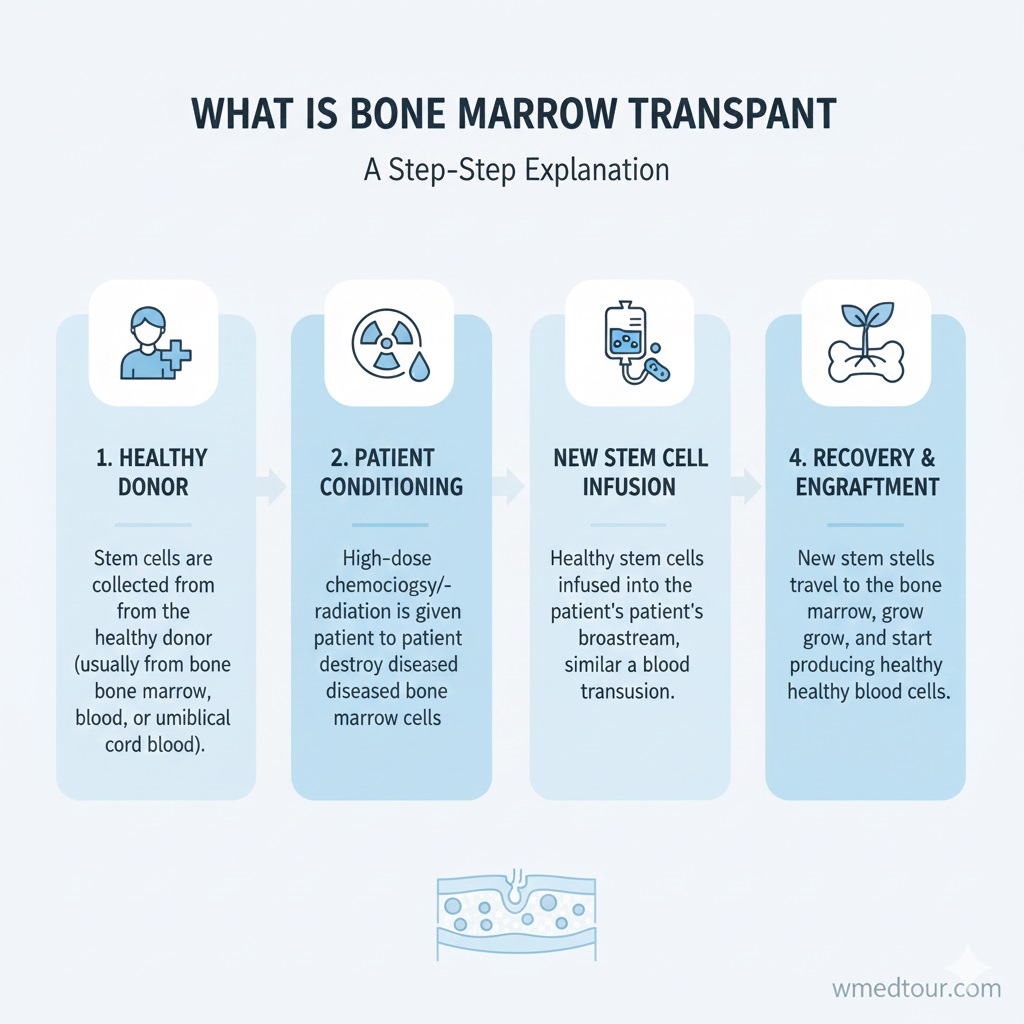
The process of a bone marrow transplant, from donor cell collection to patient recovery, demystifying a critical medical procedure.
🛡️ Key Factors Determining the Best BMT Destination
When searching for the Top countries for bone marrow transplant 2026, international patients must look beyond simple price lists. Instead, they need to evaluate the following crucial elements:
✅ Accreditation and Quality Assurance
The level of accreditation directly reflects a center’s commitment to safety and quality.
The Role of International Standards
The most important accreditation for BMT centers is from the Foundation for the Accreditation of Cellular Therapy (FACT). FACT accreditation verifies that a center’s entire process—from collection to administration—meets the highest global standards. Furthermore, the Joint Commission International (JCI) accreditation, while broader, ensures the hospital meets strict patient safety and quality benchmarks. Therefore, always check for these accreditations when considering an international center. You can find accredited facilities through organizations like the World Health Organization’s collaborating centers. (Source: FACT Accreditation Requirements)
💰 The Cost Conundrum: International Pricing Differences
The cost of a BMT in the US can easily exceed $300,000 for an allogeneic transplant, often reaching $800,000. Consequently, cost becomes the primary driver for medical travel. International hospitals in the Top countries for bone marrow transplant 2026 can offer the same procedure for 50% to 70% less, due to lower operational costs, reduced professional indemnity insurance, and governmental healthcare subsidies. Indeed, this financial relief allows patients to afford essential post-transplant follow-up care.
🔬 Clinical Volume and Specialization
A high-volume center handles more cases, which translates to superior surgeon and support staff experience. Specifically, look for centers that regularly perform the particular type of transplant you need, such as those specializing in haploidentical BMT. High specialization in hemato-oncology also ensures better management of complex post-transplant complications like Graft-versus-Host Disease (GvHD). You can review our detailed guide on hemato-oncology treatment in Iran, which highlights advanced centers.
🏆 Analyzing the Top Countries for Bone Marrow Transplant 2026
The landscape of BMT medical tourism is dynamic, but several countries consistently rank high due to their specific value propositions.
🇩🇪 1. Germany: The European Gold Standard
Germany remains a global benchmark for complex medical procedures, including BMT. Importantly, German centers are pioneers in clinical research and often have direct links to the European Group for Blood and Marrow Transplantation (EBMT).
Pros of BMT in Germany:
- Pioneering Research: Access to the latest clinical trials and novel therapies. (Source: DKMS German Donor Registry).
- Rigorous Regulation: Extremely strict governmental oversight ensures exceptional quality control.
- Global Donor Network: Excellent integration with international donor registries.
Cons of BMT in Germany:
- Highest Cost: Costs often match or exceed US prices, primarily for allogeneic transplants.
- Lengthy Wait Times: Priority often goes to domestic and EU patients. Therefore, international patients may experience significant delays.
Furthermore, for patients considering Germany, a review of our medical travel guide for Germany is highly recommended to manage logistical expectations.
🇹🇷 2. Turkey: High Volume and Integrated Care
Turkey has cemented its reputation as a leader in medical tourism, especially for complex surgeries and oncology treatments. Its high number of JCI-accredited facilities and geographically advantageous location make it a top choice for BMT.
Pros of BMT in Turkey:
- Excellent Accreditations: Numerous hospitals hold JCI and even FACT accreditation.
- Integrated Packages: Centers often provide all-inclusive pricing that covers the procedure, donor search, and extended inpatient care.
- High Throughput: Significant patient volume, ensuring surgeon and BMT team experience.
Cons of BMT in Turkey:
- Variable Pricing: Prices vary significantly between the private and public sectors. Thus, patients must compare packages carefully.
- Logistical Complexity: Requires detailed coordination of travel and extended stays.
As a result, Turkey is frequently listed among the Top countries for bone marrow transplant 2026 for patients seeking a balance of high quality and managed costs. More detailed information can be found in our comprehensive Turkey medical tourism guide.
🇮🇷 3. Iran: Unmatched Value in BMT Specialization
Iran possesses a highly developed medical infrastructure, particularly in the fields of hematology and oncology. Significantly, Iran stands as a global leader in providing complex medical care, including BMT, at profoundly lower costs without compromising clinical standards.
Pros of BMT in Iran:
- Exceptional Affordability: The cost is significantly lower than in Europe or the US, often representing the best economic value proposition globally.
- Expert Hemato-Oncology Teams: Many surgeons and oncologists hold international fellowships, bringing world-class expertise to local centers.
- Immediate Access: Shorter waiting times compared to countries with saturated BMT units.
- High Success Rates: BMT centers maintain excellent success rates comparable to major global institutions.
Cons of BMT in Iran:
- Donor Registry Access: While international matching is facilitated, the local donor network is smaller than major Western registries.
- Visa and Travel: Navigating travel logistics and obtaining a medical visa requires planning, though WMEDTOUR assists with this via its medical travel Iran visa guide.
Furthermore, Iran’s reputation for quality BMT and oncology care means it is increasingly recognized among the Top countries for bone marrow transplant 2026.
🇮🇳 4. India: Mass Volume and Low-Cost Options
India’s strength lies in its ability to handle a massive volume of patients at one of the lowest price points globally. As a result, it is a key destination for financially restricted patients.
Pros of BMT in India:
- Ultra-Low Cost: Offers the most competitive pricing, often starting much lower than other international options.
- English Proficiency: Widespread English speaking staff simplifies communication.
Cons of BMT in India:
- Quality Variability: Accreditation levels differ widely. Therefore, careful vetting of the chosen center is non-negotiable.
- Infrastructure Strain: High patient volume can sometimes strain resources compared to dedicated BMT units in other nations.
For more on this destination, see the medical tourism guide for India.
📊 Bone Marrow Transplant Global

Comparison Table (2026 Estimates)
This table compares the estimated cost and key operational factors across the Top countries for bone marrow transplant 2026. (Prices are estimates for an Allogeneic BMT from an Unrelated Donor, excluding travel/accommodation unless noted).
| Factor | Germany 🇩🇪 | Turkey 🇹🇷 | Iran 🇮🇷 (Recommended) | India 🇮🇳 |
|---|---|---|---|---|
| Estimated Allogeneic Cost (USD) | $250,000 – $450,000+ | $80,000 – $150,000 | $55,000 – $90,000 | $45,000 – $100,000 |
| Availability of FACT/JCI Acc. | FACT is common, JCI less focused. | High JCI presence, growing FACT. | Strong national accreditation, JCI in select centers. | High JCI presence in major cities. |
| Wait Time for Scheduling | Long (Months) | Moderate (Weeks to 1-2 Months) | Short (Weeks) | Short (Weeks) |
| Access to Haploidentical BMT | Excellent | Good | Excellent, specialized units. | Good, growing. |
🔍 Specialized Considerations for BMT Patients
A BMT journey is protracted and complex. Therefore, patients must meticulously plan for pre-transplant workup, the procedure itself, and a crucial post-transplant period.
💉 Pre-Transplant Workup and Donor Matching
Before a BMT, patients undergo extensive testing to assess their fitness for the procedure and to ensure complete disease remission. In fact, this phase is non-negotiable, regardless of the country. Furthermore, donor matching relies on national and international registries. Consequently, the capability of the foreign BMT center to efficiently search international databases (like the World Marrow Donor Association, WMDA) is paramount, especially for patients with rare HLA types. This process can take several weeks or months. For cancer patients generally, understanding advanced therapies like CAR-T therapy or TCR-T cell therapy—which often intersect with BMT—is also useful.
🦠 Managing Isolation and Post-Transplant Recovery
The highest risk period for BMT patients is the first 100 days post-transplant, especially the initial period of deep immunosuppression. Hence, BMT centers must have:
- Positive Pressure Rooms: Specialized, sterile isolation rooms to prevent infection.
- Experienced Nursing: Nurses specialized in managing GvHD, neutropenic fever, and complex medication regimens.
- Proximity: Patients must typically remain near the hospital for 3 to 6 months post-discharge. Therefore, the chosen country must offer affordable, suitable accommodation for this extended recovery period.
👤 Who is This For? Identifying the Ideal BMT Medical Tourist
Traveling abroad for a BMT is a major undertaking that suits highly organized and financially motivated individuals who are medically stable enough for long-distance travel.
🎯 The Best Fit for International BMT
- The Uninsured or Underinsured Patient: This individual faces catastrophic out-of-pocket costs in their home country, often exceeding $200,000. Consequently, the massive cost reduction found in the Top countries for bone marrow transplant 2026** is life-enabling.
- The Time-Sensitive Patient: A patient with an aggressive disease (e.g., Acute Myeloid Leukemia) who cannot wait 3 to 6 months for a slot in a domestic BMT unit. Thus, countries with shorter wait times provide a critical advantage.
- The Proactive Planner: An individual who has meticulously organized their post-transplant care plan, including a willing hematologist back home to manage long-term immunosuppression and follow-up. This proactive approach is detailed in our pre-travel checklist for patients.
- The Financial Prudent Patient: Someone looking for the best return on investment for their treatment without sacrificing quality. Specifically, the centers in Iran offer this unique blend of advanced care at a lower operational cost.
🚫 When NOT to Choose International BMT
Patients with severe, uncontrolled comorbidities or those who require intensive, immediate post-operative access to complex domestic healthcare systems should exercise extreme caution. For example, if a patient has unstable cardiac conditions (see: cardiac surgery guide), the risks of travel and the limited immediate access to specialists abroad may outweigh the cost savings.
📖 Patient Journey Example: Sofia’s Allogeneic BMT in Iran
📝 Sofia’s Story: Seeking Specialized Care in One of the Top Countries for Bone Marrow Transplant 2026
Background: Sofia, a 45-year-old from Canada, was diagnosed with relapsed Acute Lymphoblastic Leukemia (ALL). Consequently, her local hospital quoted an 8-month wait time for an allogeneic BMT slot due to high demand. Her insurance provided partial coverage, but the out-of-pocket cost and the delay were unacceptable given the urgency of her condition. She sought a solution among the Top countries for bone marrow transplant 2026 that offered immediate access.
The Strategic Decision: Sofia’s team explored international BMT centers, specifically focusing on accredited facilities in Iran known for their hemato-oncology specialization. Furthermore, the chosen center offered a FACT-standardized BMT process and a transparent package price of $75,000, which was significantly less than her expected domestic out-of-pocket cost plus the benefit of immediate scheduling. She confirmed that a suitable unrelated donor was available via the international registry and began planning the logistics, including consulting our checklist for choosing a clinic abroad.
The Experience: Sofia and her companion secured the necessary travel documents. She arrived two weeks before the procedure for the comprehensive pre-transplant workup, including a specialized Preimplantation Genetic Testing (PGT)-level screening of the donor cells to ensure compatibility. Afterward, she spent 30 days in the hospital’s specialized BMT isolation unit, followed by three months in nearby accommodation. The medical team provided detailed daily monitoring and managed her mild GvHD effectively.
The Result: Sofia returned home four months after the transplant, having achieved engraftment and stable condition. Ultimately, she received timely, high-quality, life-saving care that would have been critically delayed domestically, saving substantial time and money. Her local hematologist managed the long-term follow-up using the comprehensive, translated medical records provided by the Iranian center.

❓ FAQ Section: Essential Facts About BMT Medical Tourism
🤔 Frequently Asked Questions
1. What is the minimum time commitment required for an allogeneic BMT abroad?
The minimum commitment is typically 3 to 6 months. This includes 3 to 6 weeks of inpatient hospitalization and several months of mandatory local post-discharge observation near the transplant center to manage immediate risks like infection and Graft-versus-Host Disease (GvHD).
2. How important is JCI accreditation for a BMT center?
JCI (Joint Commission International) accreditation is highly important as it signifies that the hospital meets rigorous global standards for patient safety and quality management. However, for BMT specifically, FACT (Foundation for the Accreditation of Cellular Therapy) is the gold standard, as it is specialized for cellular therapy programs.
3. Can I find a bone marrow donor from the international registry through a foreign hospital?
Yes. Most reputable international BMT centers in the Best countries for bone marrow transplant 2026 are linked to major international registries, such as the WMDA, and can search for unrelated donors globally. The success depends on the patient’s HLA type.
4. What common complications require me to stay close to the BMT center?
Common complications include infections (due to a compromised immune system), bleeding, and GvHD. GvHD, in particular, requires aggressive, immediate intervention, making it unsafe to travel until the medical team confirms stable engraftment and minimal risk.
5. How do I manage long-term follow-up and medication once I return home?
You must secure a hematologist or oncologist in your home country who agrees to manage your follow-up care, including immunosuppressant drug monitoring and managing potential late-stage complications, before you travel. You should bring back a comprehensive medical summary. For general surgery, this kind of follow up is also crucial, see orthopedic medical tourism as an example.
6. Does travel increase the risk of infection right after the transplant?
Traveling too soon after BMT, especially during the period of neutropenia (low white blood cell count), drastically increases the risk of severe infection. Consequently, centers require the mandatory 3 to 6-month stay near the hospital before air travel is deemed safe. Global medical treatment regulations reflect this safety requirement.
7. What is the typical success rate for allogeneic BMT in these top countries?
Success rates depend heavily on the disease, stage, and donor match. However, accredited centers in the Top countries for bone marrow transplant 2026 often report 1-year survival rates for standard-risk acute leukemia cases comparable to Western institutions, typically in the 50%-70% range. (Source: American Society of Hematology – Global BMT Trends)
8. Is it possible to combine a BMT trip with other complex procedures?
Absolutely not. BMT is one of the most demanding and risky medical procedures. Therefore, combining it with any other major surgery, such as a total knee replacement or aesthetic surgery, is strongly discouraged due to the extreme risk of infection and complication. Healing from BMT must be the sole focus.
9. What is the role of cryopreservation in international BMT?
Cryopreservation (freezing) is critical. It is used to store the patient’s cells (autologous) or the donor’s cells/cord blood. Therefore, ensuring the center has high-standard, accredited cryopreservation facilities is essential for maintaining cell viability and the quality of the transplant.
10. Are the immunosuppressant drugs used abroad the same as in my home country?
The drugs are generally the same (e.g., cyclosporine, tacrolimus, methotrexate), as they are universally recognized. However, brand-name availability may vary. Crucially, ensure you have a long-term supply and confirmation that your local pharmacy can source the equivalent upon return.
11. What is the advantage of a Haploidentical BMT over a fully matched unrelated donor transplant?
The main advantage is speed and availability. Because a parent or child is always a half-match, it eliminates the lengthy and expensive process of searching for a perfectly matched unrelated donor, often saving crucial time for patients with rapidly progressing diseases. This is a common and specialized treatment in the Top countries for bone marrow transplant 2026, including Iran.
12. Should I consider specialized cancer treatments like Proton Therapy alongside BMT?
BMT often follows high-dose chemotherapy or radiation. While BMT is distinct, patients can explore advanced radiation options like Proton Therapy if radiation is required for primary disease control. Ultimately, all treatment steps must be tightly coordinated by the oncology team.
13. If my home country uses PGT for family balancing, how does this relate to BMT?
PGT (Preimplantation Genetic Testing) is an IVF technique unrelated to BMT treatment. However, if a family used PGT-M (Preimplantation Genetic Testing for Monogenic Disorders) to conceive an HLA-matched sibling to be a BMT donor, that child’s cord blood or bone marrow is used. Consequently, this is an advanced form of reproductive planning.
14. What are the key differences between the BMT approach in Iran versus Western Europe?
The key difference lies in the financial model. Specifically, clinical outcomes and protocols are highly standardized globally, particularly in internationally accredited centers. However, Iran’s healthcare system allows for significantly lower administrative and operational costs, translating directly into a much lower price point for the patient, which does not reflect a difference in quality, but rather in economics. This makes Iran a compelling option among the Top countries for bone marrow transplant 2026 for cost-conscious patients. We also offer advanced surgical procedures like Lu177 theranostics for metastasis in Iran.
➡️ Conclusion: Making the Life-Saving Choice in 2026
Selecting a destination for a Bone Marrow Transplant requires meticulous research, balancing urgent medical need against complex logistical and financial realities. The Top countries for bone marrow transplant 2026—including specialized centers in Germany, Turkey, and Iran—offer high-quality care that meets or exceeds global standards. Ultimately, the best choice depends on your specific HLA match requirements, budget, and time constraints. Significantly, by recognizing the exceptional value proposition offered by countries like Iran, which combine world-class hemato-oncology expertise with unmatched cost efficiency, patients can confidently access the life-saving treatment they need without financial ruin.
Ready to start your journey with accredited BMT centers? Explore comprehensive BMT packages and specialized oncology care globally on our platform.