🩺 Varicocele Surgery: Complete Guide to Restoring Male Fertility and Comfort
📋 Executive Summary
Varicocele surgery remains the gold standard for treating enlarged veins within the scrotum that can lead to infertility, pain, and testicular atrophy. This guide explores modern surgical techniques, specifically highlighting the microscopic varicocelectomy as the most successful approach. Key takeaways include:
- Success Rates: Surgical intervention improves sperm count in over 60-80% of patients.
- Modern Techniques: Minimally invasive options like laparoscopy and embolization offer faster recovery.
- Recovery: Most patients return to light work within 3 days and full activity within 2 weeks.
- Global Options: Countries like Iran, Turkey, and India offer world-class urological expertise at a fraction of Western costs.
Dealing with a varicocele can be a silent struggle for many men. It often manifests as a dull ache or is only discovered during a fertility workup. At WMedTour, we understand that deciding on varicocele surgery is a significant step toward improving your quality of life and reproductive health. This guide is designed to provide you with every piece of information needed to navigate this journey with confidence.
👨⚕️ Who is This For?
Understanding whether you are a candidate for surgery is the first step. Generally, varicocele surgery is recommended for individuals experiencing the following conditions:
- Infertility Issues: Couples struggling to conceive where the male partner has a palpable varicocele and abnormal semen parameters.
- Chronic Pain: Men experiencing a persistent, “bag of worms” sensation or sharp pain that worsens throughout the day.
- Testicular Atrophy: Adolescents or young men where the affected testicle is significantly smaller than the healthy one.
- Low Testosterone: Emerging research suggests that repairing a varicocele can help boost natural testosterone production in some men.
If you fit any of these categories, consulting with a specialist in our urological surgery department is highly advisable.
🔬 Understanding the Procedures: A Deep Dive
Several surgical methods exist to treat varicoceles. Each technique has its specific advantages and potential drawbacks. Consequently, the choice of procedure often depends on the surgeon’s expertise and the patient’s specific anatomy.
1. Microscopic Varicocelectomy
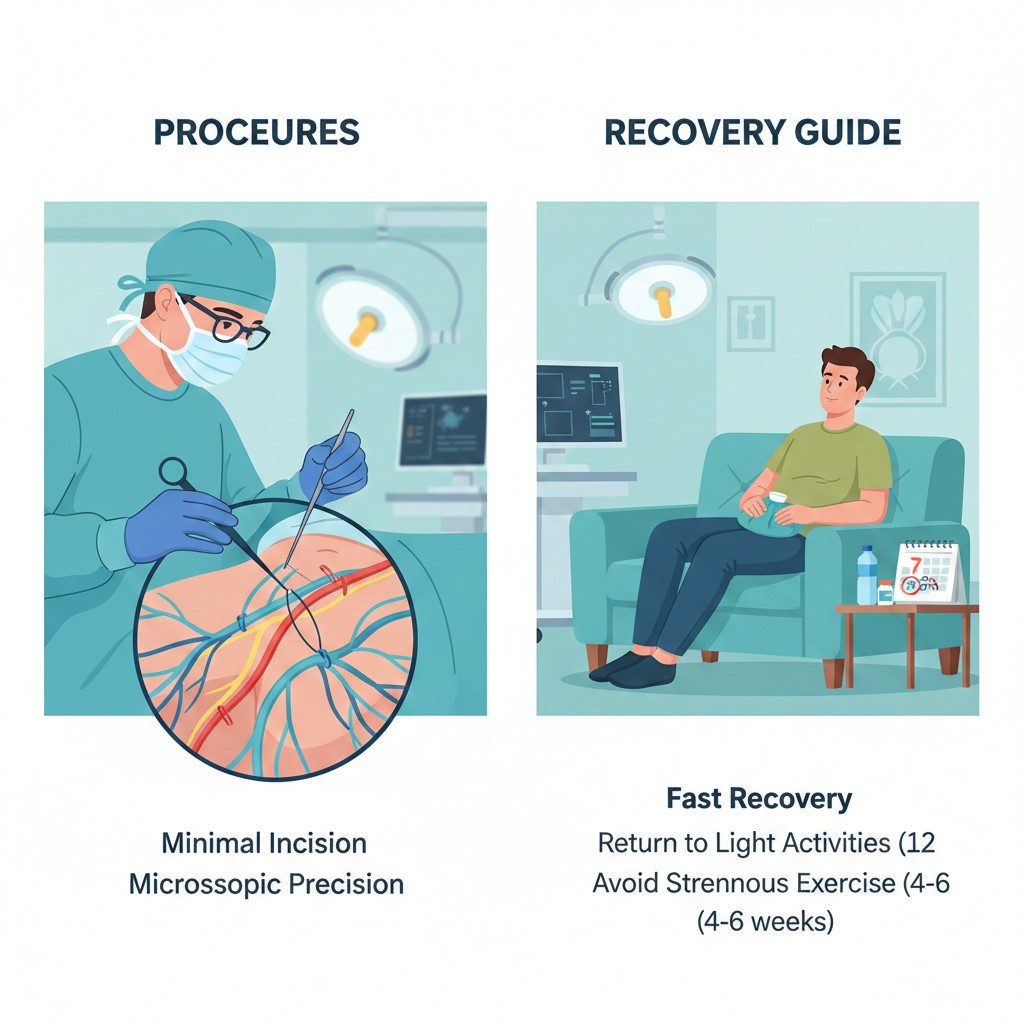
The microscopic approach is widely considered the “Gold Standard.” By using a high-powered surgical microscope, the surgeon can clearly distinguish between veins, arteries, and lymphatic vessels. This precision significantly reduces the risk of complications.
Pros:
- Lowest recurrence rate (less than 1%).
- Minimal risk of hydrocele (fluid buildup).
- Preservation of the testicular artery is much easier.
Cons:
- Requires specialized equipment and highly skilled surgeons.
- Slightly longer operating time compared to open surgery.
2. Laparoscopic Varicocelectomy
This technique involves making small incisions in the abdomen. The surgeon uses a camera and specialized tools to tie off the affected veins. This is a common choice for bilateral varicoceles (occurring on both sides).
Pros:
- Smaller external scars.
- Effective for treating both sides simultaneously.
Cons:
- Higher risk of hydrocele compared to the microscopic approach.
- Requires general anesthesia and entry into the peritoneal cavity.
3. Percutaneous Embolization
Unlike traditional surgery, embolization is performed by an interventional radiologist. A catheter is inserted through the groin or neck to reach the testicular veins. Coils or sclerosing agents are then used to block the blood flow in the damaged veins.
Pros:
- No surgical incision is required.
- Quickest recovery time among all options.
Cons:
- Slightly higher recurrence rates in some studies.
- Exposure to radiation during the procedure.
📊 Comparison of Surgical Techniques
| Feature | Microscopic | Laparoscopic | Embolization |
|---|---|---|---|
| Recurrence Rate | < 1% | 2-5% | 5-10% |
| Anesthesia | Local/General | General | Local + Sedation |
| Hydrocele Risk | Very Low | Moderate | Minimal |
| Recovery Time | 3-5 Days | 2-4 Days | 1-2 Days |
🛤️ The Patient Roadmap: What to Expect
Navigating medical care abroad or even locally requires a clear plan. Here is the step-by-step journey for a typical patient undergoing varicocelectomy with WMedTour.
Step 1: Initial Consultation
Everything begins with a thorough evaluation. You can start with a telemedicine consultation to discuss your symptoms and review previous tests. Our experts will determine if surgery is the right path for you.
Step 2: Pre-Operative Preparation
Before the big day, several diagnostic steps are necessary. You will likely undergo a scrotal ultrasound to confirm the grade of the varicocele. Additionally, a pre-operative anesthesia consultation ensures you are fit for the procedure. You should avoid eating or drinking for 8 hours before surgery if general anesthesia is planned.
Step 3: The Procedure Day
The surgery itself usually takes between 45 to 90 minutes. It is typically performed on an outpatient basis, meaning you can return to your hotel or home the same day. Most patients appreciate the care provided by doctors like Dr. Mojtaba Maleki, who specialize in minimally invasive urology.
Step 4: Immediate Recovery
In the first 24 hours, you will focus on rest and ice packs. Managing discomfort is simple with over-the-counter medication. Many patients choose to combine their recovery with a relaxing stay in Iran or Turkey.
📖 Case Study: Mark’s Journey to Fatherhood
Mark, a 32-year-old software engineer, had been trying to conceive with his wife for two years. After a semen analysis showed low motility, he was diagnosed with a Grade 3 varicocele. He was hesitant about surgery initially. However, after researching the high success rates of microscopic surgery, he decided to proceed.
Mark chose to travel to a specialized clinic through WMedTour. His surgery lasted just over an hour. Within three days, he was walking comfortably. Fast forward six months: a follow-up semen analysis showed a 40% improvement in sperm concentration. Three months later, Mark and his wife shared the happy news of a natural pregnancy. Mark’s story highlights how addressing a physical issue can lead to life-changing results.
💰 Cost Analysis: Global Perspective
One of the biggest hurdles for patients is the cost of surgery in the US or UK. Choosing medical tourism can save you up to 70% without sacrificing quality.
| Country | Estimated Cost (USD) | Service Level |
|---|---|---|
| United States | $8,000 – $15,000 | High |
| Iran | $1,200 – $2,500 | Expert / High-Tech |
| Turkey | $2,000 – $3,500 | Premium / Modern |
| India | $1,500 – $3,000 | Advanced / Accessible |
These packages often include more than just the surgery. At WMedTour, we provide comprehensive support, including air ambulance services if needed, though most varicocele patients travel via standard flights.
🏖️ Recovery & Medical Tourism
Recovering from varicocele surgery is the perfect opportunity to experience a new culture. In Iran, for instance, you can enjoy world-class hospitality while resting. The low physical impact of the surgery allows you to engage in light sightseeing just a few days post-op.
Our team assists with everything from contacting us for a quote to finding the best doctors in the region. We ensure your medical journey is seamless, combining top-tier surgery with a relaxing travel experience.
❓ Frequently Asked Questions (FAQ)
1. How long does varicocele surgery take?
Typically, the procedure lasts between 45 and 90 minutes depending on the technique used and if it is bilateral.
2. When can I resume sexual activity?
Most surgeons recommend waiting about 1 to 2 weeks to allow the incisions to heal properly and prevent discomfort.
3. Does varicocele surgery improve sperm count?
Yes, approximately 60% to 80% of men see a significant improvement in their semen analysis results within 3 to 6 months.
4. Is the surgery painful?
You will be under anesthesia during the procedure. Post-operative pain is usually mild and manageable with simple pain relievers.
5. Can a varicocele come back after surgery?
While rare, recurrence is possible. The microscopic approach has the lowest recurrence rate at less than 1%.
6. Will I have a scar?
Scars are very small. For microscopic surgery, the incision is about 2-3 cm in the groin area, which usually fades over time.
7. Can I fly after varicocele surgery?
Most patients are cleared to fly 48 to 72 hours after the procedure, making it ideal for international medical tourism.
8. Does insurance cover varicocele surgery?
If the surgery is for pain or infertility, many insurance plans cover it. However, many patients pay out-of-pocket for faster care abroad.
9. What are the risks of varicocele surgery?
Risks include infection, hydrocele, or injury to the testicular artery, but these are extremely low with microscopic techniques.
10. How soon can I return to the gym?
Light walking is encouraged immediately. You should avoid heavy lifting and strenuous exercise for at least 2 to 3 weeks.
11. Is general anesthesia always required?
No. Many surgeons can perform microscopic varicocelectomy under local anesthesia with heavy sedation, depending on patient preference.
12. Does repairing a varicocele increase testosterone?
Recent studies from institutions like Cornell University suggest that many men experience a boost in testosterone levels post-repair.
⚠️ Medical Disclaimer
The information provided in this guide is for educational purposes only and should not replace professional medical advice. Always consult with a qualified urologist before making decisions regarding surgery. WMedTour does not provide medical treatment but facilitates access to international healthcare providers.
For more information on other urological procedures, visit our varicocelectomy service page or explore our medical blog for more health tips.
External Research Sources:
Urology Care Foundation,
National Institutes of Health,
Harvard Medical School.