🩺 How to Verify a Foreign Doctor’s Credentials (A Step-by-Step Checklist)
📋 Executive Summary
Choosing a surgeon abroad requires more than just looking at a price tag. This guide provides a definitive roadmap for patients to vet international medical professionals. You will learn how to confirm medical licenses, evaluate international board certifications, and use digital tools to ensure your safety. By following our systematic approach, you reduce the risks associated with global healthcare. We cover everything from primary degree verification to hospital accreditation and patient testimonials.
👤 Who is This For?
This comprehensive guide serves several groups of people. Firstly, it is for medical tourists seeking elective procedures like plastic surgery or dental implants. Secondly, it assists professionals in the insurance industry who must validate providers for international coverage. Furthermore, families looking for complex treatments such as cardiac surgery or oncology care will find the technical steps invaluable. If you value clinical excellence over marketing promises, this checklist is your primary tool.
🆔 Step 1: Confirming the Medical License
The most basic requirement for any doctor is a valid medical license. However, licensing systems vary wildly between nations. In countries like Iran or Turkey, central government bodies maintain searchable databases. You must ask the doctor for their registration number. Consequently, you can verify this against the National Medical Council records of that specific country.
Transitioning to the verification process requires patience. You should always check if the license is active. Furthermore, ensure there are no history of disciplinary actions or suspensions. Many patients overlook this step because they assume the hospital does the vetting. While major departments usually have strict protocols, performing your own due diligence adds a necessary layer of protection. You can often find these records through official health ministry websites or The World Directory of Medical Schools.
🏆 Step 2: Decoding International Certifications
Beyond a general license, a specialist must have specific training. For example, a doctor performing orthopedic surgery should be board-certified in that field. Many top-tier foreign doctors hold fellowships from prestigious organizations. These might include the Royal College of Surgeons (UK) or American Board of Medical Specialties (ABMS) equivalents.
When you look at a doctor’s profile, look for the following:
- Specific residency training in the relevant field.
- Membership in international societies like ISAPS for aesthetic procedures.
- Continuing medical education (CME) credits from recognized institutions.
It is important to note that “membership” is not the same as “certification.” Membership often just requires a fee. Certification, however, requires rigorous testing and peer review. Therefore, always prioritize doctors who have passed formal specialty exams.
🏥 Step 3: Evaluating Hospital Affiliations
A surgeon is only as good as the facility where they operate. High-quality doctors usually align themselves with accredited hospitals. Look for institutions that hold Joint Commission International (JCI) accreditation. This ensures the facility meets global standards for patient safety and infection control.
If you are considering neurosurgery or ophthalmology, check the facility’s specific equipment. Does the hospital have an advanced ICU? Is there 24/7 emergency support? You can browse our all locations guide to see which cities host the most accredited centers. Working with a doctor at a reputable hospital minimizes the risk of post-operative complications.
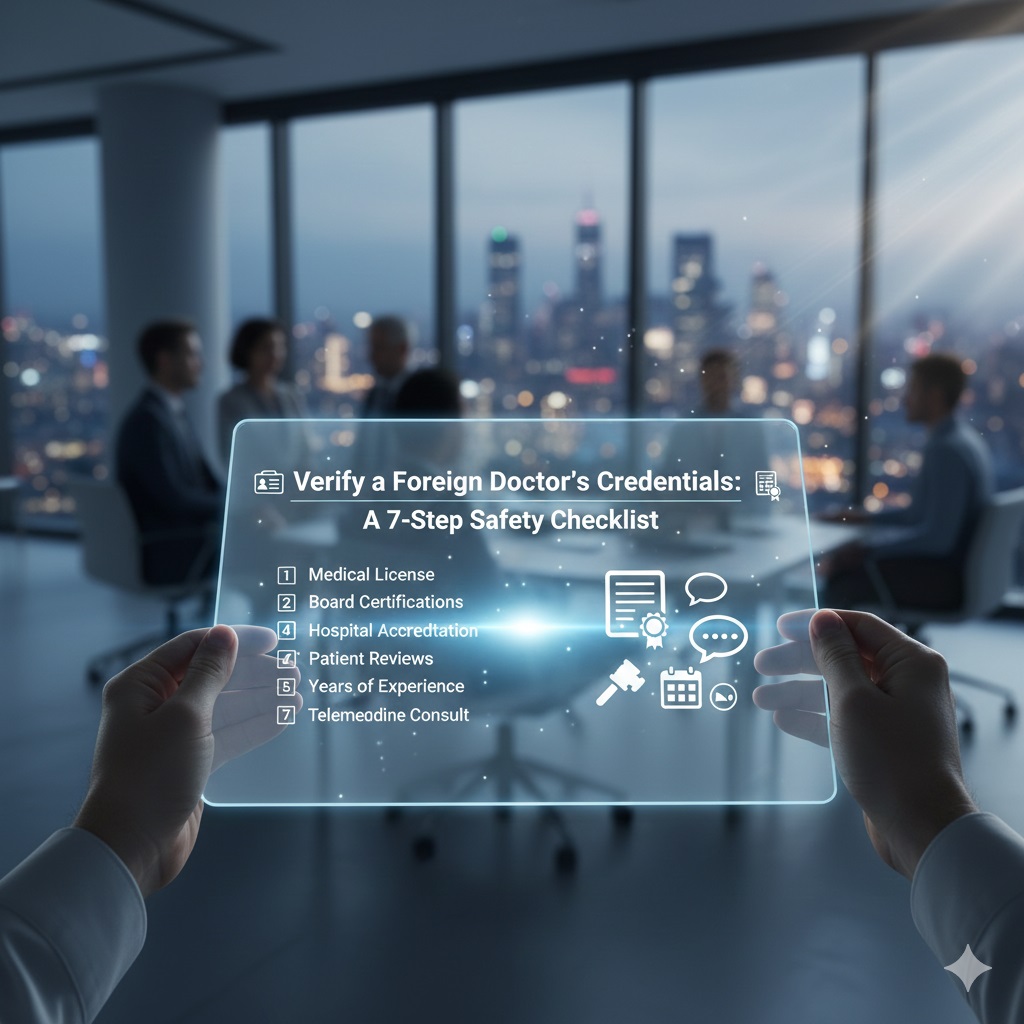
🗺️ The Patient Roadmap: How to Verify a Foreign Doctor’s Credentials
Following a structured path ensures no detail is missed. This roadmap guides you from the initial search to the final consultation.
- Initial Research: Identify potential doctors via trusted medical facilitators.
- Document Request: Ask for a digital copy of the medical license and board certificates.
- Third-Party Verification: Use portals like ECFMG to verify the doctor’s education.
- Clinical History Check: Inquire about the number of times they have performed your specific procedure, such as total knee replacement.
- Hospital Quality Review: Confirm the doctor has “operating privileges” at an accredited facility.
- Direct Interview: Use a telemedicine consultation to ask about their complication rates.
- Final Confirmation: Check for independent patient reviews on non-hospital-owned forums.
⚖️ Pros and Cons of Manual Verification
| Aspect | Pros | Cons |
|---|---|---|
| Personal Control | You know exactly what has been checked. | Requires significant time and research. |
| Accuracy | Reduces the chance of falling for “fake” certificates. | Language barriers can make records hard to read. |
| Peace of Mind | High confidence before flying for surgery. | Can feel overwhelming for non-medical people. |
💰 Cost Analysis of Verification
While verifying a foreign doctor’s credentials is mostly free, some specific steps may involve small fees. Understanding these costs helps you budget for your medical journey.
| Service Type | Estimated Cost (USD) | Notes |
|---|---|---|
| Online License Search | $0 | Available via most Health Ministries. |
| Telemedicine Consult | $50 – $200 | Highly recommended for final vetting. |
| Formal Credential Report | $100 – $300 | Using agencies like DataFlow. |
📖 Case Study: Sarah’s Rhinoplasty in Turkey
Sarah was looking for rhinoplasty surgery. She found a doctor with a beautiful Instagram page. However, she decided to follow our checklist. Sarah requested the doctor’s diploma and license number. When she checked the Turkish Medical Association database, she discovered the doctor was a general practitioner, not a certified plastic surgeon.
By using our advisory services, Sarah was redirected to a board-certified specialist. This surgeon had over 15 years of experience in facial reconstruction. Ultimately, she had a successful surgery with no complications. This case proves that verification is the difference between a life-changing result and a medical disaster.
✈️ Recovery & Medical Tourism
Verification doesn’t end when the surgery is over. You must also verify the doctor’s protocol for follow-up care. Does the doctor provide a clear recovery plan? If you are staying in Mashhad or Istanbul, ensures your surgeon is available for local post-op checks. Furthermore, consider if you need an air ambulance in rare emergencies. Proper vetting includes knowing the doctor’s policy on “revisions” if the initial result is not as expected.
❓ Frequently Asked Questions
1. How can I verify if a foreign doctor is really a specialist?
Verifying whether a foreign doctor is truly a qualified specialist is essential—especially for surgery or advanced treatments. Here are reliable, practical steps you can take:
✅ 1. Check the Doctor’s Medical License
- Every legitimate physician must be licensed by a national or regional medical council.
- Look for:
- License number
- Status (active/in good standing)
- Many countries have online medical council databases where you can verify this.
🎓 2. Verify Specialist Certification (Not Just “Doctor”)
Being a doctor is not the same as being a specialist.
- Confirm:
- Formal specialty training (e.g., plastic surgery, cardiology)
- Board certification or specialist registration
- Ask directly:
- “Are you board-certified in this specialty?”
- “Which authority granted your specialist title?”
🏥 3. Confirm Hospital or Clinic Privileges
- Reputable specialists usually have operating privileges at accredited hospitals.
- Contact the hospital or check its website to confirm:
- The doctor’s role
- Their specialty
- Hospitals typically verify credentials before granting privileges.
🌍 4. Look for International Training or Affiliations
While not mandatory, many reputable specialists have:
- Fellowships or training abroad
- Membership in recognized international medical associations
- Academic publications or conference participation
These are positive—but should support, not replace, license verification.
📄 5. Request Documentation (This Is Normal)
A legitimate provider should have no issue sharing:
- Medical license
- Specialist certificate
- Years of experience
- Number of procedures performed
- Before-and-after cases (where appropriate)
Refusal or vague answers are red flags.
⚠️ 6. Be Cautious with Titles and Marketing Claims
Watch out for:
- Titles like “cosmetic expert”, “aesthetic doctor”, or “international surgeon” without formal certification
- Clinics advertising outcomes without naming the responsible surgeon
- Pressure tactics or unusually low prices
🤝 7. Use a Trusted Medical Tourism Platform
Established medical tourism platforms:
- Pre-verify doctors and hospitals
- Work only with licensed, credentialed specialists
- Can provide written confirmation of a doctor’s qualifications
This significantly reduces risk, especially when language or legal systems differ.
🧾 Bottom Line
✔️ Verify license + specialist certification
✔️ Confirm hospital privileges
✔️ Ask for proof—confident doctors provide it
❌ Don’t rely on marketing alone
2. What is the most reliable way to check for malpractice history abroad?
Checking malpractice history can be challenging due to privacy laws. However, many countries have public disciplinary records. You should search the name of the doctor on the official website of the country’s medical regulatory authority. Additionally, look for independent patient forums and legal news in that country. If a doctor has multiple civil lawsuits, it is a significant red flag. Always ask the doctor directly about their complication rates during a telemedicine session. Their transparency in this matter is a good indicator of their professional integrity.
3. Does JCI accreditation mean the doctors are good?
JCI accreditation focuses on hospital systems and patient safety protocols. While it is a mark of a high-quality facility, it does not guarantee the individual skill of every surgeon. Therefore, you must vet the doctor and the hospital separately. A great surgeon might work at a mediocre clinic, or a poor surgeon might have privileges at a top hospital. Ensure both the medical professional and the facility meet international benchmarks. This dual-layer check is the gold standard for safety in medical tourism today.
4. What if the doctor’s credentials are not in English?
If credentials are in a foreign language, do not rely on the doctor’s own translation. Instead, use an independent, certified translation service. Alternatively, many medical tourism agencies provide verified English profiles for their staff. You can also use browser-based translation tools on official government websites to navigate their databases. If a doctor refuses to provide documents because of “language barriers,” it is best to seek another provider. Transparency is a non-negotiable requirement for international patient care.
5. Are doctors in medical tourism “hubs” better trained?
Doctors practicing in popular medical tourism hubs (such as Turkey, Thailand, South Korea, Germany, or India) are not inherently better trained simply because of location. However, many are highly skilled and internationally competitive due to the structure and demands of medical tourism.
Why Doctors in Medical Tourism Hubs Are Often Very Well Trained
- High Case Volume
- Medical tourism centers handle large numbers of international patients.
- Surgeons performing the same procedures frequently tend to develop greater technical precision and consistency.
- International Training and Exposure
- Many specialists in these hubs:
- Train or complete fellowships abroad
- Attend international conferences
- Follow global clinical guidelines
- This keeps their techniques aligned with international standards.
- Market Competition
- Medical tourism is highly competitive.
- Clinics must maintain strong outcomes and reputations to attract international patients, which encourages ongoing training and quality improvement.
- Access to Advanced Facilities
- Leading hubs invest heavily in:
- Modern hospitals
- Updated surgical equipment
- Multilingual care teams
- These resources support higher-quality training and practice.
Why “Hub” Status Alone Is Not Enough
Being in a medical tourism destination does not guarantee quality:
- Training standards vary by country and by specialty
- Some providers rely more on marketing than credentials
- Titles and experience can be exaggerated
That’s why individual verification is essential.
What Matters More Than Location
✔️ Accredited medical education and residency
✔️ Recognized specialist certification
✔️ Hospital privileges at accredited facilities
✔️ Proven experience in the specific procedure
✔️ Transparent outcomes and complication management
A well-trained surgeon in a non-tourism country can be better than a poorly vetted one in a famous hub.
Bottom Line
✅ Doctors in medical tourism hubs are often highly trained due to volume, competition, and international exposure
❌ But hub status alone is not a guarantee of superior training
Smart patients focus on credentials, experience, and verified outcomes—not geography.
6. Can I trust reviews on a doctor’s own website?
Reviews on a doctor’s website are curated and should be viewed with caution. They are essentially marketing materials. Instead, look for reviews on third-party sites like Google, Trustpilot, or specialized medical boards. Look for “verified” reviews that include detailed accounts of the pre-op and post-op experience. Pay attention to how the clinic responds to negative reviews. A professional response indicates a commitment to patient satisfaction. Our article database often features deeper dives into how to spot fake medical reviews online.
7. Is there a global database for all doctors?
Currently, there is no single global database that tracks every doctor’s license. However, the International Association of Medical Regulatory Authorities (IAMRA) provides links to many national medical boards. This is the closest thing to a central directory. You must search by the specific country where the doctor is practicing. Because systems are fragmented, using a checklist is the only way to ensure complete verification. This is why we provide tools for checking locations and provider backgrounds across different regions.
8. How do I verify a doctor’s education from decades ago?
Verifying older degrees requires contacting the university’s registrar. Most reputable surgeons are happy to provide their graduation details. You can also use the “World Directory of Medical Schools” to see if the school existed and was accredited when the doctor graduated. For older doctors, their “years in practice” and continued checkup certifications are often more relevant than their initial degree. Ensure they have remained active in the medical community and have updated their skills with modern surgical techniques and technologies.
9. Why should I check a doctor’s research and publications?
Research and publications in medical journals indicate that a doctor is an expert in their field. You can search for their name on PubMed or Google Scholar. If they are publishing papers on breast oncology or new surgical methods, they are likely at the forefront of their specialty. While not every good doctor is a researcher, it adds a layer of clinical authority. It shows they are peer-reviewed and contribute to the advancement of medical science, which is a strong sign of professional excellence.
10. Should I verify the anesthesia provider as well?
Absolutely. The anesthesiologist is just as important as the surgeon for your safety. During your anesthesia consultation, ask about the qualifications of the person who will be monitoring you. They should be a board-certified anesthesiologist, not just a technician. This is especially critical for major surgeries like bariatric surgery. Many complications abroad arise from anesthesia errors rather than surgical ones. Ensuring a qualified team is behind the surgeon is a vital part of your personal safety checklist.
11. What are “Board Eligible” vs “Board Certified”?
“Board Certified” means the doctor has completed all training and passed the necessary exams. “Board Eligible” means they have completed the training but have not yet passed the exam or are in the process of doing so. For your safety, always prioritize “Board Certified” surgeons. This is particularly important for high-risk procedures in ENT surgery or spinal work. Certification is the proof that the doctor has met the highest standards set by their peers. Don’t settle for “eligible” when you can have “certified.”
12. Can WMedTour help me verify these credentials?
Yes, we specialize in this process. We maintain a pre-vetted network of qualified doctors who have already undergone rigorous credential checks. We verify their licenses, hospital affiliations, and patient outcomes so you don’t have to do it alone. By choosing a doctor through our portal, you are accessing a curated list of international medical experts. If you have questions about a specific provider, you can always contact us for a detailed background report and assistance with your medical journey planning.
⚠️ Medical Disclaimer
The information provided in this guide is for educational purposes only. It does not constitute legal or medical advice. Always consult with a qualified healthcare professional before undergoing any medical procedure. While we strive for accuracy, medical regulations and doctor statuses can change without notice. Verifying a foreign doctor’s credentials is a personal responsibility, and users should perform their own final due diligence.